Throttle Buff is reader-supported: we may earn a commission when you buy through links on this page. Learn more.
Yes, Icon helmets are good for street riders who want modern safety certification, strong styling and useful features at a mid-range price. Every current Icon full-face helmet is certified to both DOT and the newer ECE 22.06 standard, and several add MIPS and a drop-down sun visor for $250 to $400. They are not the quietest or the best-warrantied helmets you can buy, and fit varies a lot between models, so the right Icon depends on your head shape and how you ride.
This guide is research-based. We didn’t crash-test anything ourselves. We pulled certification data from Icon and retailer spec sheets, independent impact scores from the UK government’s SHARP programme, measured weights from published reviews, and owner feedback, all checked in November 2026.
Quick verdict
- Buy an Icon if: you ride on the street, want DOT and ECE 22.06 certification, like bold graphics, and have an intermediate or long oval head.
- Look elsewhere if: you tour long distances and hate wind noise, need a round-head fit, want Snell certification, or expect a 5-year warranty.
- Best Icon for most riders: the Icon Ultraflite, which is the only current Icon with a SHARP 4-star score under the newer ECE 22.06 test.
Who makes Icon helmets?
Icon is a Portland, Oregon motorcycle gear brand owned by LeMans Corporation, the parent company of the distributor Parts Unlimited. That is why you’ll find Icon in almost every US dealer and in RevZilla’s and Cycle Gear’s catalogues. Icon designs its helmets in-house, and launch coverage of the Airframe Pro reported that the shells are built by an independent manufacturer in South Korea, which is common for helmet brands at this price.
The brand built its name on loud graphics and a street-fighter image. Under the paint, the current helmets are much more conventional than that image suggests: multi-density EPS liners, multiple shell sizes, quick-change shields and, on most models, an internal sun visor Icon calls the DropShield.
Are Icon helmets safe?
All current Icon full-face and modular helmets carry both DOT FMVSS 218 and ECE 22.06. ECE 22.06 is the tougher of the two. It tests impacts at more points and speeds, adds a rotational-impact test, and checks visors and accessories. A helmet that passes both is a solid baseline. None of Icon’s helmets carry Snell certification, which some track days and racing schools require. Our DOT vs ECE 22.06 vs Snell vs SHARP guide explains the differences.
SHARP, the UK government’s independent test programme, buys helmets and scores them from 1 to 5 stars. It has tested five Icon models:
| Model | SHARP rating | Weight tested | Notes |
|---|---|---|---|
| Ultraflite | 4 stars | 1.8 kg | Tested to ECE 22.06 in 2026; side impacts scored 3/5 at the highest speed |
| Airframe (original) | 4 stars | 1.63 kg | Older ECE 22.05 model, replaced by the Airframe Pro |
| Airflite | 3 stars | 1.70 kg | Tested in 2019 to ECE 22.05 |
| Alliance | 3 stars | 1.60 kg | Discontinued; weak side-impact score |
| Airmada | 2 stars | 1.62 kg | Discontinued; see our Icon Airmada review |
The trend is clear. Older Icon helmets were weak on side impacts, and the newest design tested, the Ultraflite, is a big step up. SHARP hasn’t tested the Airframe Pro, Domain, Airform or the new Threshold modular yet, so for those you have the DOT and ECE 22.06 certifications to go on. Source: SHARP Icon ratings.
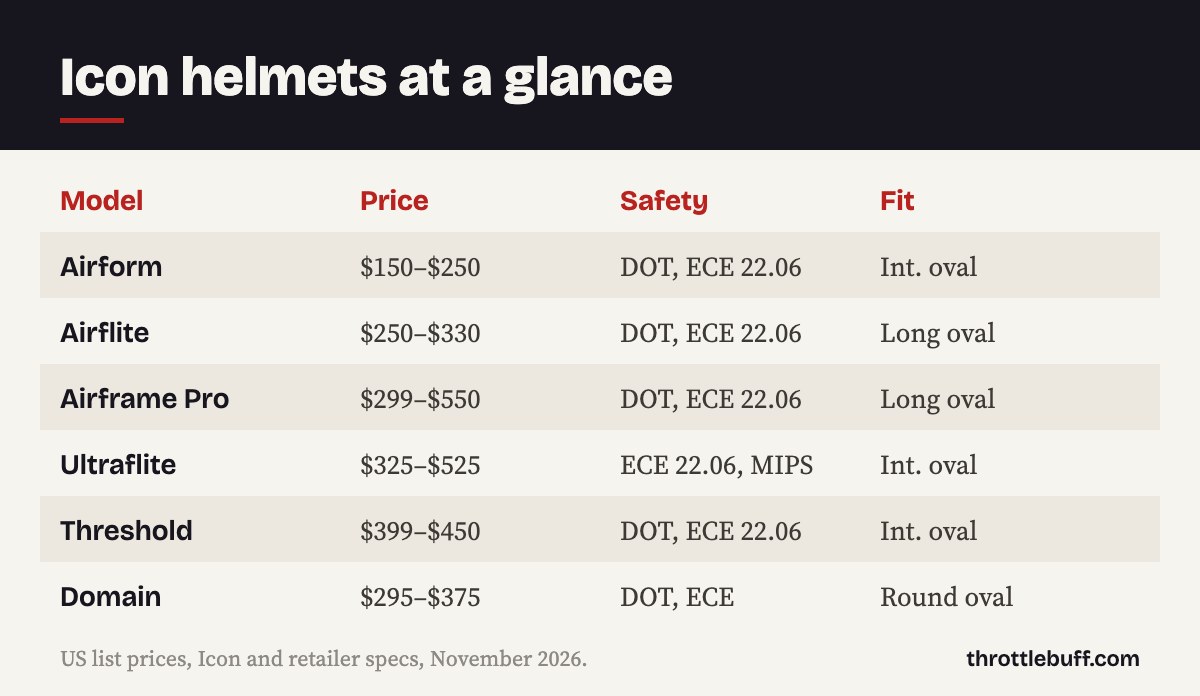
Every current Icon helmet compared
| Helmet | Type | US price | Shell | Certification | Head shape |
|---|---|---|---|---|---|
| Airform | Full face | $150–$250 | Polycarbonate | DOT, ECE 22.06 (MIPS on some) | Intermediate oval |
| Airflite | Full face | $250–$330 | Polycarbonate | DOT, ECE 22.06 (MIPS on some) | Long oval |
| Domain | Full face | $295–$375 | Fiberglass composite | DOT, ECE | Round oval |
| Airframe Pro | Full face | $299–$550 | Composite or carbon | DOT, ECE 22.06 | Long oval |
| Ultraflite | Full face | $325–$525 | Fiberglass or carbon | DOT, ECE 22.06, MIPS | Intermediate oval |
| Threshold | Modular | $399–$450 | Composite | DOT, ECE 22.06 | Intermediate oval |
| Elsinore | Open face | $275 | Fiberglass | DOT | Intermediate oval |
Prices are Icon’s US list prices in November 2026. Graphics cost more than solid colours.
Icon Airform: best budget Icon
The Airform is Icon’s entry point, from $150 in plain black. It’s certified to DOT, ECE 22.06 and Japan’s PSC standard, has a drop-down sun visor and a Pinlock-ready shield, and the MIPS graphics models add a rotational-impact liner. Ultimate Motorcycling measured an XL at 1,763 g and called it surprisingly quiet, though it found the shield whistled when fully closed and rear venting was weak.
Icon Airflite: the bestseller
The Airflite is the helmet most people picture when they think of Icon. It has the aggressive chin bar, the internal DropShield and the FliteShield visor. It suits long oval heads and is roomier than the Airform. It’s on the heavy side at around 3.75 lb, which webBikeWorld noted along with good airflow and lower noise than expected. Our Icon Airflite review covers it in detail.
Icon Airframe Pro: lightest Icon
The Airframe Pro is Icon’s sport-focused helmet, with four shell sizes and a carbon version that Jalopnik measured at 1,428 g in a medium. That’s very light for a full-face helmet. It has no internal sun visor, and webBikeWorld found the cheek pads thick and the vents hard to adjust, so try it on before buying.
Icon Ultraflite: best all-rounder
The Ultraflite replaced the Airflite at the top of Icon’s touring and street range in 2025. It moves to a fiberglass shell, comes with MIPS as standard, includes both clear and dark smoke shields, and scored 4 stars from SHARP under ECE 22.06. It’s heavier than the Airflite and only average for noise, but it’s the safest-rated Icon you can buy.
Icon Domain and Threshold
The Domain is a fiberglass full face with a rounder fit, which makes it the Icon to try if other Icons press on your forehead. The Threshold is Icon’s new modular, with a flip-up chin bar, internal sun visor and DOT plus ECE 22.06 certification. It’s the one to look at if you wear glasses or ride two-up and want to talk at stops. For more flip-up options see our best modular helmets guide.
How do Icon helmets fit?
Icon doesn’t use one head shape across its range, which is the biggest reason owner opinions vary so much:
- Intermediate oval: Airform, Ultraflite, Threshold and Elsinore. This is the most common head shape in North America.
- Long oval: Airflite and Airframe Pro. These suit longer, narrower heads.
- Round oval: Domain.
Sizes run XS to 3XL, about 53 to 66 cm depending on the model. Several owners say the Ultraflite and Airframe Pro run snug, so measure your head and check each model’s chart. Our helmet size calculator converts your measurement to Icon sizes.
What riders like about Icon helmets
- Value for the certification: DOT and ECE 22.06, MIPS options and a sun visor at prices where many brands offer DOT only.
- Styling: no other mainstream brand offers as many bold graphics.
- Useful extras: fog-free or Pinlock-ready shields, removable and washable HydraDry liners, emergency-release cheek pads on newer models, and Bluetooth-ready designs that work with Icon’s Sena-made HelmLink.
- Airflow: reviewers consistently rate Icon ventilation well, especially the Airflite and Ultraflite.
Common complaints
- Noise: Icons are average to loud at highway speed. If you ride long touring days, wear earplugs or consider a quieter premium helmet. The Shoei RF-1400 is a common step up; see our Shoei RF-1400 review.
- Weight: the Airflite and Ultraflite weigh around 1.7 to 1.8 kg, which you’ll notice on long rides.
- Warranty: Icon covers defects for one year from purchase, handled through the selling dealer. Shoei, Arai and Bell offer five years or more.
- Older models’ safety scores: discontinued Icons like the Airmada and Alliance scored poorly on SHARP side impacts. If you’re buying used or clearance, check the model.
Icon vs other brands at the same price
| Brand | Typical price | Strength | Weakness vs Icon |
|---|---|---|---|
| Icon | $150–$550 | Styling, ECE 22.06 across the range, sun visors | 1-year warranty, noise |
| Scorpion | $150–$600 | Quiet, AirFit liner, long warranty | Plainer graphics |
| Bell | $150–$900 | Wide range, 5-year warranty | Budget models are DOT-only |
| HJC | $130–$900 | Value, many models in each size | Fewer bold graphics |
For a wider view, read our best motorcycle helmet brands guide or our best Scorpion helmets list.
Who should buy an Icon helmet
Icon is a good choice for commuters, sport riders and weekend riders who want ECE 22.06 safety, MIPS or a sun visor, and real personality in the design for under $400. The Ultraflite is the best overall, the Airform is the best value, and the Airframe Pro is the light, sporty option. If you’re a long-distance tourer sensitive to noise, or you need a round fit or Snell certification, spend the money on a premium brand instead. Our best helmets under $300 list compares Icon with its closest rivals.
FAQ
Are Icon helmets DOT approved?
Yes. Every Icon helmet sold in the US is DOT FMVSS 218 certified, and all current full-face and modular models are also ECE 22.06 certified.
Are Icon helmets Snell approved?
No current Icon helmet carries Snell certification.
Where are Icon helmets made?
Icon is based in Portland, Oregon. Its helmets have been reported to be made by an independent manufacturer in South Korea.
Are Icon helmets loud?
They’re average to loud for full-face helmets. Reviewers rate the Airform and Airflite as quieter than expected, while owners describe the Ultraflite as on the loud side. Earplugs help with any helmet.
What is the safest Icon helmet?
The Ultraflite. It’s certified to DOT and ECE 22.06, has MIPS as standard, and scored 4 stars in SHARP testing under ECE 22.06.
How long is the Icon helmet warranty?
One year from the date of purchase, covering defects in materials and workmanship. Claims go through the dealer you bought it from.