Throttle Buff is reader-supported: we may earn a commission when you buy through links on this page. Learn more.
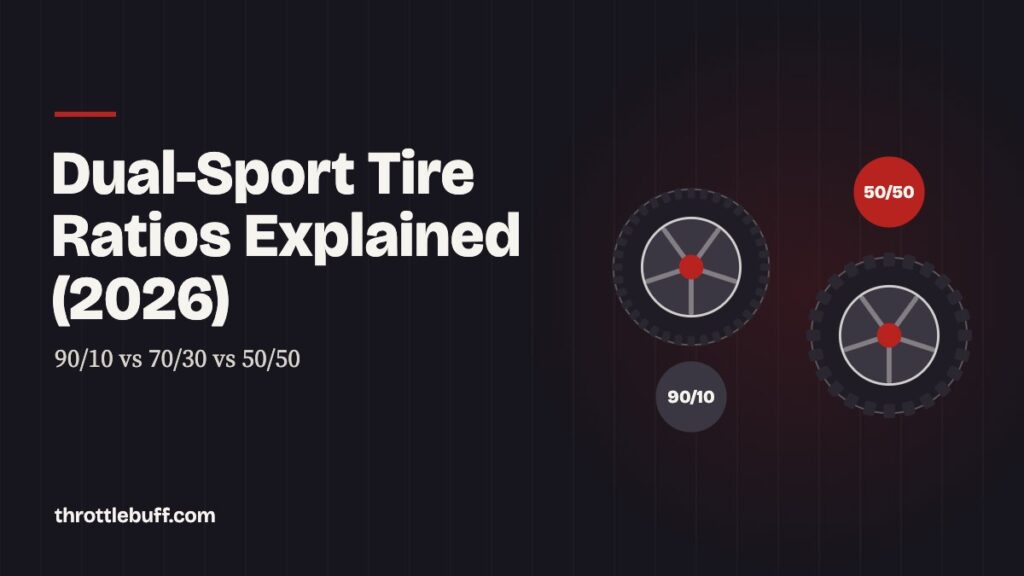
A dual-sport tire ratio tells you roughly how a tire splits its ability between pavement and dirt. The first number is the on-road share and the second is off-road, so a 90/10 tire is almost a street tire and a 40/60 is a knobby that tolerates pavement. The numbers aren’t a standard. Each manufacturer decides its own, so use them to compare tires within a brand and pick based on the worst terrain you actually ride.
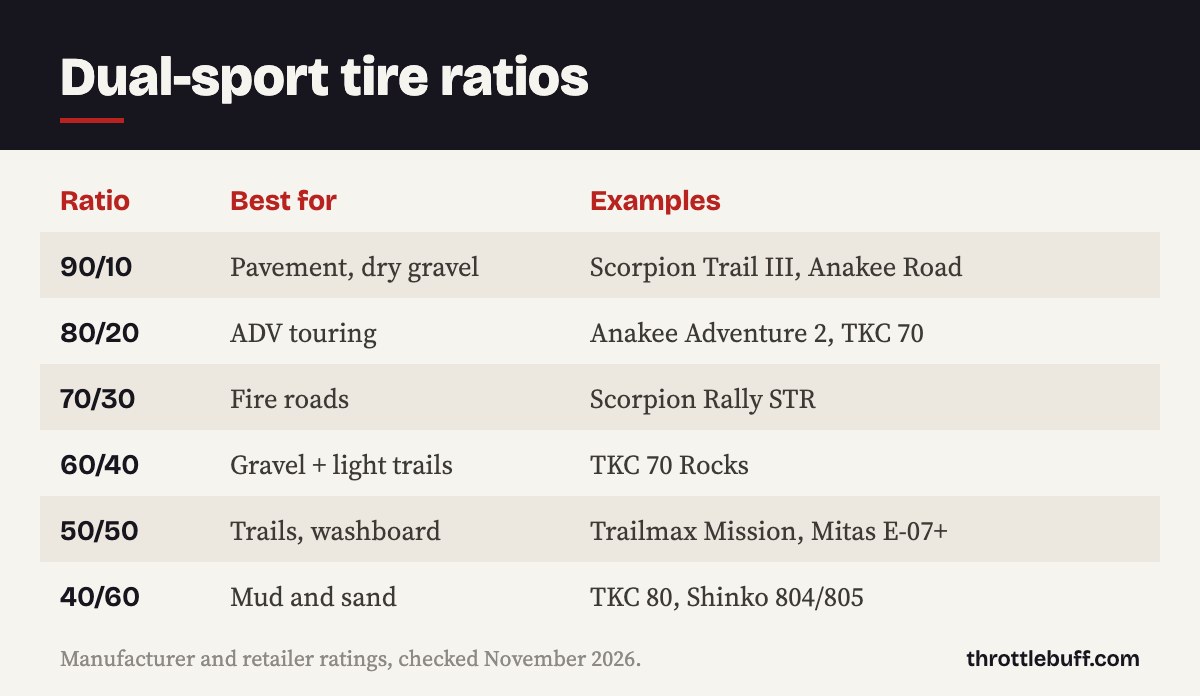
This guide is research-based. We checked manufacturer-published ratios from Pirelli, Michelin, Dunlop, Mitas and Motoz, retailer listings for brands that don’t publish one, and owner mileage reports, all in November 2026.
Quick answer: which ratio do you need?
| Your riding | Ratio to look at | Example tires |
|---|---|---|
| Mostly pavement, occasional gravel road | 90/10 | Michelin Anakee Road, Pirelli Scorpion Trail III |
| Long-distance ADV touring with dirt roads | 80/20 | Michelin Anakee Adventure 2, Continental TKC 70, Shinko 705 |
| Fire roads, gravel and the odd trail | 70/30 to 60/40 | Pirelli Scorpion Rally STR, Continental TKC 70 Rocks |
| Real trails, washboard, some mud | 50/50 | Dunlop Trailmax Mission and Raid, Mitas E-07+, Michelin Anakee Wild, Metzeler Karoo 4 |
| Mostly dirt, mud and sand | 40/60 and lower | Continental TKC 80, Shinko 804/805, Mitas E-10 and E-09 |
The rule most experienced riders follow is simple. Choose for the worst terrain you expect to ride, not the average. A 90/10 tire that’s perfect for 95% of your miles can leave you stuck on the one muddy climb you can’t avoid. The same logic applies to your helmet: if you spend real time on trails, prioritize venting, as in our dual-sport helmet airflow comparison.
What the numbers actually mean
There’s no regulation or industry test behind dual-sport ratios. It’s a marketing guideline. One brand’s 50/50 can be noticeably more aggressive than another’s, and nobody defines whether the split refers to miles ridden, time spent or ability on each surface. Even manufacturers’ own messaging can blur it: Dunlop sells the Trailmax Raid as a 50/50, while some launch coverage described it as 40% road and 60% off-road.
What changes as the ratio shifts toward dirt is the tread design:
- Void ratio: street-biased tires have a closed pattern with more rubber touching the road, which means a bigger contact patch, better wet grip and longer life. Dirt-biased tires have big gaps between blocks so the knobs can bite into loose ground and clear mud.
- Knob height and shape: taller, more widely spaced knobs dig into dirt and sand but squirm, hum and wear quickly on pavement.
- Compound and carcass: softer rubber grips better but wears faster. Tires built for heavy adventure bikes use stronger carcasses to resist punctures and handle load.
Dual-sport tire ratios by band
90/10: street tires that tolerate gravel
These look like road tires with deeper grooves. They’re quiet, stable at highway speed, grip well in the wet and last the longest. Off-road they’re fine on hard-packed gravel and dry fire roads, but they clog in mud and wash out in sand.
- Pirelli Scorpion Trail III: Pirelli rates it 90/10. It’s the current version of the Trail II, which many adventure bikes come with from the factory.
- Michelin Anakee Road: listed by retailers at 90/10, built for big adventure tourers on mostly paved roads.
80/20: adventure touring
The sweet spot for riders who cover big distances on pavement but want confidence on gravel and dirt roads. Blocks are bigger and more open than a 90/10, but they’re still closely spaced enough to wear well and stay quiet.
- Michelin Anakee Adventure 2: Michelin’s own 80/20 rating, with a claimed 14% longer life than the original Anakee Adventure.
- Continental TKC 70: rated 80/20. One long-term test reported about 4,400 miles from a rear.
- Shinko 705: rated 80/20 and one of the cheapest options. Some sizes are tube-type only.
70/30 and 60/40: the all-rounders
These are the tires to choose if your trips regularly include fire roads, gravel tracks and the occasional rough trail. They give up some wet-road grip and mileage for noticeably better bite on loose surfaces.
- Pirelli Scorpion Rally STR: Pirelli rates it 70/30. It’s a popular OEM fitment on adventure bikes and comes in tubeless sizes.
- Continental TKC 70 Rocks: rated 60/40. It’s a more aggressive version of the TKC 70 with a rugged centre tread.
50/50: true dual purpose
“50/50” is the most-searched category, and it’s really an umbrella term. Manufacturers rate tires in this group anywhere from 60/40 to 40/60. Expect blocky, widely spaced knobs that work properly on trails, mud and washboard, with acceptable but noisier road manners.
- Dunlop Trailmax Mission: Dunlop’s 50/50, built for durability. Dunlop says a rear completed 8,000 miles of testing on a V-Strom 1000.
- Dunlop Trailmax Raid: Dunlop’s newer, more aggressive 50/50.
- Mitas E-07 and E-07+: Mitas rates them 50/50. The E-07+ is the reinforced version for heavy adventure bikes.
- Michelin Anakee Wild: Michelin’s 50/50 for big ADV bikes.
- Metzeler Karoo 4: listed at 50/50, a favourite on large adventure bikes.
- Heidenau K60 Scout: often called a “true 50/50” and known for long life, though owners report weak wet-road grip.
- Motoz Tractionator GPS: rated 50/50, with a reversible rear. Mounted the other way, it becomes a mostly off-road tire.
40/60 and below: dirt first
These are knobbies with DOT approval. They shine in mud, sand and loose climbs, but they wear quickly on pavement, hum at speed and feel vague in wet corners.
- Continental TKC 80: rated 40/60 and probably the best-known adventure knobby. Expect roughly 3,000 to 4,000 miles from a rear on a big bike.
- Shinko 804/805: a budget 40/60 set. Owners report about 5,000 miles per set.
- Mitas E-10 (40/60) and E-09 (20/80): for riders who spend most of their time in the dirt.
Mileage and street behaviour
The more off-road a tire is, the faster it wears on pavement. Owner reports vary hugely with bike weight, riding style and pressure, but the pattern is clear:
| Tire | Ratio | Reported rear life |
|---|---|---|
| Dunlop Trailmax Mission | 50/50 | 8,000 miles in Dunlop’s testing |
| Continental TKC 70 | 80/20 | About 4,400 miles in one long-term test |
| Shinko 804/805 | 40/60 | About 5,000 miles per set |
| Continental TKC 80 | 40/60 | About 3,000–4,000 miles |
| Heidenau K60 Scout | 50/50 | From about 4,000 to over 13,000 miles, depending on the rider |
On pavement, knobbier tires also run hotter. One rider using a 50/50 on 90% pavement saw rear pressure rise from 38 to 48 psi on a hot day, so check pressure cold and don’t run off-road pressures on the highway.
Tubeless vs tube-type
- Tubeless tires need tubeless rims. Most spoked dual-sport rims are tube-type unless the bike has sealed spoke rims.
- Running a tube in a tubeless tire adds heat. Many tire makers advise dropping one speed rating and one load index, and using a radial-rated tube in a radial tire.
- Off-road trade-offs: tubeless tires are easier to plug on the trail, but beads can unseat on rocks at low pressure. Tubes risk pinch flats below about 15 psi.
Airing down off-road
Lower pressure lets the tire flatten and grip loose ground. As a starting point on a light dual-sport bike, begin at the manufacturer’s road pressure and drop 2 to 3 psi at a time. Around 18 psi is generally safe for trail riding with tubes, and around 15 psi works at a moderate pace. Heavy adventure bikes need noticeably more air, so go cautiously and carry a pump to reinflate before you hit the pavement. The number on the sidewall is the maximum pressure, not the one you should run.
Is a 50/50 tire street legal?
Every tire in this guide carries a DOT stamp, which makes it legal on US roads. Pure motocross and enduro tires are often marked “Not for highway use”, so check for the DOT code before fitting knobbies to a plated bike. Some aggressive dual-sport tires use slightly shorter knobs specifically to pass DOT’s high-speed test.
Prices
Prices vary widely by size. As a guide, US retail per tire in November 2026:
- Shinko 705: about $83–$196
- Continental TKC 80: about $112–$209
- Mitas E-07+: from about $136 on sale
- Continental TKC 70: about $181–$293
- Michelin Anakee Road and Heidenau K60 Scout: from about $184
- Pirelli Scorpion Rally STR: about $228–$352
For specific picks by bike and budget, see our best dual-sport tires guide, and for road tires our best motorcycle tires.
How to choose: a quick checklist
- List the worst surface you’ll ride: wet pavement, gravel, mud or sand. Choose for that.
- Consider your bike’s weight: heavy adventure bikes need reinforced tires like the Mitas E-07+ or Anakee Wild; light 250 to 500cc bikes can run lighter knobbies.
- Be honest about miles: if you ride 5,000 miles of pavement a season, a 40/60 tire will need replacing mid-season.
- Check rim type: tubeless or tube-type, and match sizes to your rims.
- Mix and match if needed: some riders run a more street-biased front for wet grip and an aggressive rear for traction. Check your bike maker’s approved combinations.
New to tires? Our guides on reading a tire sidewall, how long motorcycle tires last and changing a motorcycle tire cover the basics.
FAQ
What does 50/50 mean on a dual-sport tire?
It means the tire is intended for roughly equal use on pavement and off-road. It’s a manufacturer guideline, not a tested standard, so two 50/50 tires from different brands can feel quite different.
Is 80/20 or 70/30 better for adventure riding?
80/20 suits riders who mostly tour on pavement and use gravel roads. 70/30 gives more bite on loose fire roads and light trails, at the cost of some wet grip and mileage.
How long do 50/50 tires last?
It varies a lot. Owners report anywhere from about 4,000 to over 10,000 miles from a 50/50 rear, depending on the tire, bike weight and how much pavement you ride.
Are dual-sport knobbies good in the rain?
The more aggressive the tire, the less rubber touches the road, so wet grip falls as you move toward 40/60. Street-biased 90/10 and 80/20 tires are the best choice if you ride in the wet often.
Can I mix tire ratios front and rear?
Many riders do, for example a more street-biased front with a knobbier rear. Check your motorcycle manufacturer’s approved tire combinations first.