Throttle Buff is reader-supported: we may earn a commission when you buy through links on this page. Read our affiliate disclosure.
Drifting a motorcycle means deliberately letting the rear tire slide while you control the bike’s angle with the throttle, rear brake and body position. The safe way to learn is on dirt or a closed supermoto track, starting at low speed: first practice rear-brake slides, then use small bursts of throttle to break the rear loose on loose ground, keeping your eyes up and your weight on the outside peg. Drifting belongs on a closed course with full protective gear, never on public roads.
What “drifting” means on a motorcycle
Riders use the word for a few different techniques:
- Power slides: using the throttle to spin the rear tire and slide it out on exit from a corner. Common in dirt track and motocross.
- Backing it in: using the rear brake and engine braking to slide the rear on corner entry. The signature move of supermoto.
- Stunt drifting: long, high-angle slides on pavement by stunt riders on modified bikes in closed areas.
All three involve the rear tire losing grip in a controlled way. That’s why learning on low-traction surfaces at low speed is so important: when the tire slides, it does so gradually and the consequences of a mistake are smaller.
Before you start
The right bike
A light dirt bike or small supermoto is ideal. They’re easy to pick up, forgiving and built for sliding. Big street bikes are heavy and expensive to drop, and their electronics (traction control and ABS) are designed to prevent slides. If you’re new to dirt, see our guide on how to pick a dirt bike.
The right place
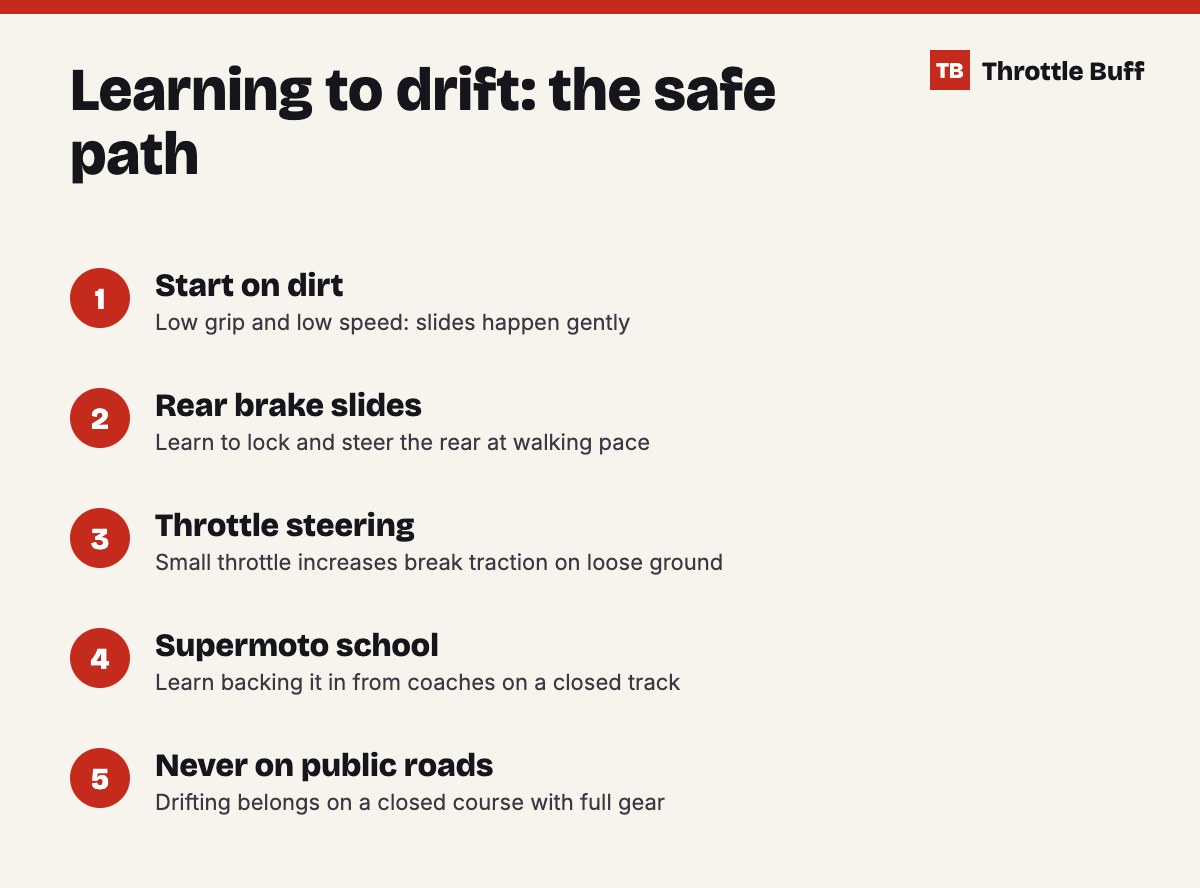
Start on a flat dirt or gravel area, a practice track or a closed supermoto course. Never practice on public roads.
The right gear
Expect to fall. Wear a full-face or MX helmet, boots, gloves, and body armor. See our guides to the best motorcycle armor, back protectors and motocross knee braces.
How to drift a motorcycle: step by step
1. Get comfortable standing and moving on the bike
Ride in slow circles on dirt, standing and sitting, until you’re relaxed. Grip the bike with your knees and keep your arms loose. Tension in your arms is the most common reason slides turn into crashes.
2. Learn rear-brake slides at walking pace
On a straight at low speed, press the rear brake firmly enough to lock the rear wheel briefly, then release. Feel how the rear moves. Next, do it while turning gently so the rear steps out a little. Release the brake to regain grip.
3. Add body position
In a turn, sit forward on the seat, put your inside foot forward near the front axle (flat-track style) and weight the outside peg. Keep your head up and look where you want to go, not at the ground.
4. Use the throttle to slide the rear
In a slow turn on loose dirt, roll on the throttle smoothly but firmly to make the rear tire spin and step out. Control the slide angle with the throttle: more throttle, more slide; less throttle, more grip. Avoid snapping the throttle shut, which can make the rear grip suddenly.
5. Countersteer the slide
As the rear steps out, the front naturally points into the slide. Let the bars move and steer slightly toward the direction you want to go. Keep your eyes on the exit.
6. Build up gradually
Increase speed and slide angle slowly, session by session. If you want to learn backing it in on pavement, do it at a supermoto school with coaches and the right bikes.
Common mistakes
- Looking down: you go where you look.
- Stiff arms: they fight the bike and turn a slide into a high-side.
- Chopping the throttle: sudden grip can throw you off.
- Too much speed too soon: slides get harder to control fast.
- Using the front brake mid-slide: it can tuck the front.
Where to learn properly
A riding school is the fastest and safest way to learn. Dirt-track and supermoto schools teach sliding with coaches, suitable bikes and controlled environments. For general skills, look at courses from the Motorcycle Safety Foundation, and for organized off-road and track events, the American Motorcyclist Association lists sanctioned events.
Is drifting bad for your motorcycle?
It wears the rear tire, chain or belt and clutch faster, and crashes damage levers, pegs and plastics. If you practice a lot, check chain tension often; see how to adjust a motorcycle chain. On street bikes, deliberately sliding at speed risks serious damage and injury.
Related guides: racing boots and kids motorcycle helmets.
FAQ
Can you drift any motorcycle?
Technically most bikes can slide, but light dirt bikes and supermotos are by far the easiest and safest to learn on.
Is it legal to drift on public roads?
No. Deliberately sliding on public roads is dangerous and can lead to reckless-driving charges. Practice only on closed courses or private land with permission.
How long does it take to learn?
Basic rear-brake and throttle slides on dirt can come in a few sessions. Smooth, confident drifting takes much longer, which is why coaching helps.
Do I need traction control off?
On bikes with traction control or rear ABS, the electronics are designed to stop slides. Only change those settings on a closed course and per your owner’s manual.
Summary
To drift a motorcycle, start on dirt with a light bike and full gear, learn rear-brake slides at low speed, then use smooth throttle to slide the rear while keeping your eyes up and weight on the outside peg. Build up gradually, and learn advanced moves like backing it in at a supermoto school, never on public roads.
Browse all our how-to and safety guides.