Throttle Buff is reader-supported: we may earn a commission when you buy through links on this page. Read our affiliate disclosure.
How we chose: this guide is research-based, built from manufacturer specifications, safety certifications and owner feedback rather than hands-on testing. How we research.
The best modular helmet for most riders is the Shoei Neotec 3: it is quiet, well made and ready for an integrated intercom. If you tour long distances, the Schuberth C5 is the quietest option, and the HJC RPHA 91 gives you flagship features for much less. On a tight budget, the HJC i91 is the one to beat.
Quick picks
-
Best overall
- Best for
- Overall
- Shell
- Composite fiberglass
- Price
- $$$$
-
Best for long-distance touring
- Best for
- Touring
- Shell
- Fiberglass (carbon option)
- Price
- $$$$
-
Best premium value
- Best for
- Premium value
- Shell
- Premium composite
- Price
- $$$
-
Best for cruisers and Harley riders
- Best for
- Cruisers
- Shell
- Fiberglass composite
- Price
- $$
- Best adventure modular: Scorpion EXO-AT960
- Best budget modular: HJC i91
- Best 180-degree flip-back: LS2 Advant X
- Best with built-in Bluetooth: Sena Outrush 2
We picked these flip-up helmets from current 2026 models using manufacturer specs, safety certifications and long-term owner reviews. Every helmet here is still on sale. Older picks like the Neotec 2 and Sena’s first Outrush have been replaced by their successors.
Best modular helmets compared
| Helmet | Best for | Shell | Sun visor | Intercom | Price |
|---|---|---|---|---|---|
| Shoei Neotec 3 | Overall | Composite fiberglass | Yes | Integrated SRL3 (optional) | $$$$ |
| Schuberth C5 | Touring | Fiberglass (carbon option) | Yes | Pre-wired SC2 (optional) | $$$$ |
| HJC RPHA 91 | Premium value | Premium composite | Yes | HJC Smart ready | $$$ |
| Bell SRT Modular | Cruisers | Fiberglass composite | Yes | Clamp-on | $$ |
| Scorpion EXO-AT960 | Adventure | Polycarbonate | Yes | Clamp-on | $$ |
| HJC i91 | Budget | Polycarbonate | Yes | HJC Smart ready | $ |
| LS2 Advant X | Flip-back | Fiberglass (carbon option) | Yes | Clamp-on | $$$ |
| Sena Outrush 2 | Built-in Bluetooth | Polycarbonate | Yes | Built-in mesh | $$ |
The best modular motorcycle helmets for 2026
1. Shoei Neotec 3: best overall

The Neotec 3 is the modular most riders measure others against. Shoei redesigned the shell and chin bar for a quieter ride than the Neotec 2, kept the drop-down QSV sun visor, and made the shell ready for the Sena-built SRL3 communication unit, which hides inside the helmet instead of clamping on the side.
The chin bar locks shut with a reassuring clunk and opens one-handed with gloves on. Fit is Shoei’s intermediate-oval, which suits most riders in North America and Europe.
Pros
- Quietest and most refined Shoei modular yet
- Integrated SRL3 intercom option keeps the profile clean
- Pinlock-ready shield and internal sun visor
Cons
- Premium price, plus extra for the SRL3
- Heavier than a full-face of the same size
2. Schuberth C5: best for long-distance touring

Schuberth has built flip-ups for police and touring riders for decades, and the C5 shows it. It is homologated to ride with the chin bar open as well as closed (P/J), has an internal sun visor, and takes the SC2 intercom, developed with Cardo, in a pre-wired slot.
The C5 is noticeably slim for a modular and is known for low wind noise. A carbon version is available if you want to save weight.
Pros
- Low noise and a slim, aerodynamic shell
- P/J certified for riding chin-bar-up
- Pre-wired for the SC2 mesh intercom
Cons
- Expensive, and the SC2 is extra
- Fit runs on the round side for some riders

The RPHA 91 is HJC’s flagship modular and costs well under the Shoei and Schuberth. It uses HJC’s premium composite shell, meets DOT and ECE 22.06, and has speaker pockets and wiring paths for HJC’s Smart intercoms (built by Sena).
Riders praise the chin-bar mechanism, the wide eye port and the internal sun shield. A full-carbon version is sold for riders who want a lighter lid.
Pros
- Flagship features for a mid-range price
- ECE 22.06 and DOT
- Ready for HJC Smart intercoms
Cons
- Louder than the C5 at highway speed
- Ventilation is average
4. Bell SRT Modular: best for cruisers and Harley riders

The SRT Modular uses a fiberglass composite shell and has Bell’s clean, American styling, which is why it is popular with cruiser and bagger riders. It includes an internal sun shield and a Pinlock-ready shield, and the shell has room for most clamp-on intercoms.
It sits in the middle of the price range and comes in a wide range of graphics. Harley riders should also see our full-face helmets for Harley riders.
Pros
- Fiberglass shell at a mid-range price
- Internal sun shield and Pinlock-ready
- Lots of graphics
Cons
- Heavier than the premium picks
- Not as quiet as the Shoei or Schuberth
5. Scorpion EXO-AT960: best adventure modular

If you ride ADV or dual-sport, the EXO-AT960 gives you a modular with a removable peak, so you can run it as an adventure helmet on the dirt or a touring modular on the highway. It has Scorpion’s drop-down SpeedView sun visor and the AirFit cheek-pad inflation system for a snug fit.
It is a polycarbonate helmet, which keeps the price down. See our dual-sport helmet guide if you want a dedicated ADV lid.
Pros
- Removable peak for road or dirt
- AirFit inflatable cheek pads
- Good value
Cons
- Peak catches wind at speed
- Polycarbonate shell is heavier than composite
6. HJC i91: best budget modular

The i91 brings HJC’s modular design to a budget price. It has a polycarbonate shell, an internal sun shield, a Pinlock-ready shield and speaker pockets for HJC’s Smart intercoms. It meets DOT and ECE 22.06, which you rarely see at this price.
It is the helmet to buy if you want a flip-up for commuting or your first touring season without spending premium money. For more cheap lids, see our helmets under $200.
Pros
- Budget price with ECE 22.06
- Internal sun shield
- Intercom-ready
Cons
- Heavier and louder than premium modulars
- Basic liner fabric
7. LS2 Advant X: best 180-degree flip-back

The Advant X’s chin bar rotates all the way over to the back of the helmet, so with it open you are effectively wearing an open-face helmet, with better balance than a chin bar sticking up. It is certified for riding open and closed, and comes with a Pinlock insert and an internal sun visor.
A carbon version is available. If you’re unsure whether you need a modular at all, our modular vs full-face guide explains the trade-offs.
Pros
- Chin bar rotates fully behind the head
- P/J certified
- Pinlock included
Cons
- Mechanism adds bulk at the back
- Fit is snug for long-oval heads
8. Sena Outrush 2: best with built-in Bluetooth
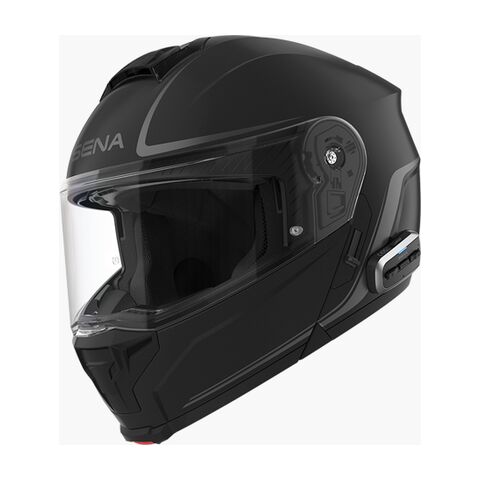
The Outrush 2 has Sena’s communication system built in, including mesh intercom, so there is nothing to clamp on or wire up. It is the cheapest way to get a modular with mesh talk to your group and music from your phone.
It is a basic helmet next to the others here, so treat it as a commuter or casual touring lid. Our Bluetooth helmet guide covers more options.
Pros
- Mesh intercom built in
- Low price for a complete package
- No clamp or wiring
Cons
- Shell and liner are entry-level
- Electronics can’t be upgraded separately
Best modular helmets under $300
If your budget tops out around $300, two modulars from major brands fit, and both are in the list above:
- HJC i91 (about $270 for solids, about $310 for graphics): DOT-certified, polycarbonate shell in three shell sizes, a drop-down sun visor, sizes XS to 5XL and an interior HJC designs to work with glasses. It’s the safest bet under $300.
- Bell SRT Modular (from about $300): DOT and ECE, fiberglass composite shell, Panovision flip-up shield and eyewear pockets in the liner. Solid colors sit right at the $300 line and graphics cost more, so watch for sales and closeout colors.
Under $300 you give up some refinement: these helmets are louder and heavier than a Neotec 3 or C5, and neither has a SHARP rating. If you can stretch to about $380, the Sena Outrush 2 adds a built-in Mesh intercom. For full-face options at this price, see our best helmets under $300, and if you wear glasses, our helmets for glasses wearers guide compares the modulars that leave room for frames.
How to choose a modular helmet
Safety certification
Look for DOT in the US and ECE 22.06 in Europe, the UK and Australia/NZ. ECE 22.06 is the newer standard and adds rotational and higher-speed impact tests. Some modulars are also “P/J” certified, which means they passed testing with the chin bar open (J) as well as closed (P). Without P/J, ride with the chin bar locked shut. NHTSA motorcycle safety guidance and SHARP ratings are worth checking, and our guide to helmet safety ratings explains what each label means.
Head shape and size
Fit matters more than any feature. Measure your head and check the brand’s shape: Shoei and Bell are intermediate-oval, while some Schuberth and LS2 fits feel rounder. Our helmet sizing guide walks you through it.
Shell material and weight
Polycarbonate shells are cheaper and heavier. Fiberglass and composite shells save weight, and carbon saves the most. Modulars always weigh more than a comparable full-face because of the hinge and chin-bar lock, so a lighter shell pays off on long days.
Noise
Modulars have more seams than full-face helmets, so noise varies a lot. The Schuberth C5 and Shoei Neotec 3 are the quietest here. Whatever you buy, wear earplugs on the highway.
Intercom integration
Helmets with an integrated system (Shoei SRL3, Schuberth SC2) or built-in electronics (Sena Outrush 2) keep the shell clean and aerodynamic. Sena has just announced the SRL3 Plus, a Bose-tuned successor to the SRL3 for the Neotec 3, and Cardo now makes the HJC PackTalk to fit inside the RPHA 91 and i91. Others take any clamp-on unit; see our best motorcycle intercoms to pick one.
If you wear prescription frames, see our guide to the best motorcycle helmets for glasses wearers.
FAQ
Are modular helmets as safe as full-face helmets?
A modular that passes DOT or ECE 22.06 meets the same standard as a full-face helmet. The chin bar is a potential weak point, so look at SHARP chin-bar latch results where available and always ride with it locked unless the helmet is P/J certified.
Can you ride with a modular helmet open?
Only if the helmet is P/J certified, like the Schuberth C5 and LS2 Advant X. Otherwise, open it only when you are stopped or riding at walking pace.
Are modular helmets heavier?
Yes. The hinge and locking mechanism add weight, usually a few hundred grams over a similar full-face helmet.
What is the quietest modular helmet?
Of the helmets here, the Schuberth C5 and Shoei Neotec 3 have the best reputations for low wind noise. Fit and your bike’s windscreen make a big difference too.
What is the best modular helmet under $300?
The HJC i91 is the strongest pick under $300: DOT-certified, a drop-down sun visor and a wide size range for about $270. The Bell SRT Modular is the other option, starting right around $300.
How long does a modular helmet last?
Most makers recommend replacing a helmet about every five years, or after any crash. Read our guide to motorcycle helmet expiration for details.
Related reading: our BILT Techno 3.0 modular review and our Bell SRT Modular review.
Verdict
Buy the Shoei Neotec 3 if you want the best all-round modular and will add the SRL3 intercom. Go for the Schuberth C5 if long highway days and low noise matter most, or the HJC RPHA 91 for most of the premium experience at a lower price. The HJC i91 is the smart budget pick. Still deciding on a helmet type? Browse our full best motorcycle helmets roundup. Riding two-up? Our guide to helmets for motorcycle passengers covers modulars, built-in comms and travel-friendly picks.
Browse all our helmet guides.