Throttle Buff is reader-supported: we may earn a commission when you buy through links on this page. Learn more.
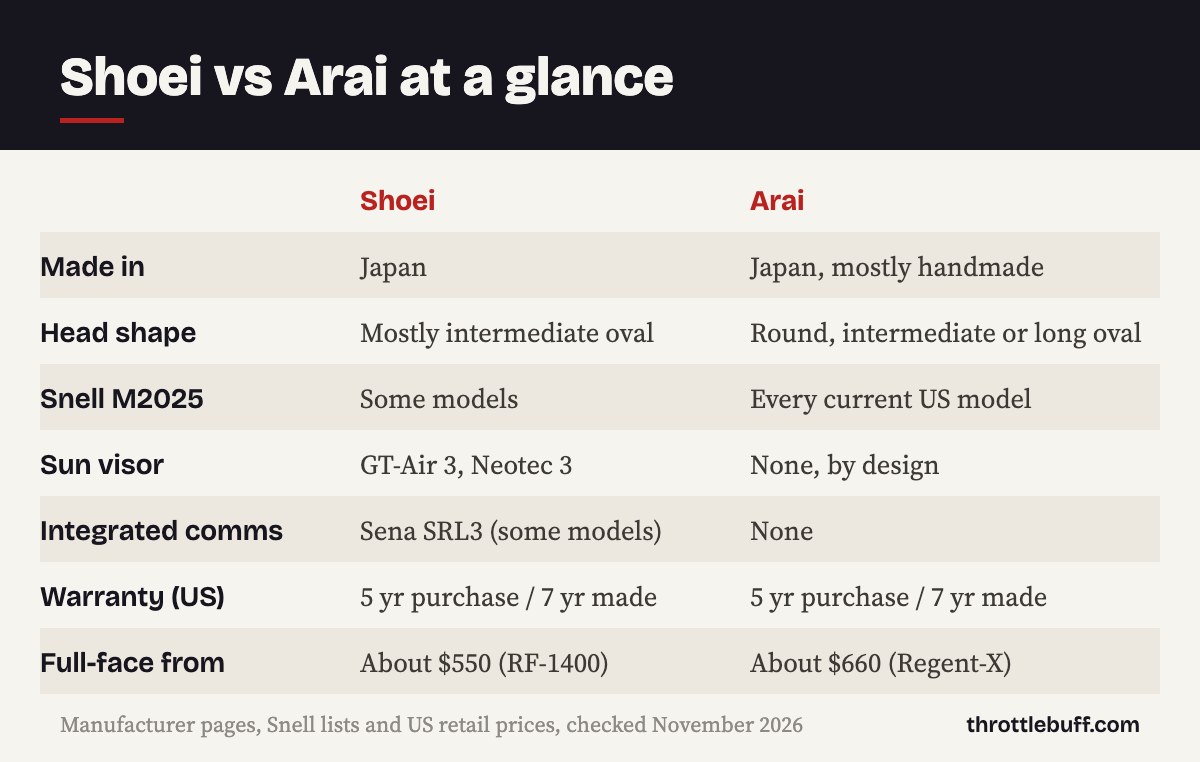
Shoei and Arai make some of the best motorcycle helmets you can buy, and both build them in Japan. The short answer: choose Arai if you want every model Snell-certified, a choice of head shapes and a shell designed to glance off impacts, and you don’t need a drop-down sun visor. Choose Shoei if you want modern touring features like an internal sun shield and built-in Sena comms, a slightly lower starting price, or you have an intermediate-oval head that Shoei fits well. The best helmet is the one that fits your head, so try both if you can.
This comparison is research-based. We used Shoei and Arai’s US sites, the Snell Memorial Foundation’s certification lists, the UK government’s SHARP crash-test results and US retail prices, all checked in November 2026. We haven’t crash-tested or worn these helmets ourselves. Arai’s US prices vary between its own pages and dealers, so treat them as approximate.
Shoei vs Arai: quick verdict
- Best for track and sport: tie. The Shoei X-Fifteen and Arai Corsair-X are both top-tier race helmets.
- Best for touring: Shoei, thanks to the GT-Air 3’s drop-down sun shield and Sena SRL3 integration.
- Best for unusual head shapes: Arai, which makes round, intermediate and long oval shapes.
- Best for certification: Arai. Every current US Arai is on Snell’s M2025 list; several Shoei touring models are DOT only in the US.
- Best for modular: Shoei. Arai doesn’t make a modular helmet.
- Best value entry point: Shoei RF-1400, from about $550.
Model-by-model comparison
| Category | Shoei | Arai |
|---|---|---|
| Race full-face | X-Fifteen, about $980–$1,000 | Corsair-X, about $980 (solid) |
| Sport / street full-face | RF-1400, about $550 | Signet-X (long oval), Quantum-X (round oval), Contour-X, about $680–$840 |
| Entry full-face | RF-SR / RF-SR2 (where available) | Regent-X, about $660 |
| Touring full-face | GT-Air 3, about $780 (sun shield, SRL3 ready) | No direct equivalent (no internal sun visor) |
| Modular | Neotec 3, about $950 | None |
| Adventure | Hornet X2, about $700–$720 | XD-5, about $1,040 (graphic) |
| Open-face | J-Cruise 3, about $700 | RAM-X about $800; Classic-V about $540 |
| Motocross | VFX-EVO, about $630 | VX-Pro4, about $820 (graphic) |
Prices are US retail for solid colours where available, November 2026. Graphics cost more for both brands.


Safety and certification
Both brands sell every US helmet with DOT certification, and both have strong SHARP crash-test results in the UK. The difference is Snell. Arai certifies its whole current US range to Snell M2025D, a voluntary standard with tougher impact tests than DOT. Shoei certifies its sport, adventure and motocross helmets (RF-1400, Hornet X2, VFX-EVO) to Snell M2025D, and the X-Fifteen to the racing-grade M2025R and ECE 22.06. But Shoei’s GT-Air 3, Neotec 3 and J-Cruise 3 are DOT only in the US.
SHARP tests European models, which sometimes have different names. Results include:
| Helmet (US name) | SHARP name | SHARP rating |
|---|---|---|
| Shoei RF-1400 | NXR2 | 5 stars |
| Shoei GT-Air 3 | GT-Air 3 | 5 stars |
| Shoei Neotec 3 | Neotec 3 | 5 stars |
| Shoei X-Fourteen (previous race model) | X-Spirit III | 5 stars |
| Arai Corsair-X | RX-7V Evo | 5 stars |
| Arai Contour-X | Quantic | 4 stars |
| Arai XD-5 | Tour-X5 | 4 stars |
SHARP hasn’t published results for the Shoei X-Fifteen or Arai Regent-X. Read our helmet safety ratings guide for what DOT, Snell, ECE and SHARP each test.
Winner: Arai for certification across the range; Shoei for SHARP results on its touring and modular helmets.
Construction and design philosophy
Arai is famous for building helmets mostly by hand: shells are hand-laid, sanded and checked, and the EPS liners are fitted by hand. Its R75 rule means every shell keeps a smooth, continuous curve so it can glance off a surface rather than catch on it. Arai is open that no test standard measures this. It’s also why Arai avoids big vents, spoilers and an internal sun visor, which it says would weaken the forehead area.
Shoei uses its AIM+ multi-fibre shell on the RF-1400 and X-Fifteen, and AIM on the GT-Air 3, in several shell sizes so smaller heads get a smaller helmet. Shoei leans into features: CWR-F2 shields with a Pinlock EVO insert included on most models, and its E.Q.R.S. emergency cheek-pad release on the X-Fifteen and RF-1400. Arai’s VAS shield system and FCS cheek pads are its own take on easy shield changes and a snug fit.
Winner: personal preference. Arai’s approach is simplicity; Shoei’s is features.
Fit and head shape
Fit matters more than brand. Shoei builds nearly all its US helmets around an intermediate oval head, the most common shape. Arai offers three: the Quantum-X for round oval heads, the Signet-X for long oval heads, and the Corsair-X, Regent-X, Contour-X and most others for intermediate oval. If Shoei helmets give you pressure on your forehead or the sides of your head, an Arai in the right shape may solve it. Measure your head with our helmet size calculator and read how to size a helmet before you buy.
Winner: Arai, for more head shapes.
Comfort and features
- Sun visor: the Shoei GT-Air 3 and Neotec 3 have drop-down sun shields. No Arai has one; Arai offers the external Pro Shade instead.
- Comms: the GT-Air 3 and Neotec 3 integrate Shoei’s Sena SRL3 intercom, which sits flush with the shell. Arai has no integrated system, so you’ll fit a clip-on unit. See our intercom install guide.
- Weight: Shoei publishes claimed weights: RF-1400 3.64 lb, X-Fifteen 3.78 lb, GT-Air 3 3.91 lb and Neotec 3 4.15 lb. Arai publishes few; retailer figures put the Contour-X at about 3.34 lb and Quantum-X at about 3.52 lb.
- Anti-fog: both include Pinlock inserts on most current full-face models.
Winner: Shoei, for touring features.
Price and warranty
Shoei’s range starts lower: the RF-1400 sells for about $550, while Arai’s cheapest full-face, the Regent-X, is about $660. At the top end they’re similar, with both race helmets around $1,000 in solid colours. Warranties are almost identical in the US: five years from purchase, capped at seven years from manufacture. Shoei requires you to register and buy from an authorised US dealer; Arai requires an intact Snell label but no registration.
Winner: Shoei on price; tie on warranty.
Which should you buy?
| Choose Shoei if… | Choose Arai if… |
|---|---|
| You tour and want a drop-down sun shield | You want Snell M2025 on any model you pick |
| You want a modular helmet | You have a round or long oval head |
| You want built-in Sena comms | You prefer a simple, smooth shell with fewer add-ons |
| You want the lowest price for a premium Japanese full-face | You value hand-built construction |
Alternatives
- For more brands at every budget, see our best helmet brands and best motorcycle helmets.
- Want carbon? Read best carbon fiber helmets.
- Comparing within Shoei? See Shoei GT-Air vs RF-1200.
FAQ
Is Arai safer than Shoei?
Neither brand is clearly safer overall. Arai certifies every current US model to Snell M2025, while several Shoei touring models are DOT only in the US. But Shoei’s RF-1400, GT-Air 3 and Neotec 3 all scored 5 stars in SHARP testing, and Arai’s Corsair-X equivalent did too. Compare specific models, not brands.
Why are Arai helmets so expensive?
Arai builds its helmets mostly by hand in Japan, with hand-laid shells and hand-fitted liners, and certifies the whole range to Snell. Shoei is also made in Japan but starts at a lower price point with the RF-1400.
Do Shoei and Arai fit the same?
Not always. Shoei helmets are mostly intermediate oval. Arai makes intermediate oval models plus the round oval Quantum-X and long oval Signet-X.
Does Arai make a modular helmet?
No. Arai doesn’t make flip-up helmets. The Shoei Neotec 3 is the modular option of the two brands. See our best modular helmets.
Which is better for touring, Shoei or Arai?
Shoei, for most riders. The GT-Air 3 has a drop-down sun shield and integrates the Sena SRL3 intercom; no Arai has an internal sun visor.
Verdict
There’s no wrong choice between Shoei and Arai; both are top-tier Japanese brands with excellent safety records. Shoei suits riders who want touring features and a slightly lower price. Arai suits riders who want Snell certification across the range, more head shapes and a deliberately simple design. Fit decides it: buy the one that’s comfortable after 30 minutes on your head.