Throttle Buff is reader-supported: we may earn a commission when you buy through links on this page. Learn more.
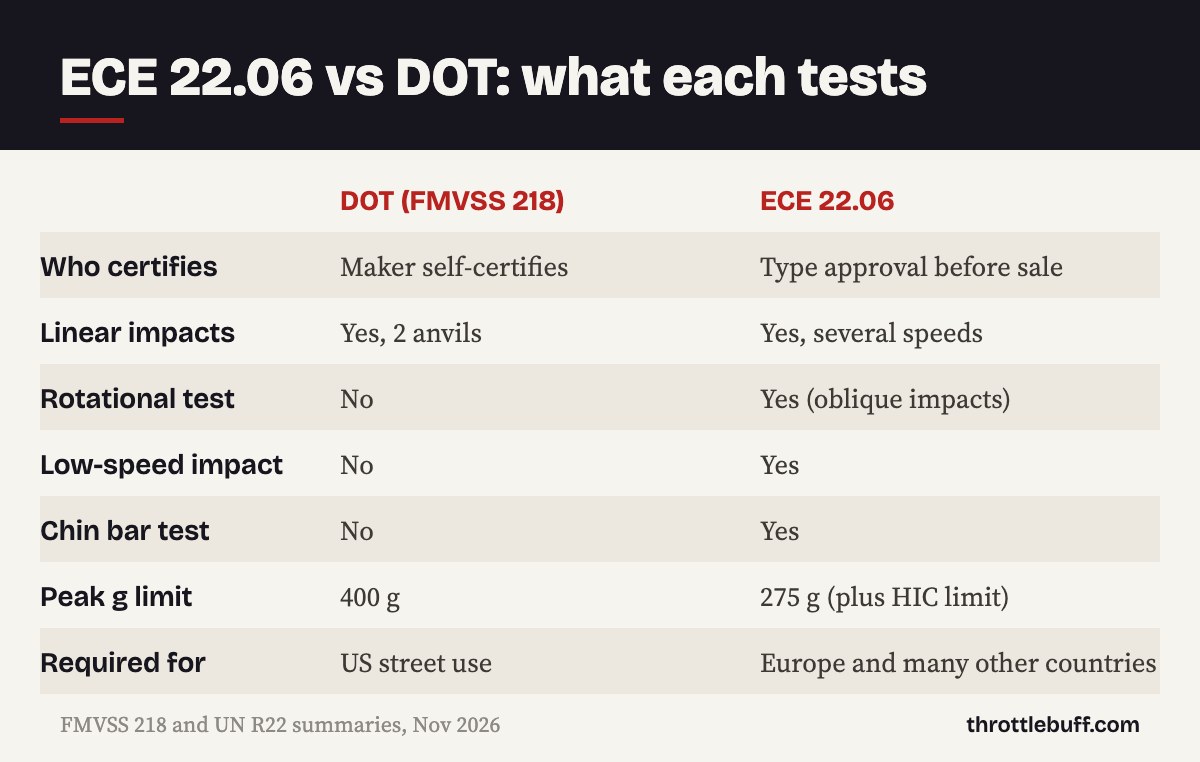
ECE 22.06 is the more demanding helmet standard. It tests impacts at more speeds and locations, adds a rotational (oblique) impact test, tests the chin bar, and sets a lower limit on how much force reaches the head. DOT (FMVSS 218) is the legal minimum for road use in the US and is self-certified by the manufacturer. If you ride in the US, make sure your helmet carries a DOT label; if you can, choose one that also has ECE 22.06.
This explainer is research-based. DOT details come from the US federal regulation (49 CFR 571.218), checked in November 2026. ECE 22.06 details come from published summaries of UN Regulation No. 22, 06 series; check the official text if you need exact test values.
ECE 22.06 vs DOT at a glance
| DOT (FMVSS 218) | ECE 22.06 | |
|---|---|---|
| Where it applies | Required for helmets sold for road use in the US | Europe and the many other countries that use UN regulations |
| Who certifies | The manufacturer self-certifies; NHTSA can buy and test helmets for compliance | Type approval by a national approval authority before sale, plus production conformity checks |
| Linear impact test | Flat and hemispherical anvils, two impacts at each of four sites | Flat and kerbstone anvils at several speeds and more locations |
| Impact speeds | About 5.2 m/s (hemi) and 6.0 m/s (flat) | Low (6.0 m/s), standard (7.5 m/s) and high (8.2 m/s) |
| Force limit | 400 g peak, with time limits above 150 g and 200 g | 275 g peak plus a head injury criterion (HIC) limit |
| Rotational test | No | Yes, oblique impacts measure rotational acceleration |
| Chin bar test | No | Yes |
| Penetration test | Yes, pointed striker dropped from 3 m | No penetration test |
| Retention test | Yes: 50 lb for 30 s, then 250 lb for 2 min, strap stretch 1 inch or less | Yes, plus a roll-off test |
| Label | “DOT”, “FMVSS No. 218” and “CERTIFIED” on the back of the shell | Sewn-in E-mark label with an approval number starting “06” |
How DOT certification works
FMVSS 218 is a federal motor vehicle safety standard. Manufacturers test their own helmets (or pay a lab to) and put the DOT label on them, which is their certification that the helmet meets the standard. There’s no approval step before sale, but NHTSA can buy helmets from the market and test them, and helmets that fail can lead to recalls and penalties.
The test itself conditions helmets hot (45–55°C), cold (−15 to −5°C), wet and at room temperature, then drops them on flat and hemispherical anvils. The headform must not exceed 400 g, and it can’t spend more than 2 milliseconds above 200 g or 4 milliseconds above 150 g. A pointed striker dropped from 3 m must not touch the headform, and the chin strap must hold 250 lb for two minutes. The helmet also has to give at least 105° of peripheral vision to each side.
How ECE 22.06 works
ECE 22.06 is the 06 series of UN Regulation No. 22, which replaced 22.05. Before a helmet can be sold, a national approval authority type-approves it, and production samples are checked afterwards. Compared with DOT, it:
- Tests more speeds: a low-speed test makes sure the liner isn’t too stiff for everyday falls, and a high-speed test checks bigger hits.
- Tests more points: including random points chosen by the lab, so a maker can’t just reinforce the usual spots.
- Adds rotational testing: oblique impacts measure how much the head twists, which is linked to brain injuries.
- Tests the chin bar on full-face and modular helmets.
- Sets a lower force limit: 275 g peak plus a head injury criterion, against DOT’s 400 g.
Visors and some accessories, such as approved communication systems, are also part of 22.06 approval. That’s one reason helmet makers now design intercom-ready helmets around specific units.
Which is safer?
On paper, ECE 22.06. It’s broader, adds rotational and chin bar tests, and requires approval before sale. DOT does test penetration, which 22.06 doesn’t, but for most real crashes the broader impact testing in 22.06 is more relevant.
That said, a standard is a pass/fail minimum, not a ranking. For a sense of how helmets compare beyond the pass mark, look at independent test programmes like the UK’s SHARP star ratings, and at Snell M2025, a voluntary US standard with tougher impact tests. Our helmet safety ratings guide covers SHARP, Snell and MIPS in detail.
Can you wear an ECE helmet in the US?
For road riding in the US, buy a helmet with a DOT label. FMVSS 218 applies to helmets sold for highway use, and in states with helmet laws the requirement is usually a DOT-compliant helmet. An ECE-only helmet hasn’t been certified to FMVSS 218, so it may not satisfy your state’s law even if it’s well made. Many helmets sold in the US carry both DOT and ECE 22.06, which gives you the legal label and the broader test. Check your state’s rules in our helmet laws by state guide.
How to tell if a helmet is DOT or ECE 22.06
- DOT: a permanent label on the back of the shell with “DOT”, “FMVSS No. 218” and “CERTIFIED”, plus a label inside with the maker, model, size and month and year of manufacture. Be wary of novelty helmets with stick-on DOT labels.
- ECE 22.06: a label sewn into the chin strap with an E and a number in a circle (the approving country), and an approval number starting with “06”. A number starting “05” means the older 22.05.
Helmets that meet both, and sometimes Snell too, are easy to find at every price. Our guides to the best motorcycle helmets and best helmets under $200 list certifications for each pick.
Both standards apply across helmet styles. If you’re still choosing a style, see our guide to the types of motorcycle helmets.
FAQ
Is ECE 22.06 better than DOT?
It’s a broader standard: it adds rotational, chin bar and multi-speed impact tests and requires approval before sale. DOT includes a penetration test that ECE doesn’t. Many helmets meet both.
Is ECE 22.06 legal in the US?
For road use, US riders should wear a helmet with a DOT label. An ECE-only helmet hasn’t been certified to FMVSS 218 and may not meet state helmet laws.
What’s the difference between ECE 22.05 and 22.06?
22.06 adds rotational (oblique) impact tests, a low-speed impact test, more impact points, and tests of visors and some accessories. 22.05 helmets are no longer approved for new production.
Is Snell better than ECE 22.06?
They test different things. Snell M2025 uses higher-energy impacts; ECE 22.06 adds low-speed and rotational tests. Neither replaces DOT for US road use. See our safety ratings guide.
Does a DOT sticker mean a helmet passed testing?
It means the manufacturer certifies that it meets FMVSS 218. NHTSA doesn’t test every model before sale, so buy from reputable brands and dealers.