Throttle Buff is reader-supported: we may earn a commission when you buy through links on this page. Learn more.
The best motorcycle helmet for glasses wearers is one with a liner that leaves room for your frame arms, either as molded eyeglass channels or soft pockets, plus a wide eyeport and a Pinlock-ready shield. For most riders that points to a modular such as the Shoei Neotec 3 (SHARP 5 stars) or, on a tighter budget, the Bell SRT Modular, whose liner has eyewear arm pockets built in. If you want a full-face, the Shoei GT-Air 3 and Arai Regent-X are well-regarded by riders in glasses.
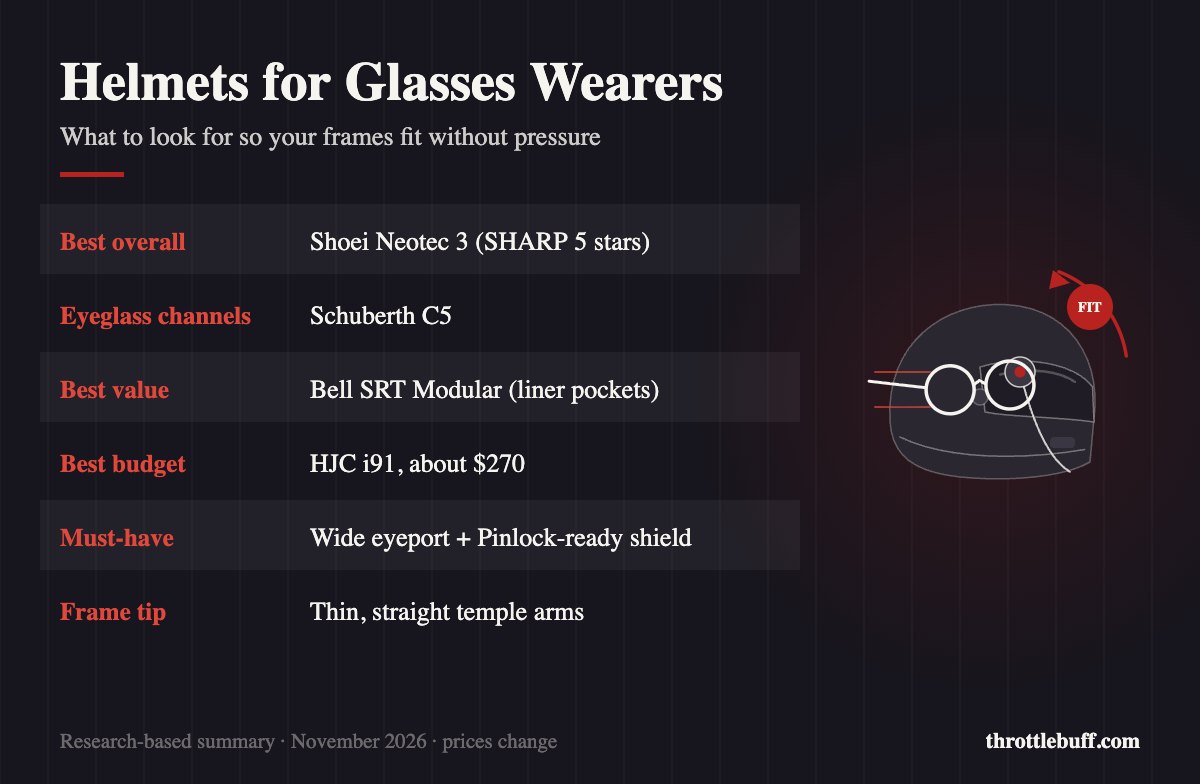
This guide is research-based. We compared manufacturer specs, DOT, ECE 22.06 and Snell certification data, UK SHARP crash-test results, published reviews and owner feedback. We did not wear or test these helmets ourselves. Prices are approximate US street prices as of November 2026 and change often.
Quick picks
- Best overall: Shoei Neotec 3 (modular, about $950)
- Best for eyeglass channels: Schuberth C5 (modular, about $800)
- Best value modular: Bell SRT Modular (about $300 to $550)
- Best budget: HJC i91 (modular, about $270 to $310)
- Best flip-back chin bar: LS2 Advant X (about $500)
- Best full-face for touring: Shoei GT-Air 3 (about $780 and up)
- Best adjustable fit: Arai Regent-X (about $660)
Comparison table
| Helmet | Type | Glasses feature | Certification / SHARP | Approx. price |
|---|---|---|---|---|
| Shoei Neotec 3 | Modular | Flip-up chin bar, roomy eyeport, Pinlock included | DOT, ECE 22.06; SHARP 5 stars | $950 |
| Schuberth C5 | Modular | Integrated eyeglass channels | DOT (US), ECE 22.06 P/J; SHARP 4 stars | $800 |
| Bell SRT Modular | Modular | Eyewear arm pockets in the liner | DOT, ECE | $300 to $550 |
| HJC i91 | Modular | 3D contour interior HJC says suits glasses | DOT | $270 to $310 |
| LS2 Advant X | Modular (180° chin bar) | Chin bar rotates fully back | DOT, ECE 22.06 P/J; SHARP 4 stars | $500 |
| Shoei GT-Air 3 | Full-face | Reviewers in glasses report easy fit | DOT, ECE 22.06 | $780+ |
| Arai Regent-X | Full-face | 5mm peel-away liner layer for custom room | DOT, Snell M2025 | $660 |
Why glasses and helmets fight
Most helmet liners are designed to press firmly against your cheeks and temples. That is good for safety and stability, but it means your frame arms get squeezed between foam and skull. After an hour, that pressure turns into a headache or sore spots above the ears. Some helmets also push the frames down your nose, so you end up looking over the top of your lenses.
The fix is a helmet that leaves a path for the arms. Brands do this in a few ways:
- Molded eyeglass channels carved into the comfort liner or EPS at the temples (Schuberth calls out integrated eyeglass channels on the C5).
- Fabric pockets or slots in the liner (Bell’s SRT has eyewear arm pockets woven into the liner).
- Removable foam layers you peel out to make room (Arai’s 5mm peel-away layer).
- Brand-wide interior designs, such as Shark’s Easy Fit, which Shark describes as a dedicated space that lets glasses arms pass through the cheek foam.
The best motorcycle helmets for glasses wearers
1. Shoei Neotec 3: best overall
The Neotec 3 is the modular we would point most glasses wearers to first. The flip-up chin bar lets you settle your frames with the helmet already on, and the eyeport is generous, so the frame edges sit inside your field of view instead of being cut off by the shell. It earned the maximum 5-star SHARP rating, which is rare for a modular.
- Price: about $950 for solid colors
- Certification: DOT in the US; ECE 22.06 version tested by SHARP
- Fog control: Pinlock-ready shield with an anti-fog insert included
- Sizes: XS to 2XL
- Other: drop-down sun shield, adjustable pads, breath guard
Good to know: Shoei doesn’t advertise a dedicated eyeglass channel on the Neotec 3. Owners generally describe the interior as glasses-friendly, but try it with your own frames. It’s also one of the priciest helmets here.

2. Schuberth C5: best for eyeglass channels
Schuberth builds eyeglass channels into the C5’s interior, and published reviews single them out as a strength for riders who wear glasses. It’s a quiet, touring-focused modular with ECE 22.06 P/J approval, meaning it’s homologated to ride with the chin bar open or closed. SHARP gives it 4 stars.
- Price: about $800
- Certification: DOT (US model), ECE 22.06 P/J
- Weight: about 1,640 g (3.6 lb)
- Sizes: XS to 3XL
- Other: internal sun visor, Pinlock lens available, comms-ready
Good to know: Schuberth’s shape suits intermediate oval heads. If you’re between sizes, try both with glasses on.

3. Bell SRT Modular: best value
Bell is direct about glasses here: the SRT Modular product page lists eyewear arm pockets woven right into the interior liner, for prescription glasses or sunglasses. That’s exactly the feature you want, at a much lower price than the European modulars. The fiberglass composite shell and Panovision shield with Class 1 optics round it out.
- Price: about $300 to $550 depending on finish
- Certification: DOT and ECE
- Weight: about 1,750 g (3.9 lb) in size M
- Other: flip-up Panovision shield, ProTint shield available as an extra
Good to know: It’s heavier than the Neotec 3 and C5, and Bell doesn’t list Pinlock compatibility on the product page. Check the label for which ECE standard your helmet carries.

4. HJC i91: best budget
The i91 is one of the cheapest modulars from a major brand, and HJC says its 3D contour interior is designed to fit riders who wear glasses comfortably and securely. You also get a multi-step drop-down sun visor, which is handy if you ride in prescription clear lenses and don’t want to swap to prescription sunglasses.
- Price: about $270 for solids, about $310 for graphics
- Certification: DOT (check the label for ECE)
- Shell: polycarbonate composite, three shell sizes
- Sizes: XS to 5XL
- Other: ready for HJC’s Smart communicator (sold separately)
Good to know: The i91 hasn’t been SHARP-tested. If crash-test data matters most, HJC’s pricier RPHA 91 earned 4 SHARP stars.

5. LS2 Advant X: best flip-back chin bar
The Advant X’s chin bar rotates a full 180 degrees and locks behind your head. For glasses wearers, that means you can pull the helmet on, then slide your frames in with nothing in front of your face, and ride open-face at a fuel stop without taking anything off. It’s ECE 22.06 P/J certified and earned 4 SHARP stars.
- Price: about $500 for solids
- Certification: DOT, ECE 22.06 P/J
- Fog control: Pinlock Max-ready, one Pinlock insert included
- Other: clear and dark smoke shields in the box, built-in sun shield
Good to know: LS2 doesn’t advertise eyeglass channels, so how your frames feel at the temples depends on your head shape. Try before you commit.

6. Shoei GT-Air 3: best full-face for touring
If you want a full-face rather than a modular, the GT-Air 3 is a strong choice. A reviewer who wears glasses at UK magazine MCN reported that frames slide in easily without catching the liner and don’t interfere with the drop-down sun visor. That matches common owner feedback. It meets ECE 22.06, and the Pinlock insert has a good record for keeping the shield clear in rain.
- Price: about $780 for solids, more for graphics
- Certification: DOT, ECE 22.06
- Weight: about 1,750 to 1,800 g (claimed)
- Sizes: XS to 2XL, three shell sizes
- Other: internal sun visor, Pinlock-ready shield
Good to know: Like any full-face, you’ll take your glasses off to put it on. Not sure between styles? Read modular vs full-face helmets.

7. Arai Regent-X: best adjustable fit
Arai’s approach is fit adjustment rather than a fixed channel. The Regent-X liner is fully removable and has a 5mm peel-away foam layer, so you can remove foam where your frames press and make room exactly where your head needs it. It’s one of the few helmets here with both DOT and Snell M2025 certification, and its intermediate oval shape fits a wide range of riders.
- Price: about $660
- Certification: DOT, Snell M2025
- Weight: about 3.4 lb
- Sizes: XS to 2XL (chart runs 2XS to 3XL)
- Other: Pinlock-ready VAS Max Vision shield (insert sold separately)
Good to know: Peeling foam is permanent, so remove a little at a time. There’s no internal sun visor.

How to choose a helmet if you wear glasses
Start with fit, not features
A helmet with eyeglass channels that doesn’t fit your head shape is still the wrong helmet. Measure your head, find your shape (round, intermediate oval or long oval), and then narrow down. Our helmet sizing guide walks through it. Don’t size up to make room for glasses: a loose helmet can shift or roll off in a crash.
Pick your helmet type
- Modular: the easiest with glasses. Flip up the chin bar, put the helmet on, then slide your frames in. Some still pull glasses off when you remove the helmet, so take glasses off first.
- Full-face: the most protection and usually quieter, but glasses come off every time the helmet does.
- Open-face or 3/4: very easy with glasses, but no chin protection and more wind and grit in your eyes.
Look for a wide, tall eyeport
A small eyeport can cut across the top of your frames, putting the shell edge right in your line of sight. A taller opening also matters if you ride in a tucked position, since the top of the port can push down on the frame.
Check safety ratings
Every helmet sold for road use in the US must meet DOT FMVSS 218. ECE 22.06 adds rotational and more varied impact tests, and SHARP stars give a useful extra data point. See our helmet safety ratings explained guide.
How to check fit with your glasses on
- Bring the glasses you’ll actually ride in. Frame arms vary a lot in thickness and shape.
- Put the helmet on first, then the glasses. Slide the arms in through the eyeport, aiming for the channel or the gap between the pads.
- Check for pressure. The arms should slide in with mild resistance. If you have to force them, or they bend, that helmet is wrong for you.
- Look at the lenses. They should sit where they normally do on your nose, not pushed down or tilted.
- Wear it for 20 to 30 minutes indoors. Pressure spots often show up after 15 minutes, not in the first one. Keep tags on, as many shops won’t take back a helmet that has been ridden in.
- Check your field of view. Look left, right and up. The frames and eyeport edge should not stack into one big blind band.
Frame shape tips
- Thin, straight arms slide past cheek pads more easily than thick acetate arms.
- Avoid sharply curved temple tips (the hook behind the ear). Straight or “skull” temples are easier to insert with a helmet on.
- Flexible or spring hinges survive being pushed past foam better.
- Medium-height lenses cover more of the eyeport than small, narrow lenses.
- Consider a dedicated riding pair. Many riders keep inexpensive, thin-framed glasses just for the bike. Take your helmet to your optician when you choose them. Prescription riding glasses are another option.
Anti-fog and Pinlock tips for glasses wearers
Glasses wearers fight fog on two surfaces: the shield and the lenses. Your breath warms both.
- Use a Pinlock insert. It’s the most reliable fix for shield fog. Neotec 3 and Advant X include one; most others here are Pinlock-ready.
- Fit the breath guard. It sends warm breath down and away from your lenses.
- Open the chin vent before you set off, and crack the shield to its first detent at low speeds.
- Treat your lenses. An anti-fog coating or a lens cleaner made for coated lenses helps. Anti-reflective coatings also cut glare at night.
More fixes are in our guide to stopping helmet visor fogging.
FAQ
Can you wear glasses under a motorcycle helmet?
Yes. Many riders do. The key is a helmet with room for the frame arms and frames that are thin and straight. Check your state’s rules too: many states require eye protection when riding without a windshield, and a closed face shield normally counts.
Are modular helmets better for glasses wearers?
Usually, yes. Flipping up the chin bar lets you put glasses on and adjust them with the helmet on. A full-face can still work well if the liner has channels, and it’s often quieter.
Should I size up a helmet to fit my glasses?
No. A larger helmet can move on your head in a crash. Get the correct size and choose a model with eyeglass channels or pockets, or adjust the pads.
Do eyeglass channels affect helmet safety?
Channels are designed into the liner by the manufacturer, and the helmet is certified with them. Don’t cut your own grooves into the EPS foam, though, as that can weaken it. Removing comfort foam the brand designed to peel away, like Arai’s, is fine.
Should I wear contacts instead?
Contacts avoid frame pressure but can dry out with airflow, and a lost lens on the road is a problem. If you ride in contacts, keep your shield closed and carry a spare pair of glasses.