Throttle Buff is reader-supported: we may earn a commission when you buy through links on this page. Learn more.
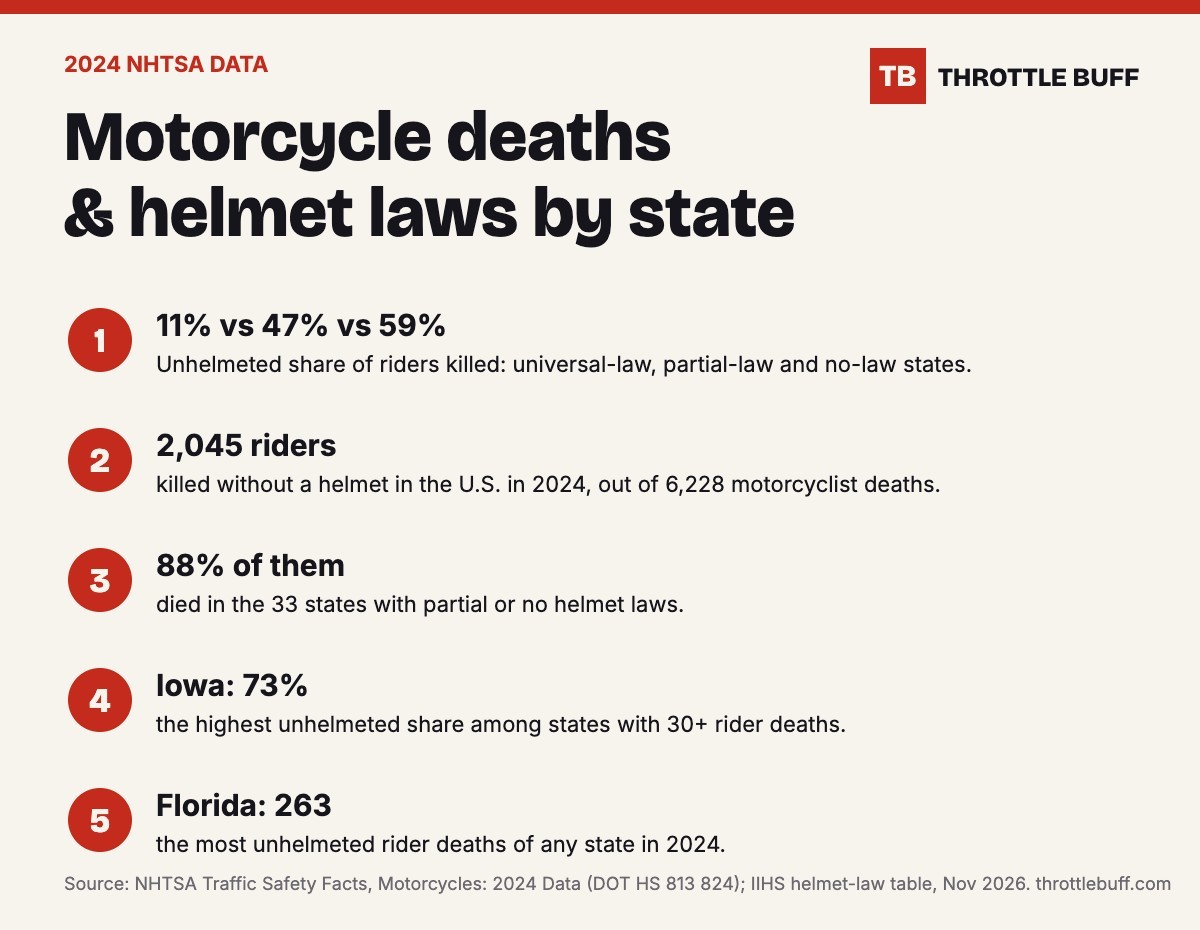
In 2024, 6,228 motorcyclists died on U.S. roads, and 2,045 of them were not wearing a helmet. Where you ride makes a huge difference: in states that require every rider to wear a helmet, only 11% of riders killed (where helmet use was known) were unhelmeted. In states with partial laws it was 47%, and in the three states with no helmet law at all it was 59%.
We combined NHTSA’s newest state-by-state fatality data with the current IIHS helmet-law table to rank every state. The full table, method and sources are below, and you’re free to republish the data or infographic with a link back to this page.
Key findings
- Universal helmet laws line up with far fewer unhelmeted deaths. The 17 states plus D.C. with universal laws had 37% of all motorcyclist deaths (2,305) but only 12% of unhelmeted deaths (247).
- 88% of unhelmeted rider deaths happened in partial-law or no-law states. That’s 1,798 of the 2,045 unhelmeted riders killed nationwide.
- Iowa had the highest unhelmeted share: 73% of riders killed with known helmet use weren’t wearing one (45 of 63 deaths). Iowa has no helmet law.
- Florida had the most unhelmeted deaths, 263, and the most motorcyclist deaths overall (642). Florida lets riders 21 and over skip a helmet if they carry medical insurance.
- Washington had the lowest unhelmeted share at 5%, followed by Massachusetts and Virginia at 6%. All three have universal laws.
Motorcycle deaths and helmet laws by state (2024)
Sorted by the share of riders killed without a helmet. “Unhelmeted share” uses only deaths where helmet use was known, as NHTSA does. Small states can swing a lot from year to year, so read low totals with care.
| State | Helmet law | Motorcyclists killed | Unhelmeted deaths | Unhelmeted share |
|---|---|---|---|---|
| District of Columbia | Universal | 9 | 6 | 75% |
| Iowa | None | 63 | 45 | 73% |
| North Dakota | Partial | 17 | 12 | 71% |
| South Dakota | Partial | 33 | 21 | 68% |
| Wisconsin | Partial | 106 | 68 | 67% |
| Indiana | Partial | 137 | 85 | 65% |
| Rhode Island | Partial | 8 | 5 | 63% |
| Arkansas | Partial | 76 | 43 | 60% |
| New Mexico | Partial | 50 | 25 | 60% |
| Ohio | Partial | 222 | 128 | 59% |
| Kentucky | Partial | 118 | 70 | 59% |
| Hawaii | Partial | 26 | 15 | 58% |
| Illinois | None | 149 | 78 | 55% |
| New Hampshire | None | 35 | 19 | 54% |
| Montana | Partial | 38 | 19 | 53% |
| Minnesota | Partial | 76 | 38 | 52% |
| Kansas | Partial | 56 | 25 | 52% |
| Utah | Partial | 53 | 27 | 52% |
| Maine | Partial | 35 | 18 | 51% |
| Colorado | Partial | 165 | 80 | 50% |
| Pennsylvania | Partial | 217 | 103 | 49% |
| South Carolina | Partial | 154 | 73 | 48% |
| Oklahoma | Partial | 106 | 46 | 47% |
| Michigan | Partial | 184 | 77 | 45% |
| Connecticut | Partial | 75 | 29 | 43% |
| Florida | Partial | 642 | 263 | 41% |
| Delaware | Partial | 22 | 9 | 41% |
| Missouri | Partial | 145 | 56 | 40% |
| Texas | Partial | 583 | 211 | 38% |
| Arizona | Partial | 219 | 77 | 38% |
| Idaho | Partial | 47 | 17 | 38% |
| Wyoming | Partial | 24 | 6 | 35% |
| West Virginia | Universal | 38 | 10 | 26% |
| Maryland | Universal | 95 | 24 | 25% |
| Nebraska | Partial | 32 | 8 | 25% |
| Alaska | Partial | 10 | 2 | 25% |
| New York | Universal | 209 | 36 | 18% |
| Louisiana | Universal | 70 | 12 | 18% |
| Alabama | Universal | 127 | 21 | 17% |
| Mississippi | Universal | 55 | 9 | 17% |
| Vermont | Universal | 7 | 1 | 14% |
| Georgia | Universal | 182 | 17 | 10% |
| New Jersey | Universal | 112 | 11 | 10% |
| Tennessee | Universal | 188 | 16 | 9% |
| Oregon | Universal | 85 | 7 | 9% |
| California | Universal | 522 | 39 | 8% |
| North Carolina | Universal | 212 | 16 | 8% |
| Nevada | Universal | 89 | 6 | 7% |
| Virginia | Universal | 122 | 7 | 6% |
| Massachusetts | Universal | 70 | 4 | 6% |
| Washington | Universal | 113 | 5 | 5% |
Among states with at least 30 motorcyclist deaths, these ten had the highest unhelmeted share. Seven of the ten have only age-based (partial) laws; the other three have none.
- Iowa: 73% (no helmet law)
- South Dakota: 68% (helmets required for riders 17 and younger)
- Wisconsin: 67% (17 and younger)
- Indiana: 65% (17 and younger)
- Arkansas: 60% (20 and younger)
- New Mexico: 60% (17 and younger)
- Kentucky: 59% (20 and younger)
- Ohio: 59% (17 and younger, plus first-year riders)
- Illinois: 55% (no helmet law)
- New Hampshire: 54% (no helmet law)
States with the most motorcyclist deaths
Raw totals follow population and riding season. Florida (642), Texas (583) and California (522) lead the country. The contrast between them is the clearest example in the data: Florida and Texas, with partial laws, had 41% and 38% unhelmeted shares, while California, with a universal law, had 8%.
What the helmet law categories mean
Want just your state’s rule? Use our helmet law lookup by state.
- Universal: every rider and passenger must wear a helmet. 17 states and D.C.
- Partial: only younger riders must wear one (usually under 18 or under 21), sometimes plus new riders or passengers. 30 states.
- None: no helmet requirement for adult or young riders. Illinois, Iowa and New Hampshire.
Laws change, so check your state’s current rules before you ride. The IIHS helmet-law table lists the details, including the insurance and training exemptions in Florida, Michigan, Missouri, Nebraska and Texas.
How to ride safer, whatever your state’s law
A helmet only works if it fits and meets a real standard. Look for DOT FMVSS 218 certification at minimum, and ECE 22.06 or Snell for more tested protection. Our guide to the types of motorcycle helmets explains why a full-face helmet covers the chin, where many crash impacts land.
- New riders: start with our best beginner motorcycle helmets and the beginner gear checklist.
- On a budget: our best helmets under $200 are all DOT certified.
- Carrying a passenger: they need a helmet too. See helmets for passengers and kids’ motorcycle helmets.
- Old helmet: liners degrade, so check when a motorcycle helmet expires.
- Beyond the helmet: ABS and an airbag vest address other common crash injuries.
Alcohol is the other big factor: see our companion study on drunk riding deaths by state.
For the national picture, see our full motorcycle accident statistics fact sheet.
Methodology and sources
Fatality and helmet-use figures come from Table 7 of NHTSA’s Traffic Safety Facts: Motorcycles, 2024 Data (DOT HS 813 824, July 2026), which draws on the Fatality Analysis Reporting System (FARS). Helmet-law categories come from the IIHS helmet-law table as of November 2026. The unhelmeted share divides unhelmeted deaths by deaths with known helmet use. Group totals are our own sums of NHTSA’s state figures; they match NHTSA’s national total of 2,045 unhelmeted deaths and its 11% figure for universal-law states. Puerto Rico is excluded. Laws are matched to 2024 deaths using the current table, so a state that changed its law recently may be miscategorized.
Use this data
Journalists, bloggers and rider-safety groups are welcome to use the table and infographic. Please credit Throttle Buff with a link to this page. Data on this page is shared under CC BY 4.0. To embed the infographic, copy this code:
<a href="https://throttlebuff.com/motorcycle-deaths-helmet-laws-by-state/"><img src="https://throttlebuff.com/wp-content/uploads/2026/11/motorcycle-deaths-helmet-laws-by-state-infographic.jpg" alt="Motorcycle deaths and helmet laws by state, 2024" width="1200" height="930"></a><br>Source: <a href="https://throttlebuff.com/motorcycle-deaths-helmet-laws-by-state/">Throttle Buff</a>Questions about the data? Contact the editor.

FAQ
Which state has the most motorcycle deaths?
Florida, with 642 motorcyclists killed in 2024, followed by Texas (583) and California (522).
How many states have universal motorcycle helmet laws?
17 states plus the District of Columbia require all riders to wear a helmet. 30 states have partial, age-based laws, and Illinois, Iowa and New Hampshire have none.
What percentage of motorcyclists killed weren’t wearing helmets?
Nationally, 34% of motorcyclists killed in 2024 with known helmet use weren’t wearing a helmet: 2,045 riders.
Do helmet laws reduce motorcycle deaths?
This data shows a strong link between universal laws and helmet use among riders killed (11% unhelmeted vs 47–59% elsewhere). It doesn’t prove cause on its own, but NHTSA and IIHS both report that helmets reduce the risk of death in a crash.
Browse all our how-to and safety guides.