Throttle Buff is reader-supported: we may earn a commission when you buy through links on this page. Read our affiliate disclosure.
How we reviewed it: this review is research-based, built from manufacturer specifications, safety certifications and owner feedback rather than a long-term test. How we research.
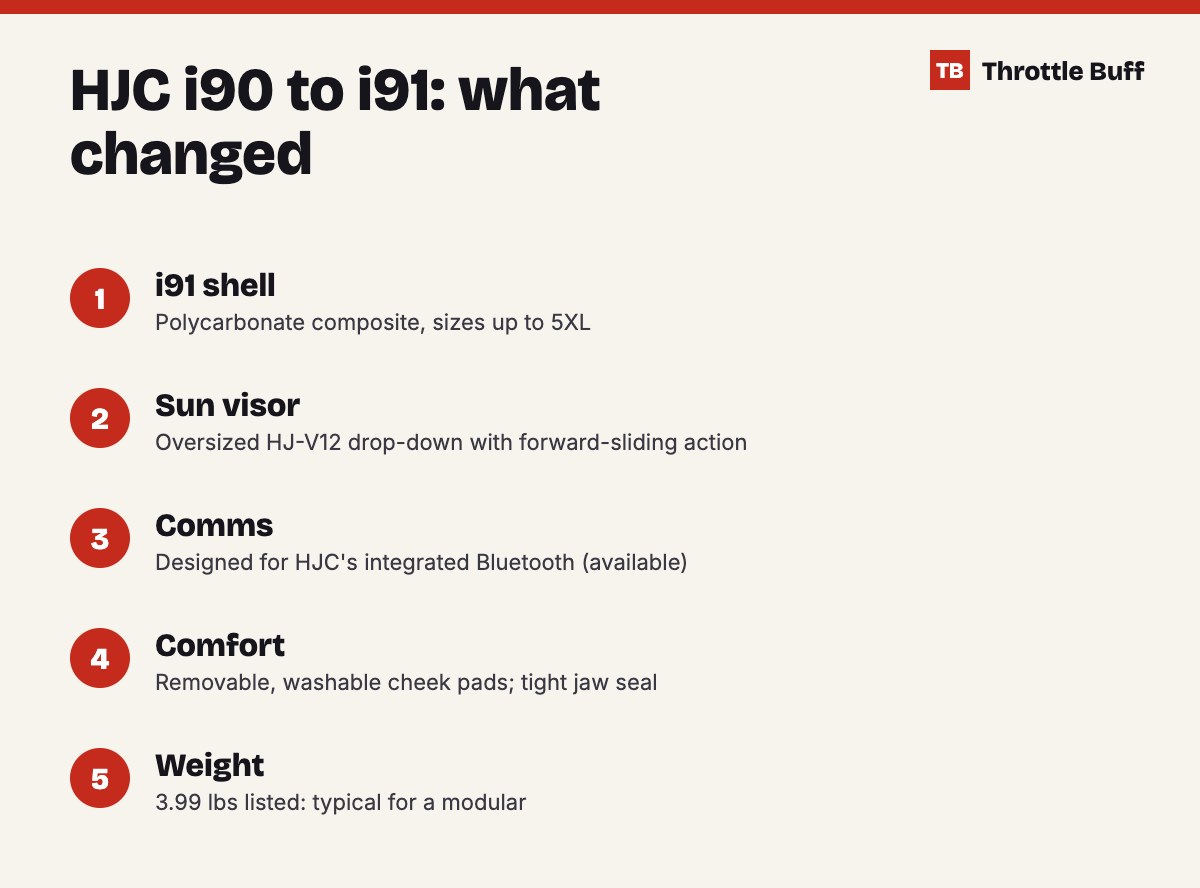
Short answer: the HJC i90 modular helmet has been replaced by the HJC i91. The i91 keeps the i90’s formula of an affordable flip-up helmet with a drop-down sun visor, and adds an oversized HJ-V12 sun visor with a forward-sliding action, a tighter seal around the jaw and support for HJC’s integrated Bluetooth. Sizes run up to 5XL. If you’re shopping for a budget modular in 2026, the i91 is the one to buy.
What was the HJC i90?
The i90 was HJC’s entry-level modular helmet. It combined a polycarbonate shell, a flip-up chin bar and an internal sun visor at a price well below premium modulars, which made it popular with commuters and touring riders who wanted the convenience of a flip-up without spending a lot. HJC has since replaced it with the i91.
HJC i91 at a glance
| Type | Modular (flip-up) |
|---|---|
| Shell | Polycarbonate composite |
| Sizes | XS to 5XL across multiple shell sizes (largest shell for 3XL–5XL; check listing by color) |
| Sun visor | Oversized HJ-V12 drop-down visor with forward-sliding deployment |
| Comms | Designed for HJC’s available integrated Bluetooth |
| Interior | Removable, washable cheek pads |
| Listed weight | 3.99 lbs |
| Head shape | Intermediate oval |
Specs are from RevZilla’s listing at the time of writing.
HJC i90 vs i91: what changed
The i91 is the same idea as the i90, an affordable polycarbonate flip-up with a drop-down sun visor, with an updated sun shield, a newer generation of HJC’s Bluetooth and certification to a newer standard. Here’s how the two compare on HJC’s own spec pages.
| Spec | HJC i90 | HJC i91 |
|---|---|---|
| Shell | Advanced Polycarbonate | Advanced Polycarbonate Composite |
| Certification (HJC US) | DOT and ECE 22.05 (XS to 2XL); DOT only for 3XL to 5XL | DOT FMVSS 218 (retailers outside the US list ECE 22.06 versions) |
| Sun visor | HJ-V9 integrated sun visor | Dynamic multi-step sun shield, anti-fog coated |
| Face shield | HJ-33, Pinlock ready | Check the listing for your size and color |
| Bluetooth | Smart HJC (first generation) | Smart HJC 2nd Gen |
| Interior | Supercool, removable, glasses grooves | Supercool, fully removable, integrated glasses grooves |
| Ventilation | Advanced Channeling Ventilation System | Advanced Channeling Ventilation System |
The practical differences are the sun shield and the comms. The i91’s multi-step shield stops at more than one position, so you can drop it part way, and HJC says it is anti-fog coated. The i90 and i91 take different Smart HJC units, so if you’re moving from an i90 with a Smart HJC headset fitted, check compatibility before you assume it will carry over. Shell material, ventilation layout and the glasses-friendly interior are much the same.
Which should you buy? If you can still find a new i90, it’s only worth it at a clear discount, and check the production date on the label because helmet foam ages. For most riders the i91 is the better buy because it’s the current model, it’s easy to get spares for, and it works with HJC’s current Bluetooth. Specs are from HJC’s i91 page and its i90 page.
HJC i91: the i90’s replacement

HJC aims the i91 at touring, commuting and urban riders. Its aerodynamically stable shell is shaped for a tight seal around the jaw, which helps keep wind noise down, and HJC routes air through the EPS for good internal airflow. The headline feature is the oversized internal sun visor, which slides forward as it drops so it covers more of your view than many budget visors.
It’s built for communicators too, with available integrated Bluetooth from HJC. The cheek pads are removable and washable, and a wide size range up to 5XL means it fits riders with larger heads that some brands don’t cater for. At a listed 3.99 lbs, it’s heavier than a full-face helmet, which is normal for a modular with a chin-bar mechanism.
Who it’s for: commuters, tourers and glasses wearers who want an affordable flip-up with a big sun visor.
HJC i91 Carst (graphic version)

Want a graphic instead of a solid color? The i91 Carst has the same helmet with a different finish. Graphics usually cost a little more than solids.

Is a modular right for you?
- Pros: flip the chin bar up to talk, drink or pay for gas without removing the helmet; easier on and off with glasses.
- Cons: heavier than a full-face, and the hinge adds complexity. Check the certification label for how the helmet is rated with the chin bar.
Prefer a full-face? HJC’s RPHA 72, F71 and i71 all have internal sun visors, and the HJC CL-17 is another budget option. For other brands, see our SEDICI Strada 3 and Bell Qualifier reviews.
Weighing a modular against a full-face? Our best motorcycle helmets guide ranks both types, including the Shoei Neotec 3 and HJC RPHA 91.
Tips for i90 and i91 owners
- Fit a communicator in the speaker pockets; see the best motorcycle Bluetooth headsets.
- Wash the cheek pads regularly using our helmet cleaning tips.
- Keep the visor clear with our tips on stopping visor fog.
- Replace any helmet after an impact, and an old i90 once it reaches the end of its service life.
Check current models on the HJC website, and see the NHTSA guide to choosing a DOT-compliant helmet.
FAQ
Is the HJC i90 discontinued?
It’s been replaced by the HJC i91, which retailers now list instead.
What’s better about the i91?
An oversized, forward-sliding HJ-V12 sun visor, a tighter jaw seal, available integrated Bluetooth and sizes up to 5XL.
Is the HJC i90 or i91 better?
The i91. It adds a multi-step, anti-fog sun shield and works with HJC’s 2nd Gen Smart HJC Bluetooth, while keeping the i90’s polycarbonate shell, ventilation and glasses grooves.
How much does the i91 weigh?
RevZilla lists it at 3.99 lbs.
Is the HJC i91 good for glasses wearers?
Modular helmets are generally easier to put on with glasses because the chin bar flips up.
Verdict
The HJC i90 was a solid budget modular, and the i91 improves on it with a bigger sun visor, a better seal and Bluetooth readiness. If you want an affordable flip-up helmet in 2026, buy the i91.
Browse all our helmet guides.