Throttle Buff is reader-supported: we may earn a commission when you buy through links on this page. Learn more.
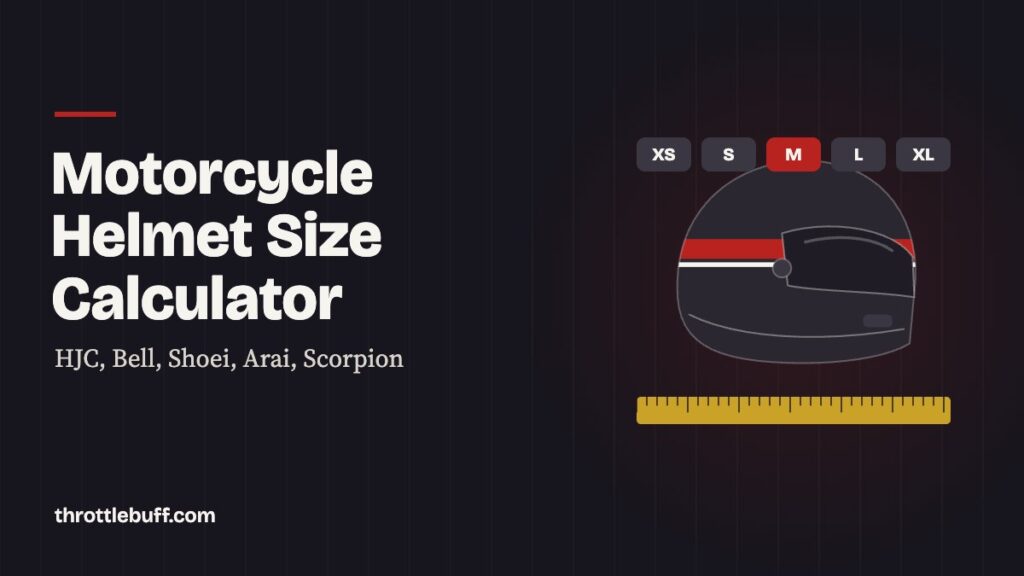
To find your motorcycle helmet size, measure around your head at its widest point, about 1 inch above your eyebrows, and match that number to the brand’s size chart. Enter your measurement below and the calculator shows your size for HJC, Bell, Shoei, Arai and Scorpion helmets at once.
Enter your head circumference
Sizes are not standard between brands: a 58 cm head is a Medium in Bell, Shoei and Arai charts but can fall into HJC’s Medium or Large. That’s why it pays to check each brand separately.
How to measure your head for a motorcycle helmet
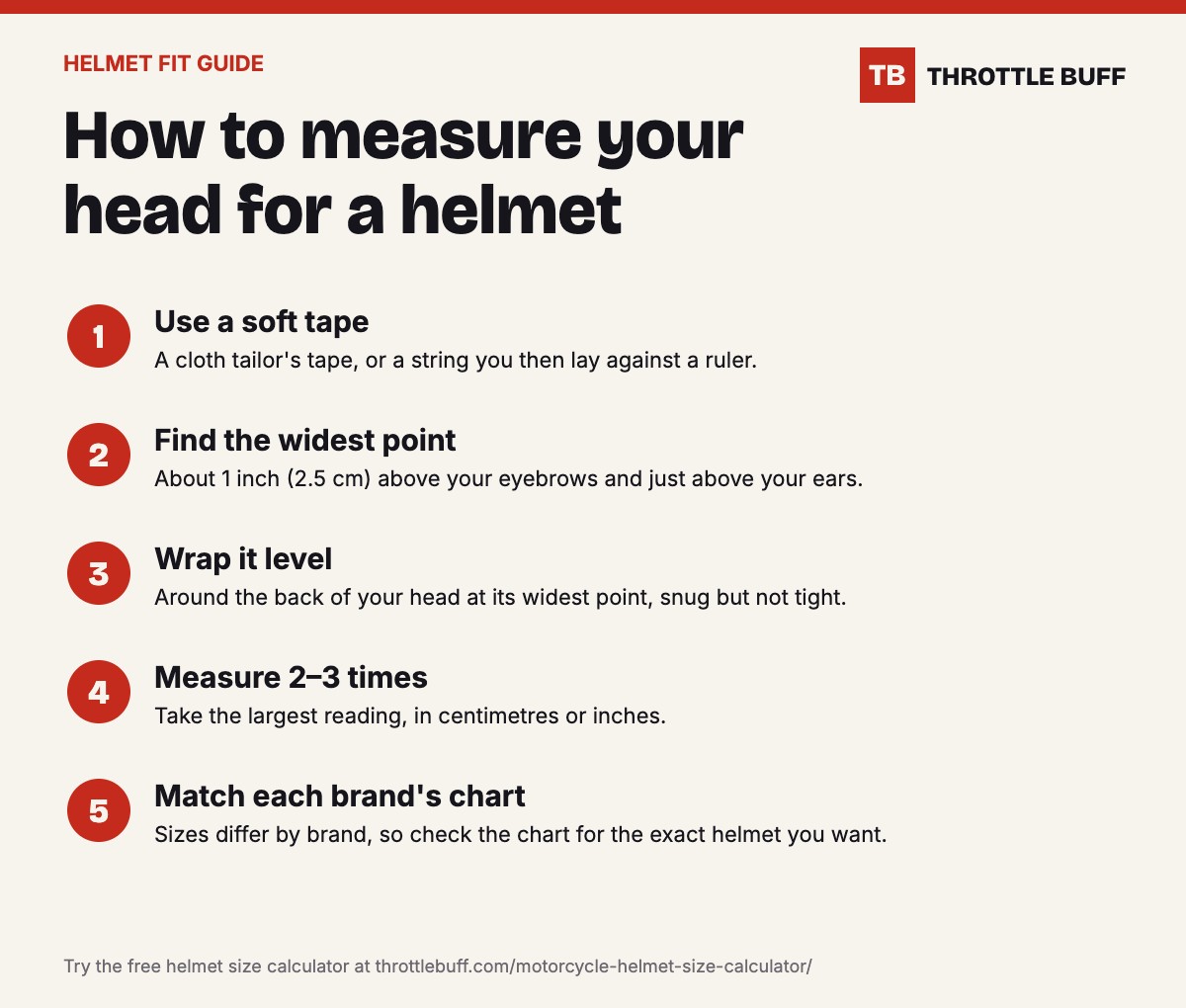
- Use a soft cloth tape measure. No tape? Wrap a piece of string, mark it, then lay it against a ruler.
- Place the tape about 1 inch (2.5 cm) above your eyebrows and just above your ears.
- Wrap it around the widest part of the back of your head, keeping it level. It should be snug, not tight.
- Measure two or three times and use the largest reading.
- Enter it in the calculator above, then double-check the chart for the exact model you plan to buy.
Motorcycle helmet size charts by brand
These are the size charts shown on RevZilla’s listings for each brand. Some brands use different charts for certain models (Bell’s chart below covers the Custom 500, Moto-3, MX-9, MX-10, Qualifier, Recon and Scout Air), so always confirm on the product page.
| Brand | Sizes (head circumference) |
|---|---|
| HJC | 3XS 50–51 cm; 2XS 52–53; XS 54–55; SM 55–56; MD 57–58; LG 58–59; XL 60–61; 2XL 62–63; 3XL 64–65; 4XL 66–67; 5XL 68–69 |
| Bell | XS 53–54 cm; SM 55–56; MD 57–58; LG 59–60; XL 61–62; 2XL 63–64; 3XL 65–66 |
| Shoei | 2XS 51–52 cm; XS 53–54; SM 55–56; MD 57–58; LG 59–60; XL 61–62; 2XL 63–64; 3XL 65–66 |
| Arai | 2XS 51–52 cm; XS 53–54; SM 55–56; MD 57–58; LG 59–60; XL 61–62; 2XL 63–64; 3XL 65–66 |
| Scorpion | XS 21 1/4 in; SM 21 5/8–22; MD 22 1/2–22 7/8; LG 22 7/8–23 1/4; XL 23 5/8–24; 2XL 24 3/8–24 3/4; 3XL 25 1/4–25 5/8; 4XL 26–26 3/8 |
How a motorcycle helmet should fit
- Snug all round: the cheek pads should press lightly on your cheeks, and there should be no gap at the forehead.
- No pressure points: a hot spot on your forehead or temples after a few minutes usually means the shell shape doesn’t suit your head.
- The roll test: with the strap fastened, try to roll the helmet forward off your head. It shouldn’t come off.
- Minimal movement: when you turn the helmet side to side, your skin should move with it.
- Expect break-in: new liners compress over the first rides, so a helmet that’s slightly snug in the shop often ends up just right.
Head shape matters as much as size. Many brands make helmets for round, intermediate oval or long oval heads, so if a size feels right in length but tight at the sides, try a different shell shape. Learn more in our guides to types of motorcycle helmets and helmet safety ratings.
Check whether your state requires a helmet with our motorcycle helmet laws by state lookup.
Find your next helmet
- Best motorcycle helmets
- Best beginner motorcycle helmets
- Best motorcycle helmets under $200
- Best modular helmets
- Best kids motorcycle helmets
- When to replace a motorcycle helmet
Shopping for a new lid? Browse motorcycle helmets at RevZilla. Each listing shows its own size chart.
Use this calculator on your site
Riding schools, clubs and bloggers are welcome to link to this calculator: https://throttlebuff.com/motorcycle-helmet-size-calculator/

FAQ
How do I know my motorcycle helmet size?
Measure your head circumference about 1 inch above your eyebrows, then match it to the brand’s size chart. A 57–58 cm head is a Medium in most charts.
Are helmet sizes the same across brands?
No. For example, 58 cm is a Medium for Bell, Shoei and Arai, but sits on the Medium/Large boundary in HJC’s chart. Always check the specific brand.
Should a motorcycle helmet be tight?
It should be snug with firm, even pressure and no painful hot spots. Liners loosen slightly as they break in.
What if I’m between sizes?
Try both. Choose the smaller size if it fits without pressure points, since the liner will settle with use.