Throttle Buff is reader-supported: we may earn a commission when you buy through links on this page. Read our affiliate disclosure.
How we reviewed it: this review is research-based, built from manufacturer specifications, safety certifications and owner feedback rather than a long-term test. How we research.
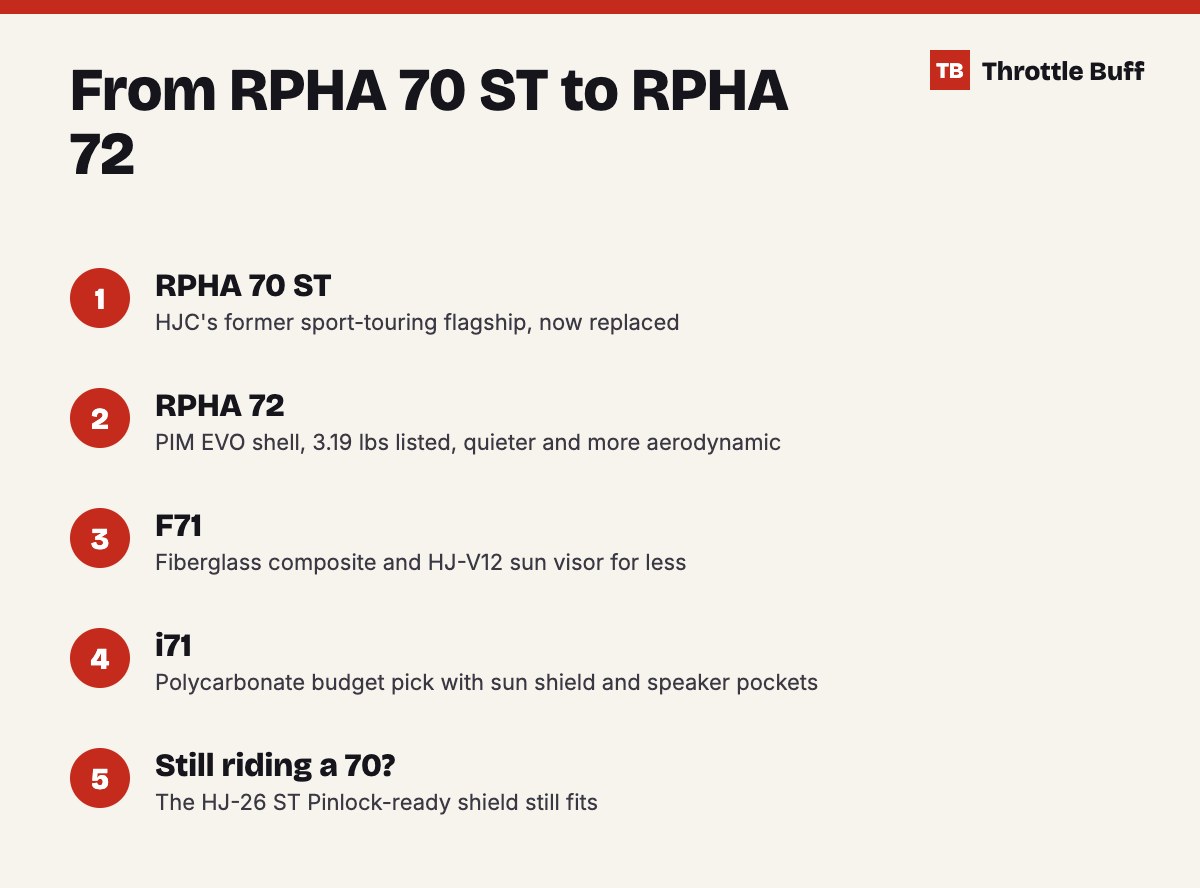
Short answer: the HJC RPHA 70 ST is no longer HJC’s current sport-touring helmet. It was followed by the RPHA 71 and now the RPHA 72, which RevZilla lists at 3.19 lbs with a redesigned shell that HJC says cuts drag and noise compared with the RPHA 70 and 71. If the RPHA 72 is more than you want to spend, the HJC F71 and i71 give you an internal sun visor and Pinlock-ready shield for much less. RPHA 70 owners can still buy the HJ-26 ST replacement shield.
What was the HJC RPHA 70 ST?
The RPHA 70 ST was HJC’s premium sport-touring full-face helmet, sitting below the race-focused RPHA 11 in the RPHA line. It combined a lightweight premium composite shell with an internal drop-down sun visor, a Pinlock-ready shield and HJC’s channeled ventilation, aimed at riders who spend long days on sport-tourers and naked bikes. It built a reputation as a lighter, cheaper alternative to the big Japanese premium brands.
HJC has since moved the line on twice: the RPHA 71, then the RPHA 72. If you’re shopping new, the RPHA 72 is the helmet to look at.
Still riding an RPHA 70? Replacement shield

The HJ-26 ST shield is the replacement for the RPHA 70 ST series. It’s Pinlock ready (insert sold separately) and also fits the RPHA 11 Pro for riders who don’t need tear-off posts. A fresh shield and Pinlock insert help a lot with fogging; see our guide on how to stop helmet visor fogging. Remember that helmets should be replaced after any impact, and most makers suggest replacement after several years of use as liners degrade.
RPHA 70 ST replacements compared
| Helmet | Shell | Listed weight | Shield / sun visor | Head shape | Price tier |
|---|---|---|---|---|---|
| HJC RPHA 72 | PIM EVO premium composite; 3 shells, 4 EPS sizes | 3.19 lbs | HJ-48 Pinlock ready; HJ-V12 multi-step sun visor | Intermediate oval | $$$ |
| HJC F71 | Advanced fiberglass composite | Check listing | HJ-38 Pinlock prepared; HJ-V12 multi-step sun visor | Intermediate oval | $$ |
| HJC i71 | Advanced polycarbonate composite; 3 shells | 3.75 lbs (size L) | HJ-38 Pinlock ready; dark smoke sun shield | Intermediate oval | $ |
Specs are from RevZilla’s listings. Prices change, so check before you buy.

The best RPHA 70 ST replacements
1. HJC RPHA 72: the direct successor

The RPHA 72 is HJC’s current sport-touring helmet with a strong sport bias. Its Premium Integrated Matrix EVO composite shell is redesigned to reduce drag and noise, with aerodynamic refinements over the RPHA 70 and 71 whether the vents are open or closed. HJC borrowed some of the wind-tunnel work from the RPHA 12 development. It comes in three shells with four EPS sizes, and RevZilla lists it at 3.19 lbs.
You get a Pinlock-ready HJ-48 visor, the HJ-V12 multi-step internal sun visor, HJC’s channeled ventilation and a moisture-wicking liner with a semi-neck roll designed for better noise control. There’s an emergency cheek pad release system, and it’s ready for HJC’s Smart HJC communicators. RevZilla notes a true-to-size intermediate oval fit with some extra room at the cheeks, so sport riders may want thicker cheek pads.
Who it’s for: RPHA 70 owners who want the like-for-like premium upgrade.
2. HJC F71: the mid-price option

The F71 brings the same HJ-V12 multi-step sun visor to a lower price, with an advanced fiberglass composite shell that HJC wind-tunnel tested for low drag. It uses an HJ-38 Pinlock-prepared shield, a double D-ring strap and interchangeable, washable cheek pads, and it’s Smart HJC ready and DOT approved.
Who it’s for: riders who want most of the RPHA’s day-to-day features without the premium shell.
3. HJC i71: the budget pick

The i71 is a simpler, cheaper helmet with an advanced polycarbonate composite shell in three shell sizes. It has an installed dark smoke sun shield, a Pinlock-ready HJ-38 shield with a push-release lock, two intakes and two exhausts, speaker pockets under the cheek pads and grooves for eyeglasses. The liner is removable, washable and anti-bacterial. RevZilla lists a size large at 3 lbs 12 oz, so it’s heavier than the RPHA.
Who it’s for: commuters and newer riders on a budget.
Other helmets to consider
If you liked the RPHA 70 but want to compare brands, see our Shoei RF-1400 review and AGV K3 review. For something sportier from HJC, read our HJC RPHA 11 Pro review, and for a budget HJC, our HJC CL-17 review. The SEDICI Strada 3 is another value option with a sun visor.
How to choose
- Fit first: all three are intermediate oval. Try before you buy if you can, and check HJC’s sizing on the HJC website.
- Weight and noise: the RPHA 72’s premium shell is the lightest here and designed to be quieter on long rides.
- Comms: all have provision for a communicator; see the best motorcycle Bluetooth headsets.
- Certification: check the label and listing. The NHTSA explains DOT compliance.
FAQ
Is the HJC RPHA 70 ST discontinued?
It’s been succeeded by the RPHA 71 and now the RPHA 72. Retailers mainly list the RPHA 72 and spare parts for the 70.
Does the RPHA 72 shield fit the RPHA 70?
No. The RPHA 72 uses the HJ-48 visor, while the RPHA 70 ST uses the HJ-26 ST.
Is the RPHA 72 good for touring?
Yes. It’s a sport-touring helmet with a sun visor, a noise-reducing neck roll and a Pinlock-ready shield.
Verdict
The HJC RPHA 70 ST was a standout sport-touring helmet, but it’s been replaced. Buy the RPHA 72 for the closest, most refined upgrade, the F71 to save money while keeping a good sun visor, or the i71 if budget comes first. RPHA 70 owners can keep their helmet fresh with the HJ-26 ST shield, as long as it’s undamaged and within its service life.
Browse all our helmet guides.