Throttle Buff is reader-supported: we may earn a commission when you buy through links on this page. Learn more.
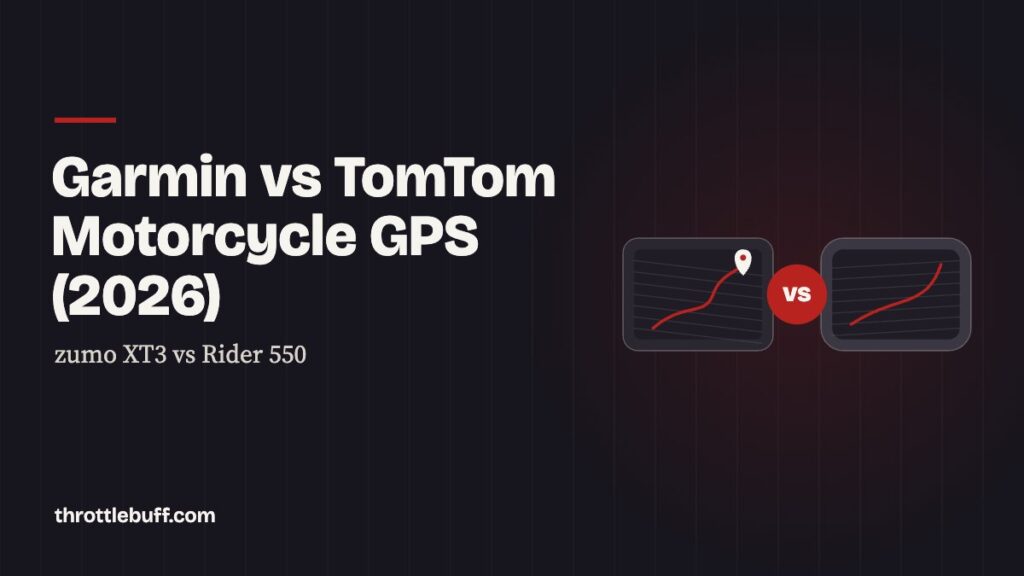
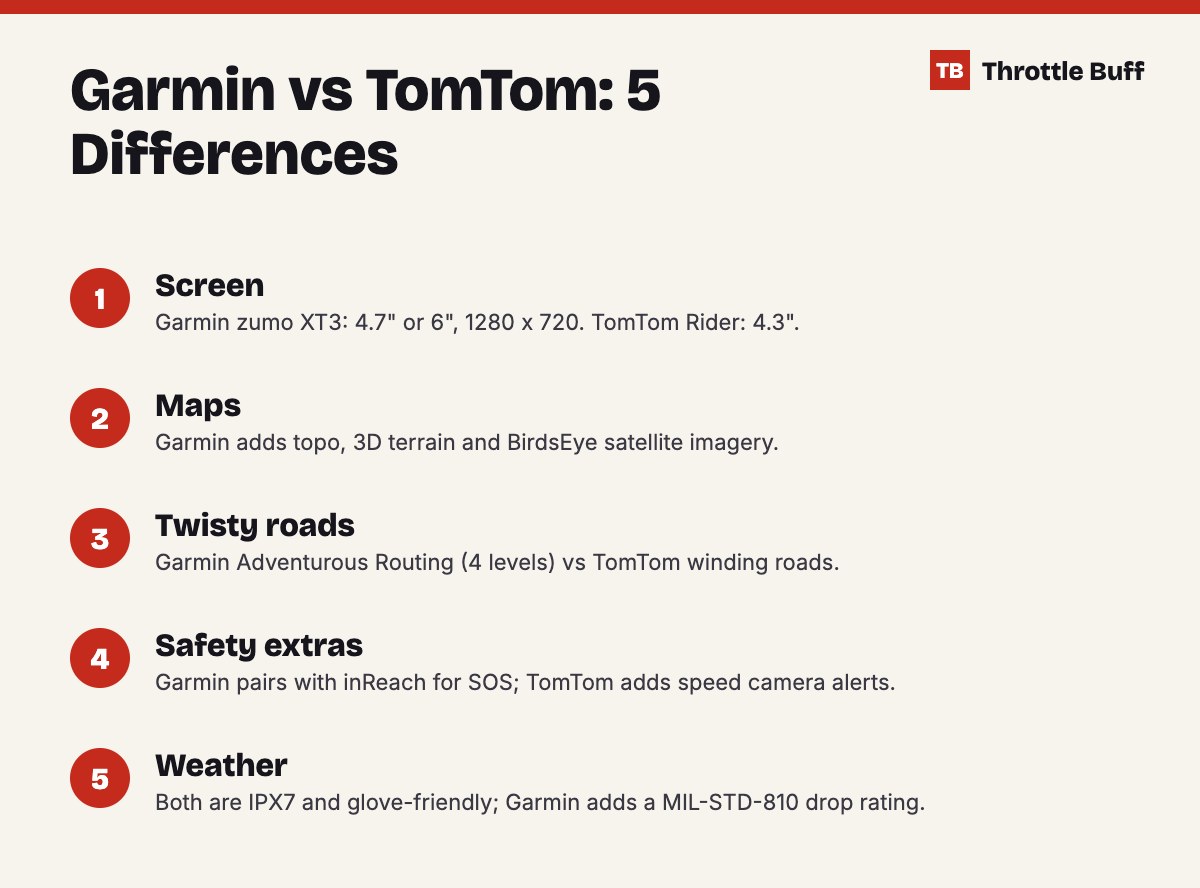
For most riders in 2026, Garmin is the better motorcycle GPS: the zumo XT3 has a bigger, sharper screen, topo and satellite maps, adventurous routing, inReach messaging and group-ride tracking. TomTom’s Rider 550 is the simpler choice for road touring, with winding-road routing, Wi-Fi map updates and speed camera alerts at a similar price. If you ride off pavement or want the most features, pick Garmin; if you want easy road navigation, TomTom still does the job.
Quick verdict
- Best overall: Garmin zumo XT3. More screen, more maps, more features.
- Best for simple road touring: TomTom Rider 550. Straightforward, with excellent twisty-road routing.
- Best budget TomTom: Rider 500. Same hardware with Europe maps instead of world maps.
Garmin vs TomTom at a glance
| Feature | Garmin zumo XT3 | TomTom Rider 550 |
|---|---|---|
| Screen | 4.7″ or 6″, 1280 x 720 | 4.3″, portrait or landscape |
| Waterproofing | IPX7, MIL-STD-810 drop rating | IPX7 |
| Glove-friendly | Yes | Yes (capacitive) |
| Battery | Up to 7 h (5 h at full brightness) | Not stated by TomTom |
| Maps | Street, 3D terrain, topo, BirdsEye satellite | TomTom world maps (Europe on Rider 500) |
| Twisty-road routing | Adventurous Routing, 4 levels | Winding and hilly roads |
| Updates | Wi-Fi and Tread app | Built-in Wi-Fi, no computer needed |
| Extras | inReach pairing, group tracking up to 20 riders, lean-angle data | Speed cameras, round-trip planning, black-spot warnings |
| Storage | 64 GB + microSD up to 256 GB | Not compared here |
| Price tier | $$$ (US list $499.99 for 4.7″) | $$$ (UK list £399.99) |
Garmin figures are from the XT3 listing at RevZilla and Garmin’s product page; TomTom figures are from TomTom’s Rider page.
The contenders
1. Garmin zumo XT3: best overall

The XT3 replaces the XT2 with a new processor, a lighter body and two screen sizes. Both use a bright 1280 x 720 glass touchscreen that works with gloves. It carries an IPX7 rating and a MIL-STD-810 drop rating, and Garmin moved the ports and SD slot to shield them from wind, rain and dust.
Maps are where it pulls ahead. You get preloaded street maps, 3D terrain and topo maps, plus downloadable BirdsEye satellite imagery, and you can switch between them on the fly. Adventurous Routing finds hills and curves at four difficulty levels, and Popular Paths shows routes other riders actually use.
Pros: big, sharp screens; topo and satellite maps; inReach messaging and SOS; group tracking; 64 GB storage. Cons: more menus to learn; 6″ version is bulky on small bikes.
2. TomTom Rider 550: best for simple road touring
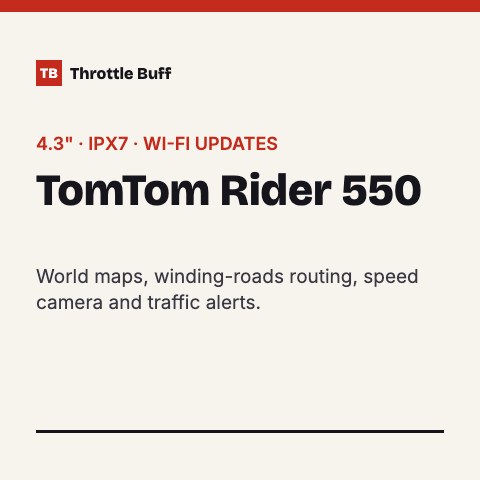
The Rider 550 is TomTom’s flagship motorcycle navigator. It has a 4.3″ sunlight-readable screen that rotates between portrait and landscape, an IPX7 weatherproof body and a capacitive touchscreen that works with gloves. TomTom’s winding-and-hilly roads option and round-trip planning make it easy to build a fun loop without a laptop, and maps, speed cameras and traffic update over Wi-Fi.
Pros: very easy to use; great twisty-road routing; world maps; speed camera alerts. Cons: smaller screen; no topo or satellite maps; fewer off-road features.
TomTom lists the Rider 550 through partner retailers. It isn’t stocked at RevZilla, so check Amazon or TomTom.
3. TomTom Rider 500 and Rider 550 Premium Pack
The Rider 500 is the same core device with Europe maps and services instead of world coverage, at a slightly lower price. The Rider 550 Premium Pack adds a car mount, an anti-theft solution and a protective carry case.
Key differences
Screen and readability
Garmin wins clearly. The XT3’s 4.7″ and 6″ screens are larger and higher resolution than TomTom’s 4.3″ display. On a big touring or adventure bike the 6″ XT3 is easier to read at a glance; on a small naked bike the 4.7″ version or the TomTom is a tidier fit.
Route planning
Both brands are good at finding fun roads. TomTom’s winding-roads routing is simple and quick on the device. Garmin’s Adventurous Routing offers four levels and pairs with the Tread app, so you can plan on your phone and send routes to the bike.
Maps and off-road
If you ride gravel or trails, Garmin is the only real choice here. Topo maps, 3D terrain, BirdsEye satellite imagery and navigate-a-track mode are built for adventure riding. TomTom focuses on road maps.
Connectivity and safety
Both pair with Bluetooth helmet headsets so you hear directions through your intercom. Garmin adds inReach pairing for two-way satellite messaging and SOS, group tracking for up to 20 riders through the Tread app, and ride summaries with lean angle. TomTom adds speed camera warnings plus accident black-spot and traffic-jam warnings.
Size and weight
According to RevZilla’s listing, the 4.7″ XT3 weighs 7 oz and measures 5.04 x 2.95 x 0.95 inches, while the 6″ version weighs 12 oz. Both are rated for up to 7 hours of battery life, or about 5 hours at full brightness, so wiring the unit to your bike is the best plan for full-day rides. TomTom doesn’t list battery life on its Rider comparison page.
Updates
Both update over Wi-Fi without a computer. TomTom includes map, traffic and speed camera updates; Garmin updates maps and software through Wi-Fi and the Tread app.
Garmin or TomTom: which should you buy?
- Adventure riders: Garmin zumo XT3, for topo maps, satellite imagery and inReach.
- Road tourers who want simplicity: TomTom Rider 550.
- Group riders: Garmin, for Tread group tracking.
- Small bikes and tight cockpits: TomTom Rider or the 4.7″ XT3.
Still deciding whether you need a dedicated unit at all? A phone mount or a CarPlay screen may be enough. See all options in our best motorcycle GPS guide and our older zumo 590LM vs 595LM comparison.
What to look for in any motorcycle GPS
- Waterproof rating: look for IPX7 at minimum. Car sat navs aren’t built for rain and vibration.
- Glove-friendly screen: you should be able to tap the main controls without taking your gloves off.
- Sunlight readability: a bright screen matters more than size when the sun is behind you.
- Routing options: twisty-road or adventurous routing turns a boring highway trip into a ride.
- Battery and power: wire it to the bike for long days; the battery is a backup for stops and walking.
- Map coverage and updates: check which regions are included and how updates are delivered before you tour abroad.
- Bluetooth: pairing with your headset lets you hear turns instead of looking down.
- Mount quality: a solid, lockable mount keeps the unit steady and harder to steal.
Think about where you ride most. Commuters and weekend road riders rarely need topo maps or satellite messaging, while adventure riders heading beyond cell coverage will use them constantly.
Mounting and power tips
Use a sturdy handlebar or RAM-style mount and wire the unit to switched power so it charges while you ride. The XT3 mounts on handlebars up to 1″ and ships with a motorcycle mount and power cable. Route cables away from the steering stops, and add a motorcycle alarm or take the unit with you when you park.

FAQ
Is Garmin or TomTom better for motorcycles?
Garmin offers more features, bigger screens and better off-road maps. TomTom is simpler and excellent for road touring.
Is TomTom still making motorcycle GPS units?
Yes. TomTom still lists the Rider 500, Rider 550 and Rider 550 Premium Pack on its site in 2026.
What replaced the Garmin zumo XT2?
The zumo XT3, with a new processor, 4.7″ or 6″ screens and less weight.
Are motorcycle GPS units waterproof?
Both the zumo XT3 and TomTom Rider are rated IPX7.
Can I hear directions through my helmet?
Yes. Both pair with Bluetooth headsets and intercoms.
Verdict
Garmin wins this matchup in 2026. The zumo XT3’s screen, maps and safety features make it the better all-round motorcycle GPS, especially for adventure and group riders. TomTom’s Rider 550 is still a smart pick if you want simple, reliable road navigation with great twisty-road routing. Set your route before you ride; NHTSA warns that distraction is a major crash risk.
Browse all our accessory guides.