Throttle Buff is reader-supported: we may earn a commission when you buy through links on this page. Learn more.
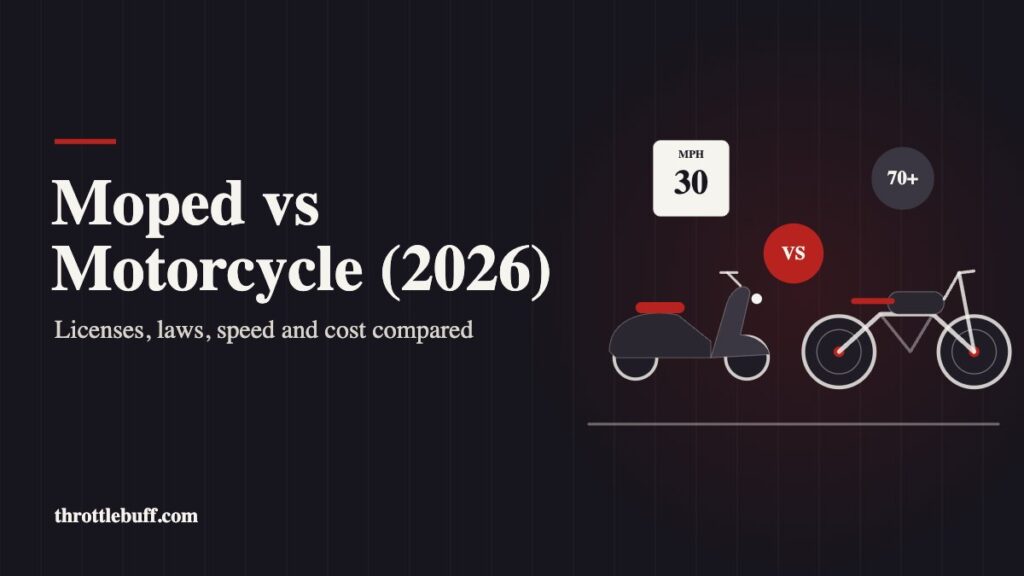
The main difference between a moped and a motorcycle is power and speed. In most US states, a moped is a small two-wheeler with an engine of about 50cc or less (or roughly 2 horsepower) that can’t go faster than about 30 mph, while a motorcycle has no such limits and is legal on highways. That one difference drives almost everything else: licensing, registration, insurance, helmet rules, and cost.
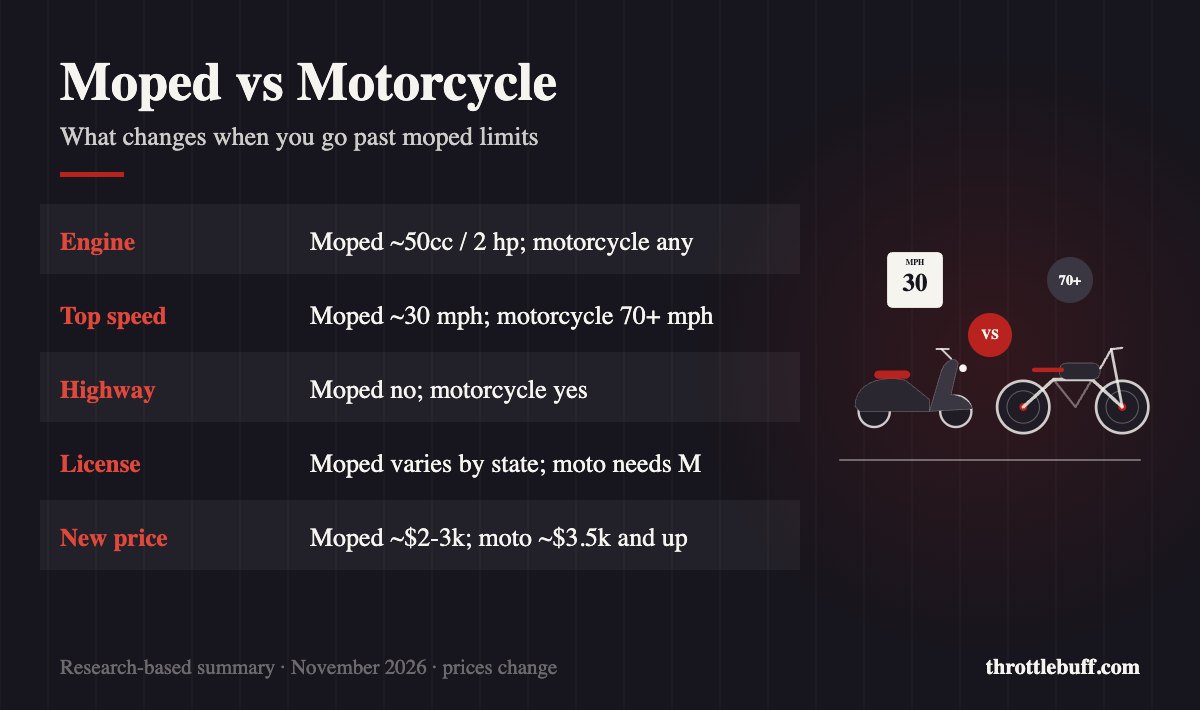
This guide is research-based. We pulled definitions and rules straight from state DMV sites (California, Florida and New York), federal safety data from NHTSA, and current manufacturer pricing. Laws change and vary a lot from state to state, so always confirm with your own DMV before you buy.
Moped vs motorcycle at a glance
| Moped | Scooter (over 50cc) | Motorcycle | |
|---|---|---|---|
| Typical engine | 49 to 50cc, about 2 hp or less | 50cc to 300cc+ (some much larger) | 125cc to 1,800cc+ |
| Top speed | About 30 mph (legal cap in many states) | 45 to 85+ mph depending on engine | 70 mph to well over 100 mph |
| Highway legal? | No | Usually yes at 150cc+ (check state minimums) | Yes |
| License | Regular car license or moped permit in many states; some require M | Motorcycle (M) endorsement in most states | Motorcycle (M) endorsement |
| Registration | Usually yes, often simpler/cheaper | Yes | Yes, plus title |
| Insurance | Varies; not required in some states | Usually required | Required in nearly every state |
| New price | About $2,000 to $3,000 | About $3,000 to $8,000+ | About $3,500 to $30,000+ |
| Best for | Short, slow, local trips | City and suburban commuting | Commuting, highways, touring, fun |
What is a moped?
The word “moped” comes from “motor” plus “pedals.” Early mopeds were bicycles with small engines, and some still have pedals. Today most look like small scooters, with a step-through frame and an automatic transmission.
There’s no single US moped law. Federal rules treat small two-wheelers as a type of motorcycle: NHTSA’s vehicle safety standards define a “motor-driven cycle” as a motorcycle with 5 brake horsepower or less. In a 1981 interpretation letter, NHTSA described its planned moped definition as a motor-driven cycle that can reach no more than 30 mph within one mile, with 2 brake horsepower or less, and, for gas engines, no more than 50cc and no gear shifting. Most states use some version of that 50cc / 2 hp / 30 mph benchmark, but each state writes its own definition.
How three states define a moped
- Florida: The FLHSMV defines a moped as a vehicle with a motor rated at no more than 2 brake horsepower that can’t exceed 30 mph on level ground. Mopeds must be registered but don’t need a title. Scooters over 50cc count as motorcycles and need a motorcycle endorsement.
- California: The California DMV calls a moped a “motorized bicycle”: under 4 gross brake horsepower, automatic transmission, and a 30 mph cap under Vehicle Code 406. You need a motorcycle license (M1 or M2), a helmet, and special moped plates with a one-time registration fee. Insurance isn’t required to register one.
- New York: The NY DMV calls mopeds “limited use motorcycles” and sorts them by top speed. Class A (over 30 up to 40 mph) needs an M license, insurance, a helmet and inspection. Class B (over 20 up to 30 mph) needs any driver license, insurance and a helmet. Class C (20 mph or less) needs any license, and insurance and a helmet are recommended. All classes must be registered.
Notice how much these differ. California requires a motorcycle license for a moped. Florida and New York (for slower classes) let you ride on a regular driver license. That’s why “do I need a license for a moped?” has no single answer.
What counts as a motorcycle?
A motorcycle is any two- or three-wheeled motor vehicle that goes beyond your state’s moped limits. Small 125cc bikes, 300cc beginner cruisers, and 1,800cc touring rigs are all motorcycles in the eyes of the DMV. California even splits them into motor-driven cycles (149cc and under) and motorcycles (150cc and up), and 150cc is a common minimum for freeway riding in many states. If you want to see the range of styles, our guide to types of motorcycles breaks them down.
Moped vs scooter vs motorcycle
People mix up “moped” and “scooter” all the time, and the law often doesn’t help. Here’s the simple version:
- Moped is a legal category, based on engine size and top speed. Many mopeds look like scooters.
- Scooter is a body style: step-through frame, floorboard, small wheels, usually an automatic. A 49cc scooter is often legally a moped. A 150cc or 300cc scooter is legally a motorcycle.
- Motorcycle is the broad category for everything above moped limits, whatever it looks like.
For example, the 2026 Honda Metropolitan is a 49cc scooter that falls under moped rules in many states. Honda’s ADV160 looks like a scooter too, but at 157cc it’s registered and licensed as a motorcycle. If you like the scooter look, see our list of scooters similar to Vespa.
Licensing: M endorsement vs moped permit
For a motorcycle, every state requires a motorcycle license or an M endorsement on your driver license. That usually means a written test, a learner permit, and a riding skills test. Many states waive the skills test if you pass a state-approved rider training course.
For a moped, rules fall into three groups:
- Regular driver license is enough. Florida and New York (Class B and C) work this way.
- Moped-specific license or permit. Some states offer a restricted moped license, sometimes open to teens younger than the car-license age.
- Motorcycle license required. California requires an M1 or M2 even for a moped.
Even if your state lets you ride a moped on a car license, a basic rider course is worth it. You’ll learn braking, swerving and how to be seen in traffic.
Registration and insurance
Most states require mopeds to be registered, but the process is often lighter: no title in Florida or New York, and a one-time fee with special plates in California. Motorcycles get a full title and yearly registration like a car.
Insurance is where mopeds can save money. California doesn’t require insurance to register a moped, and New York only recommends it for its slowest class. Motorcycles need liability insurance in nearly every state. Even where it isn’t required, liability coverage on a moped is cheap and protects you if you hit someone. Check whether your auto policy covers a moped; many don’t.
Helmet requirements
Helmet laws for motorcycles range from universal (every rider) to age-based (only younger riders). Moped helmet rules can be different from motorcycle rules in the same state. California and New York (Class A and B) require helmets on mopeds, for example, while New York only recommends one on Class C. Our motorcycle helmet laws by state guide has the details.
Whatever the law says, wear one. A crash at 30 mph is plenty to cause a serious head injury. Look for a DOT label on the back of the shell, and ideally ECE 22.06 too. A full-face helmet protects your chin and face; an open-face (3/4) helmet is a popular, cooler option for low-speed moped riding. Our best beginner motorcycle helmet guide covers specific picks.
Top speed and highway legality
This is the biggest practical difference. A 49cc moped tops out around 30 mph in most states, often a bit less with a heavier rider or a hill. That’s fine on 25 to 35 mph city streets. On a 45 mph road it can feel risky, since cars will be passing you fast. Mopeds are not allowed on interstates or freeways, and some states, like New York for Class B and C, keep them in the right lane or on the shoulder.
Motorcycles can keep up with any traffic. Even a 300cc beginner bike like the Honda Rebel 300 cruises comfortably at highway speeds. If your commute includes any highway, a moped is off the table.
Costs: purchase, insurance and fuel
Purchase price
New 49cc mopeds and scooters from major brands run about $2,000 to $3,000. The 2026 Honda Metropolitan lists at about $2,649. Entry-level motorcycles start higher: the 2026 Honda Grom is about $3,599, and the Rebel 300 runs about $4,849 to $5,349 depending on version. Prices change, and dealers add freight and setup fees. A good used motorcycle can close the gap.
Insurance
Moped insurance is usually cheaper than motorcycle insurance, often much cheaper, because the bikes are slow, cheap to repair and less likely to be in high-speed crashes. Motorcycle premiums climb with engine size, your age and your record. Get quotes before you buy.
Fuel and upkeep
Both are cheap to fuel compared with a car. A 50cc moped often gets 80 to 100+ mpg in owner reports, and small motorcycles commonly land in the 60 to 100 mpg range. Maintenance on a moped is simple, though 2-stroke models need oil mixed in. Bigger motorcycles cost more for tires, chains and service.
Gear
Don’t forget gear. A helmet, gloves, jacket and boots can add a few hundred dollars or more for either vehicle. Budget for it up front.
Safety
Any two-wheeler is riskier than a car. According to NHTSA, 6,228 motorcyclists were killed in 2024, and per mile traveled, motorcyclists were almost 27 times more likely than passenger car occupants to die in a crash. NHTSA also notes that 37% of motorcycle riders in fatal crashes in 2024 were speeding.
Mopeds are slower, which helps, but they bring their own risks: they’re small and hard for drivers to see, and they can’t accelerate out of trouble. Riding at 30 mph on a road where traffic moves at 45 creates a big speed gap. Bright gear, a headlight that’s always on, and staying out of blind spots matter on both. For more numbers, see our motorcycle accident statistics page.
Which should you buy? How to choose
Start with where you’ll ride, not what looks cool.
Choose a moped if:
- Your trips are short (a few miles) on roads with speed limits of 35 mph or less.
- You want the lowest purchase, insurance and running costs.
- Your state lets you ride one without a motorcycle endorsement, and you don’t want to get one yet.
- You live in a college town, beach town or dense city with easy parking.
Choose a motorcycle (or a 150cc+ scooter) if:
- Any part of your ride involves roads over 40 mph or highways.
- You want to carry a passenger, ride longer distances or keep up with traffic.
- You’re willing to take a rider course and get your M endorsement.
- You want room to grow as a rider.
A common middle path is a 125cc to 300cc scooter or small motorcycle. It costs a bit more than a moped but can handle faster roads, and in most states it needs the same M endorsement as any motorcycle. Many new riders who buy a 49cc moped outgrow it within a season because of the speed limit, so be honest about your routes.
Whichever you pick, a good lock is worth it, since mopeds and small bikes are light and easy to steal.
FAQ
Is a 50cc scooter a moped?
In many states, yes. If it’s 50cc or less and can’t go faster than your state’s cap (often 30 mph), it’s usually legally a moped. Some states use horsepower or top speed instead of cc, so check your DMV’s definition.
Do you need a motorcycle license for a moped?
It depends on the state. Florida and New York (Class B and C) allow a regular driver license. California requires an M1 or M2 motorcycle license even for a moped.
Can you ride a moped on the highway?
No. Mopeds aren’t allowed on interstates or freeways, and many states restrict them to the right lane or shoulder on other roads.
Is a moped safer than a motorcycle?
Lower speeds can mean less severe crashes, but mopeds are still unprotected and hard for drivers to see. The speed gap with faster traffic adds risk. Wear a DOT helmet and protective gear on either.
Do mopeds need insurance?
Some states require it and some don’t. California doesn’t require insurance to register a moped, and New York requires it for Class A and B but only recommends it for Class C. Liability coverage is cheap and a smart buy even when optional.
What’s faster, a moped or a scooter?
A scooter over 50cc is usually faster. A 150cc scooter can reach around 60 mph, while a moped is typically capped around 30 mph.