Throttle Buff is reader-supported: we may earn a commission when you buy through links on this page. Read our affiliate disclosure.
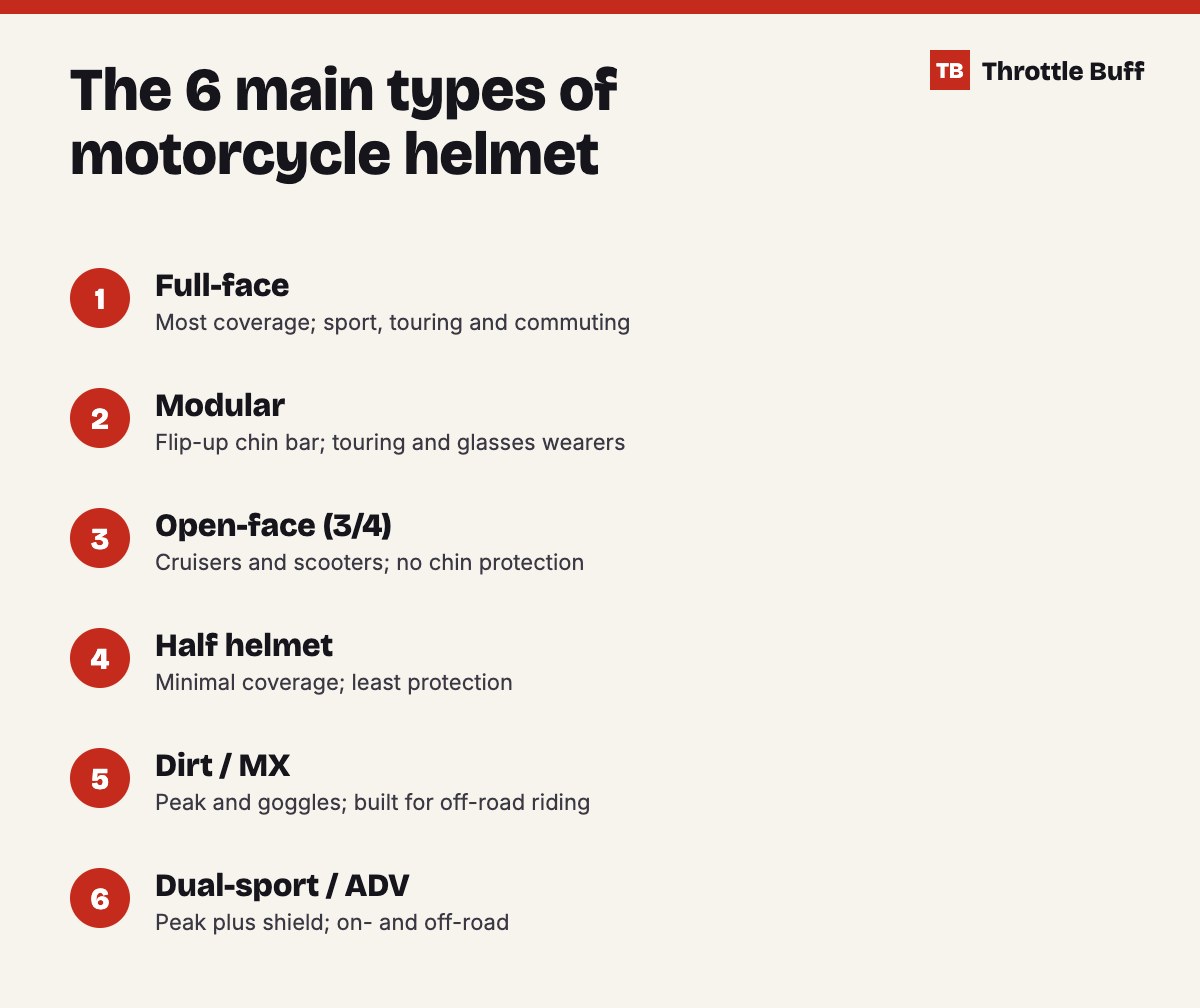
There are six different types of motorcycle helmet: full-face, modular (flip-up), open-face (3/4), half, dirt (motocross) and dual-sport (adventure). Full-face helmets give the most coverage, including the chin and face, which is why they’re the usual recommendation for street riding. Modulars add a flip-up chin bar for convenience, open-face and half helmets trade protection for airflow and style, and dirt and dual-sport helmets are built around off-road riding. Here’s how each type works, who it suits and examples of each.
Helmet laws vary a lot by state, and so do the results: see our 2024 data on motorcycle deaths and helmet laws by state.
Why helmet choice matters: see the latest motorcycle accident statistics from NHTSA.
Motorcycle helmet types compared
| Type | Chin and face coverage | Best for | Main trade-off |
|---|---|---|---|
| Full-face | Full | Sport, touring, commuting | Warmer and more enclosed |
| Modular | Full when closed | Touring, glasses wearers | Heavier; hinge adds complexity |
| Open-face (3/4) | None at the chin | Cruisers, scooters, city | No chin or full face protection |
| Half | None | Short, slow cruiser rides | Least coverage of any road helmet |
| Dirt / MX | Chin bar, open eye port | Motocross, trail, enduro | Needs goggles; noisy at road speed |
| Dual-sport / ADV | Full, with peak | Adventure riding on and off road | Peak can catch wind at speed |
1. Full-face helmets

A full-face helmet covers your whole head, with a fixed chin bar and a face shield. It offers the most protection of any road helmet, plus the best shelter from wind, rain, bugs and noise. Within full-face helmets there are sport, touring and race designs. Budget examples include the Bell Qualifier and Scorpion EXO-R430; premium examples include the Shoei RF-1400 and AGV K3.
Choose it if: you want the most protection for street riding.
2. Modular (flip-up) helmets

A modular helmet has a chin bar that flips up, so you can talk, drink or pay at a gas station without taking the helmet off, and it’s easier to put on with glasses. Closed, it covers like a full-face. Modulars are heavier because of the hinge mechanism, and you should check the certification label for how the helmet is rated with the chin bar. Examples include the HJC i91 and the Sena Outrush 2 with built-in intercom; see our passenger helmet picks.
Choose it if: you tour, wear glasses or stop often.
3. Open-face (3/4) helmets
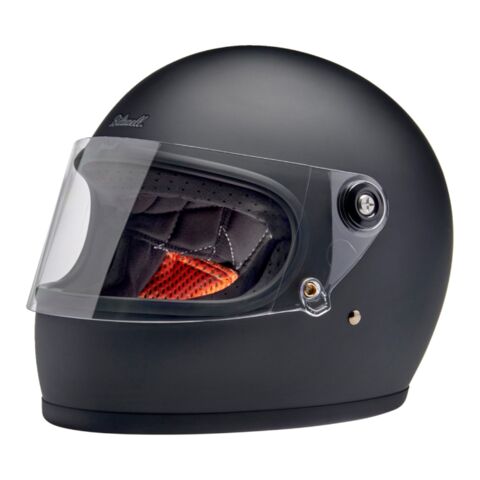
Open-face helmets cover the top, back and sides of the head and the ears, but leave the face open. Many have a shield or accept snap-on visors. They’re popular with cruiser and scooter riders for comfort and visibility, but they offer no chin protection. Retro full-face helmets like the Biltwell Gringo S shown here give a similar classic style with a chin bar; see our Bell Bullitt vs Biltwell Gringo comparison.
Choose it if: you ride slowly in town and value airflow, knowing you give up face protection.
4. Half helmets
Half helmets cover only the top of the head. They’re light and cool, but offer the least protection of any helmet type. Many cheap “half helmets” sold online are novelty helmets that don’t meet DOT standards. If you choose one, make sure it’s genuinely DOT compliant.
Choose it if: you accept the much lower coverage, and only buy a certified one.
5. Dirt (motocross) helmets

Dirt helmets have a long chin bar, a large eye port for goggles and a peak to block sun and roost. They’re light and well ventilated for hard physical riding. Many are DOT certified for road use, but they’re noisy at highway speed and need goggles. For young riders, see the best kids motorcycle helmets.
Choose it if: you ride motocross, trails or enduro.
6. Dual-sport (adventure) helmets
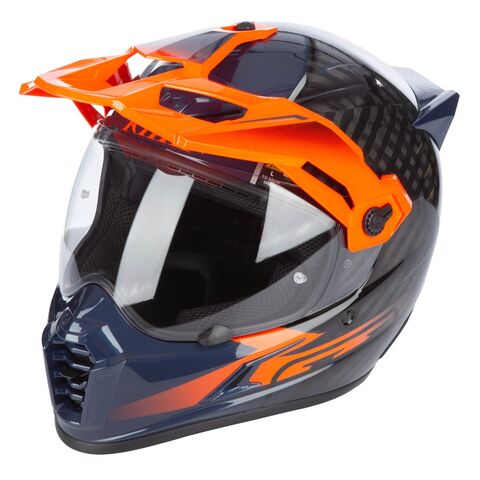
Dual-sport helmets combine a dirt-style peak and chin bar with a street-style face shield, and many accept goggles with the shield removed. They suit adventure bikes that cover pavement and dirt in the same day. The Klim Krios Pro is a premium example; see the best dual-sport helmets.
Choose it if: you ride adventure bikes on and off road.
Specialist helmets
- Snowmobile helmets add heated shields and breath boxes; see the best snowmobile helmets.
- Bluetooth helmets have communication built in; see the best Bluetooth helmets.
- Carbon fiber helmets use carbon shells to save weight; see the best carbon fiber helmets.
Helmet safety standards
In the US, every road helmet must meet DOT (FMVSS 218); the NHTSA explains how to spot a compliant helmet and avoid novelty helmets. ECE 22.06 is the current European standard, with each model lab-tested before certification, and Snell is a voluntary standard with additional testing.
How to choose the right type
- Where you ride: street riders get the most protection from full-face or modular helmets; off-road riders need dirt or dual-sport helmets.
- Fit: whatever the type, it must fit your head shape snugly.
- Comfort: weight, ventilation and noise matter more on long rides.
- Brand: see our best helmet brands guide and the best motorcycle helmets.

FAQ
How many different types of motorcycle helmets are there?
Six main types: full-face, modular (flip-up), open-face (3/4), half, dirt (motocross) and dual-sport (adventure). Specialist designs such as snowmobile, Bluetooth and carbon fiber helmets are variations on these shapes rather than separate types.
Which type of motorcycle helmet is safest?
Full-face helmets cover the most of your head and face, so they’re generally considered the most protective type for street riding.
Are modular helmets as safe as full-face?
Closed, they offer similar coverage. Check each model’s certification, including how it’s rated with the chin bar.
Can I use a motocross helmet on the street?
If it’s DOT certified, yes in the US, but you’ll need goggles and it may be noisy.
Are half helmets legal?
DOT-compliant half helmets are legal where helmets are required, but novelty helmets without genuine certification aren’t compliant.
Summary
Full-face helmets offer the most protection for street riding, modulars add convenience, open-face and half helmets trade protection for airflow, and dirt and dual-sport helmets are built for off-road riding. Choose the type that matches how you ride, then focus on fit and certification.
Browse all our helmet guides.