
Throttle Buff is reader-supported: we may earn a commission when you buy through links on this page. Read our affiliate disclosure.
Heated motorcycle gloves work by passing an electric current through very fine wires or carbon elements built into the glove. The elements resist the current and give off heat, the same way an electric blanket does. The power comes either from the motorcycle’s 12V battery through a cable, or from a small rechargeable 7V battery carried with each glove.
That choice of power source is the real decision. It sets how long the heat lasts, how you control it and how much wiring you live with. The table compares the two using the figures the heated gear maker Gerbing publishes for its own ranges.
12V wired vs 7V battery heated gloves
| Feature | 12V wired gloves | 7V battery gloves |
|---|---|---|
| Power source | Wired to the motorcycle | Rechargeable battery, 7.4V |
| Run time | Unlimited while the engine is on | Up to about 8 hours |
| Top temperature | Up to 135°F | Up to 140°F |
| Heat control | A heat controller on the cable or bike | A button on the glove: high, medium, low |
| Recharging | None | 3 to 5 hours for a first full charge, depending on the battery |
| Washing | Hand wash only | Hand wash only |
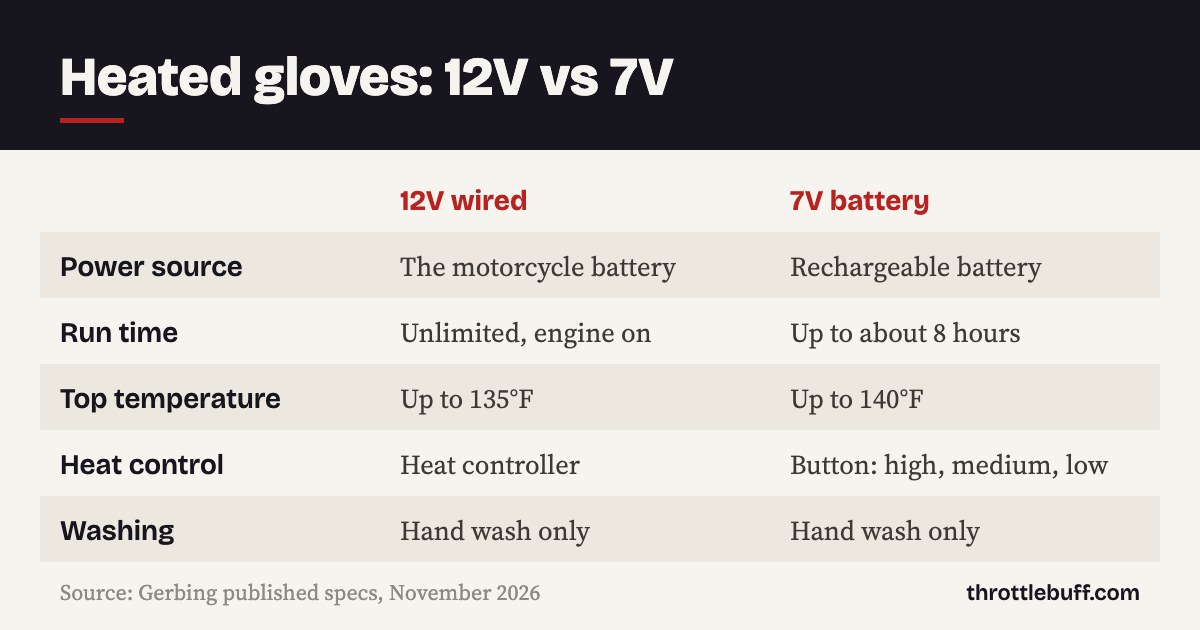
Sources: Gerbing’s technology page, FAQ and battery and garment care guide, read in November 2026. Other brands publish different numbers, so treat these as one maker’s figures and check the product page for the gloves you are looking at.
How do heated motorcycle gloves work inside?
There are two common kinds of heating element. Warm & Safe, another heated gear maker, describes them in its Heated Gear 101 guide: a very fine nickel and chromium wire, and a carbon element, which it uses in its glove liners and socks. Gerbing calls its version Microwire and describes it as thousands of ultra-fine conductive filaments woven into the garment, each about a tenth of the thickness of a human hair.
Both do the same job. Current flows through the element, the element resists it, and that resistance turns electrical energy into heat right next to your skin. Because the filaments are so thin, the glove can still flex around the controls. The insulation and windproof outer then hold that heat in, which is why a heated glove is still built like a winter glove and not like a summer one.
How 12V wired gloves get their power
A wired glove plugs into a harness that connects to the motorcycle’s battery. The cable usually runs up inside your jacket sleeves, so the gloves connect at each cuff. As long as the engine is running and the charging system keeps up, the heat does not run out.
Two details are worth knowing before you buy.
- Voltage at the glove is lower than voltage at the battery. Warm & Safe points out that a revved bike produces about 13.8 volts, but after resistance in the wires and connections you could be at 12.8 volts at the garment. Heat output follows voltage, so clean, tight connections matter.
- Leave the wiring as supplied. Gerbing states that cutting or splicing the cable or plugs voids the warranty. Use the maker’s harness and connectors.
Wired gloves share the bike’s electrical output with everything else you run. If you also use a heated liner, see our heated jacket liners guide, and if the battery itself is tired, start with the best motorcycle batteries.
How battery heated gloves get their power
Battery gloves carry their own supply. Gerbing’s 7V batteries are lithium packs rated at 7.4V and 2A output, in sizes from 2,200 to 3,400 mAh, and it rates them for more than 500 charge cycles. You press a button on the glove to switch on and step through high, medium and low.
Run time depends almost entirely on the setting. Gerbing’s “up to about 8 hours” is a maximum, so expect it only on the lower settings. It suggests low or medium at around 50 to 64°F and medium or high when it is colder, and it tells owners not to use the high setting for more than 5 minutes at a time. In practice that makes high a warm-up boost, not a cruising setting.
The upside is freedom: no harness, no cable through your sleeves, and the gloves still work when you walk away from the bike or ride a different one.
Which type suits your riding?
- Long days and touring in real cold: 12V wired. The heat never runs down, and you are not managing batteries at every stop.
- Commutes and rides of an hour or two: 7V battery. Nothing to install, and the batteries recharge at your desk or overnight.
- More than one bike, or a bike with a small charging system: 7V battery, since it asks nothing of the motorcycle.
- Mild cold only: you may not need heat at all. A good insulated glove from our best motorcycle gloves guide, with a gauntlet cuff sealed over the jacket sleeve, goes a long way. See short cuff vs gauntlet gloves.
When you are ready to compare models, our best heated motorcycle gloves guide covers both wired and battery picks.
Safety and care
Heated gloves are simple, but the makers’ rules are worth following. Gerbing’s list includes: always turn off and disconnect the battery when the gloves are not being worn, never warm them up when they are not on your hands, and never stack or cover a powered heated item.
For cleaning, Gerbing says heated gloves are hand wash only, in both its 7V and 12V ranges. Remove the battery first, use lukewarm or cold water with mild detergent, then lay the gloves flat between towels to dry. No dryer, no iron, no heat gun, and never wash the batteries or chargers. Store batteries between -4°F and 120°F.
If your hands go numb or change color in the cold even with good gloves, that is a question for a doctor, not for more heat. For the rest of your cold-weather setup, see how to stay warm riding a motorcycle and our heated motorcycle socks picks.

FAQ
How do heated motorcycle gloves work?
Fine wires or carbon elements inside the glove heat up when current passes through them. The current comes from the bike’s 12V system or a rechargeable 7V battery.
How long do heated motorcycle gloves last on a charge?
Gerbing quotes up to about 8 hours for its 7V gloves. Expect the longest times on low heat and much shorter ones on high.
Are 12V or 7V heated gloves better?
12V wired gloves are better for long, cold rides because the heat is unlimited with the engine on. 7V battery gloves are better for short rides and for riders who want no wiring.
Can you wash heated motorcycle gloves?
Gerbing says hand wash only, with the battery removed, and air dry flat. Check your own maker’s instructions, as they vary.
Are heated motorcycle gloves worth it?
If cold hands are what cuts your rides short, yes. They add warmth without adding more bulk between your fingers and the controls.
Verdict
Heated motorcycle gloves are resistance heaters you wear: thin elements, a power source and a way to control it. Choose 12V wired if you ride long distances in the cold and do not mind a harness, and 7V battery if you want to pull them on and go. Either way, follow the maker’s rules on wiring, heat settings and washing.
Browse all our riding gear guides.


