Throttle Buff is reader-supported: we may earn a commission when you buy through links on this page. Read our affiliate disclosure.
To waterproof motorcycle boots, clean them, apply the treatment that suits the material, and let them dry at room temperature. Boots with a waterproof membrane need a water-based spray once water stops beading on the outside. Plain full grain leather needs leather grease or conditioner instead. Using the wrong one can cost you breathability, so check what your boots are made of first.
That last point is where most advice goes wrong. The makers do not agree on one product for every boot: Gore-Tex tells owners to avoid waxes and greases, while REV’IT! tells owners never to spray full grain leather. Both are right for their own material. The table below sorts it out.
What to use on each type of boot
| Boot material | What to use | What to avoid | Who says so |
|---|---|---|---|
| Waterproof membrane boots (Gore-Tex and similar) | A water-based, spray-on water repellent once water no longer beads | Waterproofing waxes and greases | Gore-Tex |
| Full grain leather | Colorless leather grease or a leather conditioner | Water-repellent spray | REV’IT! |
| Waxed pull-up leather | Colorless leather grease or polish in the same color | Heat when drying | REV’IT! |
| Suede | A brush, then a water-repellent spray | Leather grease and shoe polish | REV’IT! |
| Nubuck | A brush and a little soft soap | Leather grease and shoe polish | REV’IT! |
| Fabric and leather combination | A spray-on proofer made for combination footwear, on clean, wet boots | Treating over dirt | Nikwax |
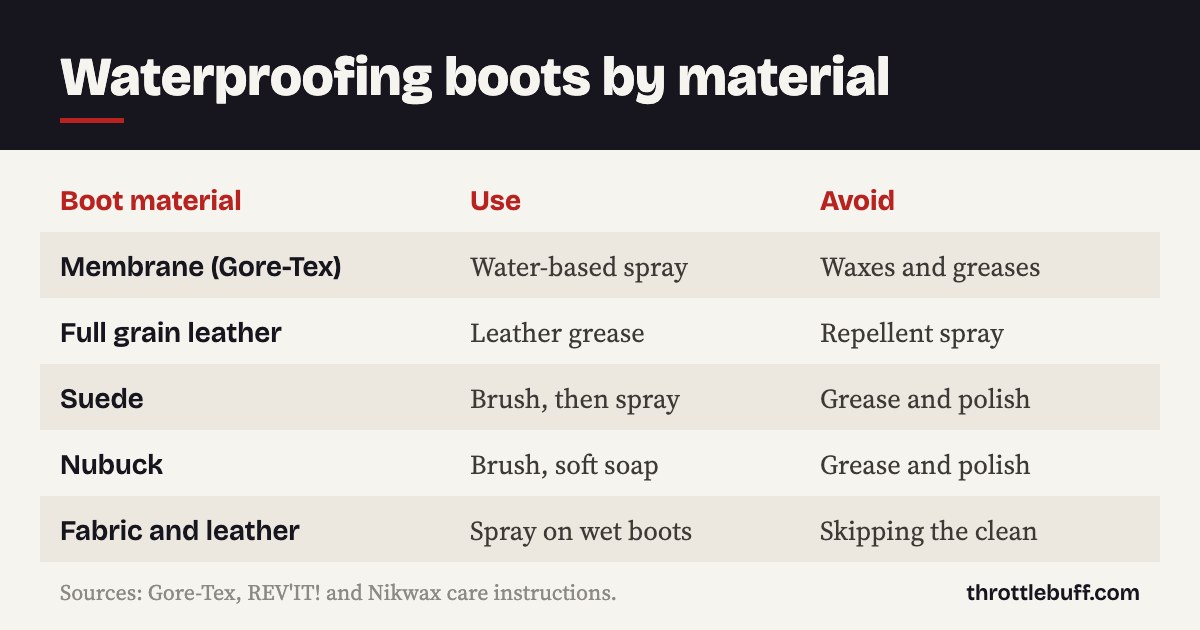
Sources: the Gore-Tex footwear care instructions, the REV’IT! wash and care guide and Nikwax product instructions, read in November 2026. If your boot is both, for example full grain leather over a Gore-Tex liner, follow the care label from the boot maker. It knows how that leather was treated at the factory.
How to waterproof motorcycle boots: step by step
1. Work out what your boots are
Look for a membrane tag or logo (Gore-Tex, Drystar, H2Out, D-Dry and similar names) on the tongue, the cuff or the care label. Then check the outer: smooth leather, suede or nubuck, textile, or a mix. Those two facts decide everything that follows. If you are not sure whether a leather is full grain or coated, the maker’s product page will say.
2. Clean them first
Dirt blocks any treatment from soaking in. Gore-Tex says to remove the laces, shake out grit, take out the insole if you can, brush off loose dirt and wash with lukewarm water and a small amount of liquid detergent. It also says not to use bleach and not to put footwear in the washing machine. For leather, REV’IT! says to remove dust and dirt with a cloth or soft brush, and not to forget the sole.
3. Apply the right treatment
Membrane boots. Gore-Tex’s test is simple: once water no longer beads and runs off, re-apply a durable water repellent, using a water-based product in a pump spray. The membrane inside is what keeps your feet dry. The spray keeps the outer from soaking up water, which matters because, as Nikwax explains, an outer that absorbs water reduces the breathability of the footwear.
Full grain and waxed leather. Work a thin layer of colorless leather grease or conditioner into the leather with a cloth, paying attention to seams and the flex creases over the toes and ankle. REV’IT! says never to use a water-repellent spray on full grain boots because it closes the pores, and notes that its waterproof leather is pretreated to minimize water absorption.
Suede and nubuck. Brush only. Suede can then take a water-repellent spray. REV’IT! says never to use leather grease or shoe polish on either.
Fabric and leather mixes. Nikwax’s method for its footwear spray is to apply it to clean, wet boots from about 6 inches (15 cm), make sure it gets into the seams, wipe off the excess after two minutes and let the boots dry naturally. It warns that light or colored leather may darken, so test a hidden patch first.
4. Dry them slowly
Every maker says the same thing here. Gore-Tex: dry naturally at moderate temperatures and avoid direct heat. REV’IT!: let wet boots dry at room temperature, away from heaters and direct sunlight. Gore-Tex adds that convection-style boot dryers work well, and that boots should not be left wet for long.
5. Test, then repeat when the beading stops
Flick some water on the dry boots. If it beads and rolls off, you are done. There is no fixed interval for redoing it. Go by the beading: when water starts to darken and soak into the outer, clean and treat again. Boots ridden through a wet winter will need it far sooner than boots used on dry weekends.
When waterproofing will not fix wet feet
A treatment renews water repellency on the outside. It does not repair the inside. If a membrane boot lets water through when the outer is clean and beading, the liner itself is likely damaged, and no spray will seal it. Check the warranty.
The other common cause is water coming in over the top. Rain runs down your leg and into the boot if your pants are tucked in, so wear rain pants or waterproof overpants over the boot shaft. Our guide to riding a motorcycle in rain covers the rest of the wet-weather setup.
Can you waterproof boots that were never waterproof?
You can make them shed a shower, not a storm. Grease or spray helps leather and fabric resist water for a while, but a boot with no membrane has stitched seams and a zip that can let water through in steady rain. If you ride in the wet often, boots built with a waterproof liner are the real fix. Our best motorcycle boots guide is the place to start, and we also cover cruiser boots, boots for wide feet, boots you can walk in and riding shoes.
Cold comes with wet. If damp feet are really a warmth problem, see how to stay warm riding a motorcycle and our heated motorcycle socks picks.

FAQ
What is the best way to waterproof motorcycle boots?
Match the treatment to the material: a water-based spray for membrane boots, leather grease or conditioner for full grain leather, and a brush plus spray for suede. Always clean first and dry at room temperature.
How do you waterproof leather motorcycle boots?
Clean them, let them dry, then work in a thin coat of colorless leather grease or conditioner. REV’IT! advises against water-repellent spray on full grain leather. If the boots have a Gore-Tex liner, check the maker’s label first, because Gore-Tex advises against waxes and greases.
Can you use waterproofing spray on Gore-Tex boots?
Yes. Gore-Tex recommends a water-based durable water repellent in a pump spray once water stops beading. It says not to use waterproofing waxes or greases, as they can affect breathability.
How often should you waterproof motorcycle boots?
When water stops beading on the outer. That depends on how much rain, dirt and washing the boots see, not on the calendar.
Can I dry wet motorcycle boots on a radiator?
No. Gore-Tex and REV’IT! both say to dry boots naturally, away from direct heat. A convection boot dryer is fine according to Gore-Tex.
Why do my waterproof boots still leak?
Either water is running in over the top of the boot, or the waterproof liner is damaged. Surface treatments cannot fix either. Wear your rain pants over the boots, and ask the maker about a liner that has failed.
Verdict
Waterproofing motorcycle boots is a short job if you match the product to the boot: spray for membranes and suede, grease or conditioner for smooth leather, always on clean boots, always dried slowly. Do it when the beading stops, not by the calendar. For how leather and textile gear differ more broadly, see our textile vs mesh vs leather gear comparison.
Browse all our riding gear guides.