Throttle Buff is reader-supported: we may earn a commission when you buy through links on this page. Read our affiliate disclosure.
No. You should not wear a bicycle helmet on a motorcycle, and where a helmet law applies to you it will not count as one. A bicycle helmet is certified to the bicycle standard, not to FMVSS No. 218, the federal standard every motorcycle helmet sold in the US has to meet, so it carries no DOT label and skips tests a motorcycle helmet must pass.
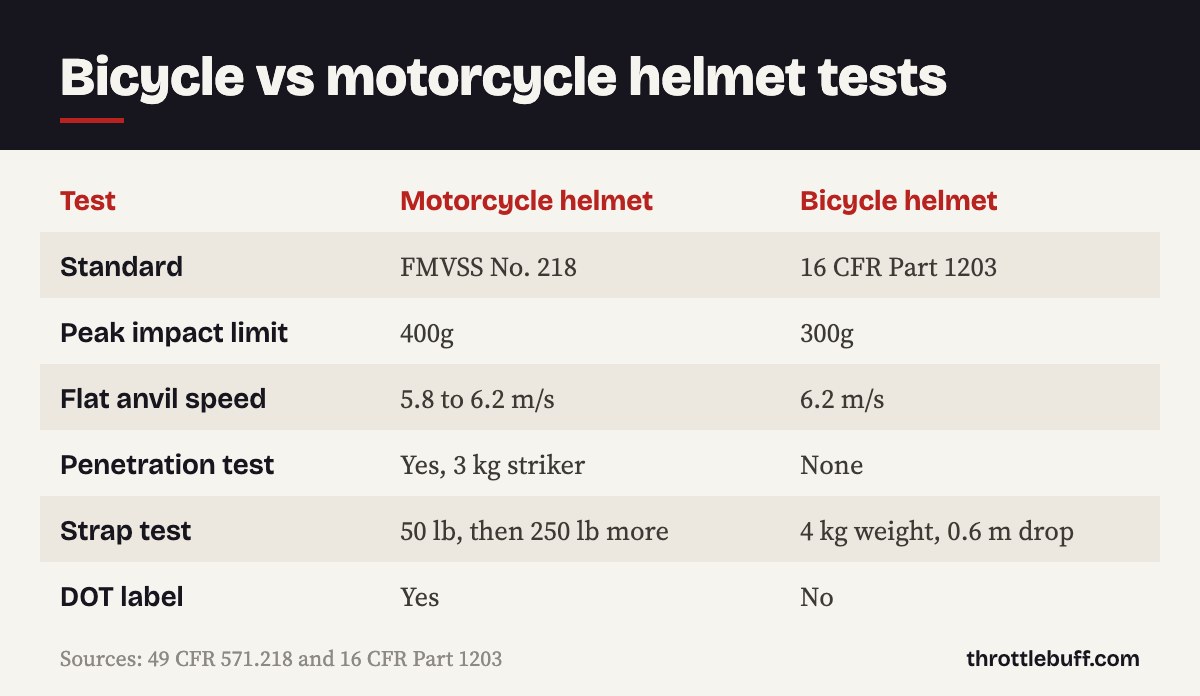
The surprise is where the two standards differ. The headline impact numbers are closer than most riders expect. The gap is in what else gets tested, how the strap is loaded and what the law accepts. The table sets the two federal standards side by side.
Bicycle helmet vs motorcycle helmet: the two standards
| Test | Motorcycle helmet | Bicycle helmet |
|---|---|---|
| Federal standard | FMVSS No. 218 (49 CFR 571.218) | 16 CFR Part 1203 |
| Peak impact limit | 400g, with time limits above 200g and 150g | 300g |
| Flat anvil impact speed | 5.8 to 6.2 m/s | 6.2 m/s |
| Rounded anvil impact speed | 5.0 to 5.4 m/s | 4.8 m/s, plus a curbstone anvil |
| Penetration test | Yes: a pointed striker of about 3 kg dropped 3 m must not touch the headform | None |
| Strap test | 50 lb load for 30 seconds, then 250 lb more for 120 seconds | 4 kg weight dropped 0.6 m |
| Side vision | At least 105° each side | At least 105° each side |
| DOT certification label | Yes | No |
Sources: FMVSS No. 218 and 16 CFR Part 1203, read in November 2026. Figures are the standards’ own limits, not results for any one helmet.
Can you wear a bicycle helmet on a motorcycle legally?
Where a motorcycle helmet law covers you, no. These laws do not just say “a helmet”. They point to a motorcycle helmet standard. California is a clear example: its Vehicle Code section 27803 says a driver and any passenger “shall wear a safety helmet meeting requirements established pursuant to Section 27802” when riding a motorcycle, motor-driven cycle or motorized bicycle.
NHTSA explains how to tell a compliant helmet. Its helmet guide says to make sure the helmet has the DOT symbol on the outside back, which means it meets FMVSS No. 218, and that the label carries the maker or brand, the model, “DOT”, “FMVSS No. 218” and “CERTIFIED”. A bicycle helmet has none of that. Our guide on how to tell if a motorcycle helmet is DOT approved shows where to look.
Helmet laws differ a lot from state to state. Some cover every rider, some only younger riders, and a few have none. Check yours in our motorcycle helmet laws by state table. In a state that does not require you to wear a helmet at all, nothing stops you wearing a bicycle helmet, but that makes it legal, not suitable.
Why a bicycle helmet is the wrong tool
It is not tested against penetration
FMVSS No. 218 drops a pointed striker weighing about 3 kg from 3 m onto the helmet, and the striker must not reach the headform inside. The bicycle standard has no penetration test at all. That is one reason bicycle helmets can have large open vents and a thin shell, while a motorcycle helmet has a hard, continuous outer shell.
The strap is held to a much lower load
A motorcycle helmet’s retention system has to hold a 50 lb load and then a further 250 lb for two minutes without separating, and its adjustable part may not move more than 1 inch. The bicycle test drops a 4 kg weight 0.6 m and allows up to 30 mm of stretch. Both check that the helmet stays on, but they are built around very different forces.
The impact numbers look similar, and that is misleading
On paper the bicycle limit is even stricter: 300g against 400g, at about the same flat anvil speed. But 6.2 m/s is roughly 14 mph. Neither standard is a highway speed crash test. Each one certifies a helmet for the kind of use it was written for. FMVSS No. 218 describes its scope as helmets “designed for use by motorcyclists and other motor vehicle users”. The bicycle standard covers bicycle helmets. A bicycle helmet has simply never been tested as a motorcycle helmet.
It covers less and has no face protection
A bicycle helmet sits on top of the head and is built to be light and airy. It has no chin bar and no face shield, so wind, rain, insects and road grit reach your eyes directly. Our guide to the types of motorcycle helmets shows how much more of the head each motorcycle style covers.
What about mopeds and scooters?
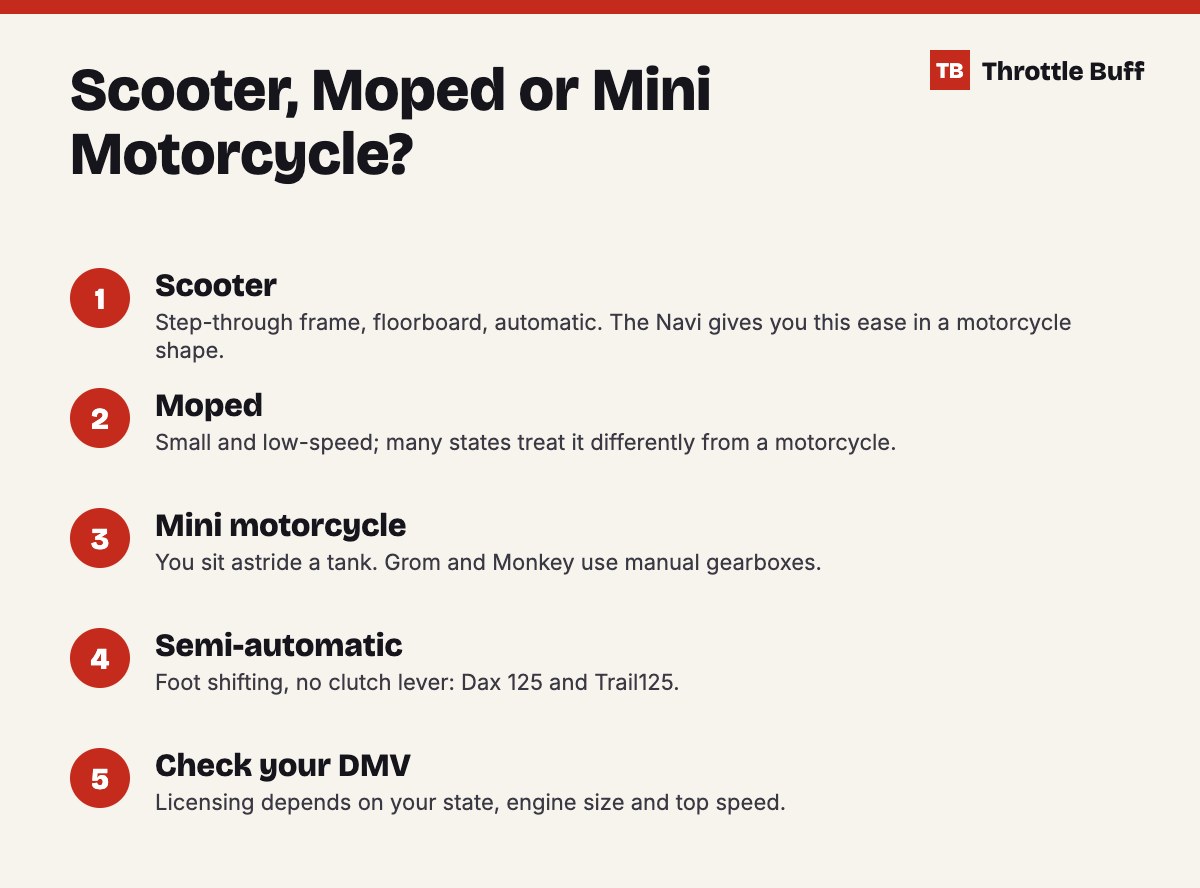
It depends on how your state classes the vehicle, so do not assume a small engine means a bicycle helmet is fine. California’s law above names motor-driven cycles and motorized bicycles alongside motorcycles, so the same helmet rule applies to them. Other states draw the line differently. Our moped vs motorcycle explainer covers how the classes work, and your state’s DMV has the final word.
What to wear instead
Any helmet with a genuine DOT label is the legal minimum. Many also carry ECE 22.06 or Snell approval, which add their own tests; see ECE 22.06 vs DOT and our overview of helmet safety ratings.
If cost is what has you eyeing a bicycle helmet, a certified motorcycle helmet does not have to be expensive. We cover that in are cheap motorcycle helmets safe, and our best beginner motorcycle helmets guide lists certified picks at sensible prices. If it is the open, light feel you want, a dirt or dual-sport helmet gets closer while staying certified: see can you wear a dirt bike helmet on the street. Whatever you choose, fit matters as much as the label, so use our guide on how to size and buy a helmet.

FAQ
Can you wear a bike helmet on a moped?
Only if your state does not class the moped as a vehicle that needs a motorcycle helmet. California’s helmet law, for example, covers motorized bicycles and motor-driven cycles as well as motorcycles. Check your state’s rules.
Is a bicycle helmet better than no helmet on a motorcycle?
It is not certified for motorcycle use, so nobody can tell you how it will perform. Where a helmet law applies it will not satisfy it. Wear a DOT certified helmet.
What is the difference between a bicycle helmet and a motorcycle helmet?
A motorcycle helmet is certified to FMVSS No. 218, which adds a penetration test and a far heavier strap test, and it has a hard full shell and usually face protection. A bicycle helmet is certified to 16 CFR Part 1203 and is built to be light and ventilated.
Can you wear a motorcycle helmet on a bicycle?
You can, but it is heavy and has little ventilation for pedaling. If a local bicycle helmet law applies to you, check which standard it asks for.
Do bicycle helmets have a DOT sticker?
No. The DOT label is the maker’s certification to FMVSS No. 218, the motorcycle helmet standard. A bicycle helmet is certified to the bicycle standard.
Verdict
A bicycle helmet is made and certified for cycling. On a motorcycle it has no DOT label, no penetration test behind it, a strap tested to far lower loads and nothing protecting your face. Where a helmet law applies it does not count. Buy a DOT certified motorcycle helmet that fits, even a budget one.
Browse all our helmet guides.