Throttle Buff is reader-supported: we may earn a commission when you buy through links on this page. Read our affiliate disclosure.
To change your motorcycle oil: warm the engine, put the bike upright, drain the old oil from the drain plug, replace the oil filter, refit the plug with a new crush washer at the correct torque, refill with the grade and amount in your owner’s manual, then run the engine and recheck the level. Most riders can do it in under an hour with basic tools.
What you’ll need
- The correct oil (grade, spec and quantity from your owner’s manual)
- A new oil filter and drain plug crush washer
- A socket set, oil filter wrench and torque wrench
- A drain pan, funnel, gloves and rags
- A paddock stand or centre stand, if your bike has one
Step by step
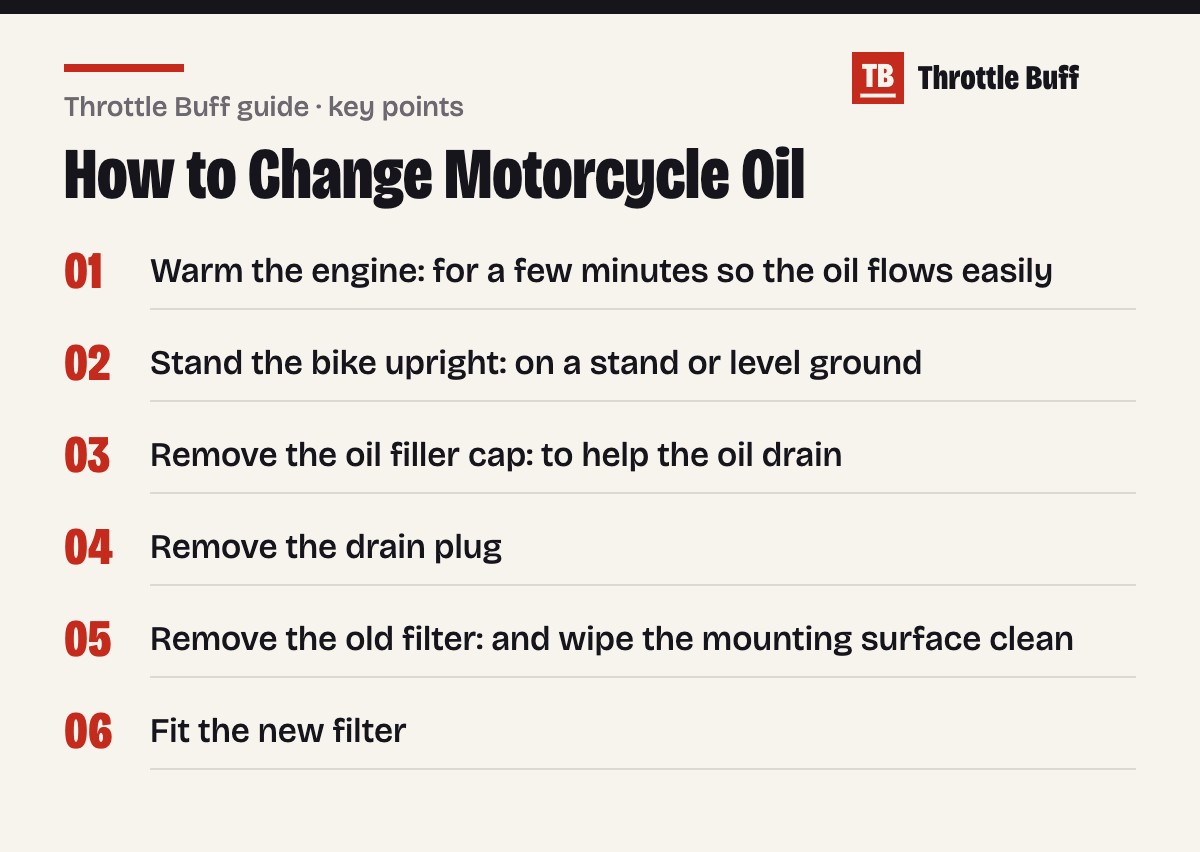
- Warm the engine for a few minutes so the oil flows easily, then switch it off. Take care: the oil and exhaust will be hot.
- Stand the bike upright on a stand or level ground.
- Remove the oil filler cap to help the oil drain.
- Remove the drain plug and let the oil drain fully into the pan.
- Remove the old filter and wipe the mounting surface clean.
- Fit the new filter: smear a little fresh oil on its seal and tighten it by hand as the filter instructions say.
- Refit the drain plug with a new crush washer, tightened to the torque in your manual.
- Refill with the specified oil, slightly under the full amount.
- Run the engine for a minute, switch off, wait, then check the level and top up to the full mark.
- Check for leaks and dispose of the old oil at a recycling centre.
Choosing the right oil
Use the viscosity (for example 10W-40) and specification in your manual. Most motorcycles with a wet clutch need oil rated JASO MA or MA2; car oils with friction modifiers can make the clutch slip. Learn more from your bike maker or the American Petroleum Institute.

Typical oil change intervals
| Situation | Typical interval |
|---|---|
| Mineral oil | Shorter, often around 2,000–3,000 miles |
| Semi-synthetic oil | Middle, often around 3,000–5,000 miles |
| Fully synthetic oil | Longer, often up to 5,000–7,000+ miles if your manual allows |
| First service (new bike) | Early, as set in the manual (often around 600 miles / 1,000 km) |
| Bike stored or ridden little | At least once a year |
These are general ranges. Always follow your owner’s manual. If the bike is about to sit for the winter, change the oil first and add a motorcycle fuel stabilizer to the tank.
When to change it sooner
- Lots of short trips where the engine never fully warms up
- Hot weather, heavy traffic or track days
- Dusty or off-road riding
- High-revving riding
- Oil that looks very dark or gritty, or smells burnt
How to check your oil
Check the level regularly with the bike upright, using the sight glass or dipstick as your manual explains. Top up with the same oil if needed.
FAQ
How often should I change my oil?
Follow your manual. See how often to change your motorcycle oil.
Can I use car oil in my motorcycle?
Usually not if your bike has a wet clutch. Use JASO MA/MA2 motorcycle oil.
Do I need to change the filter every time?
Most manuals recommend it at every oil change or every other change.
What if I overfill?
Drain the excess. Too much oil can cause leaks and foaming.
An oil change is a good time to check the intake too; see how to clean a motorcycle air filter.
Other maintenance
While you’re at it, check your tires, chain and battery. Learn how it all works in how a motorcycle engine works.
Browse all our how-to and safety guides.