
Throttle Buff is reader-supported: we may earn a commission when you buy through links on this page. Learn more.
The best motorcycle frame sliders for most riders in 2026 are Woodcraft kits: they bolt straight to the engine mounts with no offset bracket, use solid replaceable pucks, and are made for a huge range of sport and naked bikes. On a budget, Shogun sliders are a proven, affordable option, and R&G Aero sliders add a sleeker shape with bolts designed to bend rather than snap.
Quick picks
-
Best overall
- Example fitment
- Ninja 400/500, Z400/Z500
- Puck material
- Solid puck, replaceable
- Price
- $$
-
Best budget
- Example fitment
- Ninja 650 / Z650
- Puck material
- CNC-machined polymer
- Price
- $
-
Best low-profile style
- Example fitment
- Kawasaki Z900
- Puck material
- HDPE
- Price
- $$
-
Best for supersports
- Example fitment
- Ninja ZX-6R 2024–26
- Puck material
- 130 x 58 mm nylon
- Price
- $$$
- Best for naked bikes: Puig R19
- Best for cruisers and retro bikes: Puig Vintage
- Best for touring and ADV bikes: Givi SLD01
Frame sliders are cheap insurance. A parking-lot tip-over can crack a fairing, snap a lever and grind an engine case. This rewrite replaces our old no-name picks with seven kits from established brands, each linked to an example fitment; most brands cover dozens of bikes. Specs come from the manufacturers; we haven’t crash-tested them.
Frame sliders compared
| Slider | Example fitment | Puck material | Mounting | Rider-friendly extras | Price |
|---|---|---|---|---|---|
| Woodcraft | Ninja 400/500, Z400/Z500 | Solid puck, replaceable | Direct to engine mount | Puck swaps without removing engine bolt | $$ |
| Shogun PA2 | Ninja 650 / Z650 | CNC-machined polymer | Bike-specific | Swappable color inserts | $ |
| R&G Aero | Kawasaki Z900 | HDPE | Steel bolt designed to bend | Teardrop shape | $$ |
| Puig Pro 2.0 | Ninja ZX-6R 2024–26 | 130 x 58 mm nylon | Billet bracket, no cutting | Rubber bumper for knees and shins | $$$ |
| Puig R19 | MT-07 / R7 / XSR700 | Nylon | Bike-specific | Mid-length, rubber bumper | $$ |
| Puig Vintage | Honda Rebel 500 / SCL500 | Nylon, 54 mm | Bike-specific | Retro styling | $$$ |
| Givi SLD01 | Many (with Givi bracket) | Fiberglass-reinforced polymer | Bracket sold separately | Aluminum backing plate | $$ |
The best motorcycle frame sliders of 2026
1. Woodcraft Frame Slider Kit: best overall
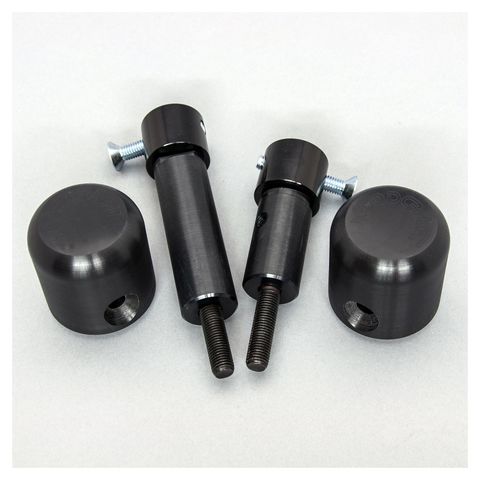
Woodcraft is a racing brand, and its sliders are a favorite with track riders for good reason. Every Woodcraft kit mounts directly to the engine mounts with no offset bracket. Woodcraft says that gives maximum strength against bending and breaking.
The patented two-piece design is the other big plus. Because the mounting bolt runs perpendicular to the puck, the puck can be solid instead of hollow, which Woodcraft says gives it nearly 50% more material and much longer life. It also means that after a crash you can swap the puck without pulling the engine bolt. The kit linked here fits the Kawasaki Ninja 400/500 and Z400/Z500, and Woodcraft makes kits for most popular sport and naked bikes.
Pros
- Direct engine-mount design, no offset bracket
- Solid pucks last longer
- Replace pucks without removing the engine bolt
- Huge fitment list
Cons
- Some kits need fairing cuts
- Racing look won’t suit every bike
2. Shogun PA2: best budget

Shogun has been making frame sliders for years, and its PA2 line is one of the best values going. This Ninja 650/Z650 kit is the cheapest option on this list. The pucks are CNC-machined from an abrasion- and UV-resistant polymer and shaped for each bike so they stick out the right amount.
Each puck has a black anodized aluminum insert that adds impact protection and reduces friction with the pavement. You can swap it for other colors (sold separately) to match your bike. Hardware is high-strength, corrosion-resistant steel, and offset brackets (where used) are machined aluminum.
Pros
- Lowest price tier
- Bike-specific puck shape
- High-strength hardware included
- Custom color inserts
Cons
- Fewer premium touches than Woodcraft
- Some fitments use offset brackets
3. R&G Racing Aero: best low-profile style

Most frame sliders are plain cylinders. R&G’s Aero sliders use a teardrop shape that looks far cleaner, especially on naked bikes like the Kawasaki Z900 shown here. They’re made from machined steel, aluminum and a high-density polyethylene (HDPE) puck. R&G chose HDPE for its high-friction qualities, so as it wears it helps slow a sliding bike.
The smartest detail is the bolt. R&G uses de-embrittled steel bolts designed to bend instead of snapping. That helps absorb energy and reduces the chance of damaging the frame’s mounting points, which is the worst-case outcome with any slider.
Pros
- Sleek teardrop shape
- Bolts bend instead of snapping
- HDPE pucks help slow a slide
- Wide fitment range
Cons
- Bent bolts need replacing after a crash
- Smaller puck than some race sliders
4. Puig Pro 2.0: best for supersports

Supersports have expensive fairings and a lot of them, so you want a big puck that keeps plastic off the ground. The Puig Pro 2.0 uses a large 130 x 58 mm nylon puck on a billet aluminum bracket. On this 2024–2026 Ninja ZX-6R kit, no bodywork modification is required, so you don’t have to cut your fairings.
Puig designed these with the rider in mind too. Each puck has a rubber bumper on its rear-facing pointed end to reduce knee and shin injuries if your leg hits it in a crash. An end cap hides the mounting bolt.
Pros
- Big 130 x 58 mm nylon puck
- No fairing cutting on this fitment
- Rubber bumper protects your legs
- Clean, finished look
Cons
- Most expensive slider here
- Larger puck sticks out more
5. Puig R19: best for naked bikes

Naked bikes like the Yamaha MT-07 have no fairings to protect, but they do have exposed engine cases, radiators, bars and levers. The Puig R19 is a mid-length slider designed to sit just inside the width of the stock handlebars and footpegs. In a crash, the pegs fold up and the bars and controls stay off the ground, so the nylon slider takes most of the damage.
Puig says mid-length sliders are also less likely to dig into uneven ground than long sliders, which can catch and flip a sliding bike. Like the Pro 2.0, each R19 has a rubber bumper cap to protect your knees and shins, and the kit includes all the hardware.
Pros
- Length tuned to keep bars and levers off the ground
- Less likely to dig in than long sliders
- Rubber bumper protects your legs
- All hardware included
Cons
- Less coverage than a full crash cage
- Style is sporty rather than retro
6. Puig Vintage: best for cruisers and retro bikes

Big race-style pucks look out of place on a Honda Rebel or a café racer. Puig’s Vintage sliders use a sleek shape with cutouts that suit retro bikes, and they stick out only as far as needed to keep the handlebars off the ground while letting the footpegs fold.
They use the same abrasion-resistant nylon as Puig’s other sliders, with a 54 mm impact area, and come as a pair with all the hardware. This kit fits the Rebel 500 and SCL500. For more upgrades for that bike, see our guide to the best Honda Rebel 500 accessories.
Pros
- Retro styling that suits cruisers and café bikes
- Keeps bars off the ground in a tip-over
- Hardware included
Cons
- Smaller 54 mm puck
- Less protection in a long slide
7. Givi SLD01: best for touring and ADV bikes
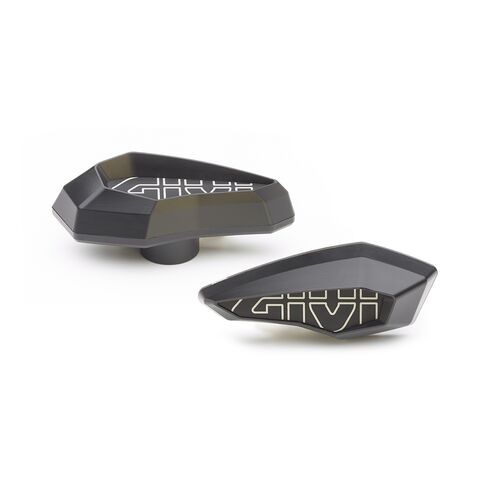
Givi is best known for luggage, and its frame sliders are a natural fit for touring, sport-touring and adventure bikes, especially if you already run Givi racks. The SLD01 pucks are an aerodynamic shape in fiberglass-reinforced polymer, backed by anodized aluminum plates. You buy the pucks, then add Givi’s bike-specific mounting bracket kit for your model.
One set of pucks can move to a new bike with the matching bracket, but check that Givi makes one for your model first. On big ADV bikes, crash bars protect more of the engine and tank.
Pros
- Fiberglass-reinforced puck with aluminum backing
- Pucks can move to a new bike with a new bracket
- Pairs well with Givi luggage systems
Cons
- Brackets sold separately
- Not a substitute for crash bars on big ADV bikes
How to choose frame sliders
Do frame sliders actually work?
Yes, within limits. They’re excellent at the most common crash: a low-speed tip-over or a lowside where the bike slides on its side. They keep fairings, levers, engine cases and the frame off the pavement, and a good puck helps the bike slide rather than dig in. In a high-speed tumble or on soft ground, no slider prevents all damage, and a long slider can even dig in. Better still, avoid the crash: our guide to cornering with confidence helps. The goal is to turn a big repair bill into a cheap puck replacement in the common crashes.
Cut or no-cut?
On faired bikes, some kits mount through the bodywork, which means drilling or cutting a hole in the fairing. “No-cut” kits use offset brackets to reach around the bodywork. No-cut kits keep your fairings untouched, which matters for resale. Cut kits can mount closer to the frame and can be stronger, because there’s less leverage on the bolt. Woodcraft’s direct-mount design is the strong-but-sometimes-cut approach, while kits like the Puig Pro 2.0 for the ZX-6R are no-cut.
Puck materials
Most pucks are made from engineering plastics such as nylon, Delrin (acetal or POM) or polyethylene (HDPE or UHMW). These slide well, resist abrasion and wear away instead of transferring all the energy to the frame. Avoid solid metal “sliders”, which grip the road and can transfer shocks straight into your engine mounts.
Mounting strength
The slider is only as good as its bolt and where it attaches. Engine mounts are usually the strongest points. Look for high-grade bolts and a design that protects the mounting point, like R&G’s bolts that bend rather than snap. Torque the bolts to the spec in the instructions, use thread locker where called for, and check them again after a few rides.
Add other protection
Frame sliders protect the middle of the bike. Add axle sliders, bar-end sliders and engine case covers for fuller coverage, or crash bars on cruisers and big ADV bikes. New riders should fit sliders before the first ride. See our list of mistakes new riders make and our beginner gear guide.
Installing sliders
Most kits take under an hour with basic tools and a torque wrench. On some bikes you replace a stock engine bolt with a longer one, so do one side at a time. See our guide to working on your own motorcycle, and add a bolt check to your regular maintenance.
FAQ
Are frame sliders worth it?
For most riders, yes. A set costs about as much as one replacement lever or a fraction of a fairing panel. If you drop the bike just once, they’ve usually paid for themselves.
Do frame sliders damage the frame in a crash?
They can transfer force to the mounting points in a hard crash, which is why mounting design matters. Direct engine-mount designs and bolts that bend rather than snap reduce that risk.
Do I need to cut my fairings?
It depends on the kit and the bike. Many brands offer no-cut kits that use brackets to reach around the bodywork. Check the listing for your exact model.
Should I replace sliders after a crash?
Replace any puck that is cracked, flat-spotted or worn down, and check the bolt and mount for bends. Woodcraft’s design lets you swap the puck without removing the engine bolt. Our guide on what to do after a crash covers checking the rest of the bike.
Verdict
Get a Woodcraft kit if one is made for your bike. It’s the strongest design, and the pucks are easy to replace. Choose Shogun if you want proven protection for less money, or R&G Aero if style matters. Whatever you buy, fit sliders before the first tip-over, not after it. Fitment guides are on R&G Racing, and the Motorcycle Safety Foundation has courses that help you avoid the crash in the first place. If you’re shopping for a bike, our used motorcycle buying guide explains how to spot slider scuffs that hint at past drops.
Browse all our accessory guides.


