Throttle Buff is reader-supported: we may earn a commission when you buy through links on this page. Read our affiliate disclosure.
How we chose: this guide is research-based, built from manufacturer specifications, safety certifications and owner feedback rather than hands-on testing. How we research.
The best motorcycle exhaust for most riders in 2026 is a quality slip-on from a major brand, like the Akrapovic Slip-On Line for sport bikes or the Vance & Hines Twin Slash for Harleys. A slip-on gives you most of the sound and weight savings for a fraction of the price and hassle of a full system. If you want real power gains and you’re willing to tune, step up to a full system like the Yoshimura AT2 or Two Brothers Ghost 2-into-1. For ADV bikes, the top exhaust brands are Akrapovic, Arrow, LeoVince and SC-Project, and we cover their adventure-bike slip-ons below.
Quick picks
-
Best overall slip-on
- Type
- Slip-on
- Example fitment
- Ninja 400/500, Z400/Z500
- Price
- $$
-
Best full system for middleweights
- Type
- Full system
- Example fitment
- Yamaha R7 / MT-07
- Price
- $$$
-
Best value slip-on
- Type
- Slip-on
- Example fitment
- Ninja 400 / Z400
- Price
- $
-
- Best Harley Touring full system: Two Brothers Ghost 2-into-1
- Best Harley Touring slip-ons: Khrome Werks HP-Plus 4.5″
- Best for adventure bikes: Vance & Hines Adventure Hi-Output 450
- Best for dual sports: Yoshimura RS-12
- Best for the track: Akrapovic Evolution Line
Exhausts are bike-specific, so “best” depends on what you ride. Our old list was a mix of generic universal mufflers that rarely fit well and often fail inspection. This 2026 rewrite picks nine current exhausts from the brands that dominate the aftermarket, covering sport bikes, middleweights, Harley Softails and Touring models, ADV bikes and dual sports. Each pick links to a specific fitment at RevZilla, and most of these product lines are also made for many other bikes. Specs and power figures come from the manufacturers. We haven’t dyno-tested them ourselves.
Motorcycle exhausts compared
| Exhaust | Type | Example fitment | Material | Street use | Price |
|---|---|---|---|---|---|
| Akrapovic Slip-On Line | Slip-on | Ninja 400/500, Z400/Z500 | Titanium or carbon muffler | Check version* | $$ |
| Yoshimura AT2 Race | Full system | Yamaha R7 / MT-07 | Stainless steel | Race use | $$$ |
| LeoVince LV Corsa | Slip-on | Ninja 400 / Z400 | 304 stainless or carbon | Check local rules | $ |
| V&H 4″ Twin Slash | Slip-on | Harley Softail 2025–26 | Chrome or black steel | Check local rules | $$ |
| Two Brothers Ghost 2-1 | Full system | Harley Touring 2017–26 | Stainless steel | Check local rules | $$$ |
| Khrome Werks HP-Plus 4.5″ | Slip-ons (pair) | Harley Touring 2017–25 | Steel, billet tips | Optional J2825 inserts | $$$ |
| V&H Adventure Hi-Output 450 | Slip-on | Harley Pan America | 304 stainless | 50-state compliant | $$ |
| Yoshimura RS-12 | Slip-on | Honda CRF300L / Rally | Stainless, carbon end cap | Spark arrestor | $$ |
| Akrapovic Evolution Line | Full system | Yamaha R1 / R1M | Titanium | Race use | $$$$ |

The best motorcycle exhausts of 2026
1. Akrapovic Slip-On Line: best overall slip-on

Akrapovic is the name most riders think of first, and its Slip-On Line is the sweet spot of the range. Akrapovic calls it the first step into exhaust tuning, but it’s far from entry-level. Each one is designed for a specific bike, with a choice of titanium or carbon fiber muffler, Akrapovic’s patented hexagonal shape, carbon fiber clamps made in-house, a CNC-machined inlet cap and silicone-shielded stainless springs. The shape is designed to maximize lean angle, which matters on sport bikes.
Akrapovic designs its systems on its own flow benches and focuses on gains across the whole rev range, not just peak power. It also gives you that deep, resonant Akrapovic sound. No fuel remapping is required, though RevZilla recommends a fuel controller for best results. The fitment linked here is for the Kawasaki Ninja 400/500 and Z400/Z500, but the Slip-On Line exists for a huge range of sport, naked and adventure bikes.
One important detail: Akrapovic often sells a racing version and a separate homologated version for the same bike. The homologated one carries approvals for road use in markets that require them. Pick the version that matches how and where you ride.
Pros
- Top-tier build quality and finish
- Bike-specific design optimized for lean angle
- No remap required to fit
- Huge range of fitments
Cons
- Pricier than most slip-ons
- Racing versions aren’t meant for street use
2. Yoshimura AT2 Race System: best full system for middleweights

Yoshimura has a long racing history, and the AT2 is its modern full-system design for popular middleweights. The listing linked here fits the Yamaha R7 and MT-07. Yoshimura says that on an R7 it adds 6.2% peak horsepower and 2.7% peak torque with a stock engine on pump fuel, with more to come if you add its airbox and camshaft kits.
The system is full stainless steel and saves about 9.6 lb over the stock exhaust, which you’ll feel in how the bike changes direction. It includes an M18 lambda (oxygen) sensor bung at the tailpipe and comes with an optional sound insert. Yoshimura notes it works on a stock bike but is designed for highly modified and tuned engines, so plan on a tune to get the most from it.
It’s labeled as a race system, so it isn’t intended for use on public roads in most places. That’s the trade-off with most full systems. See the legality section below before you buy.
Pros
- Measured gains on a stock R7
- Big weight saving
- Lambda sensor bung for tuning
- Optional sound insert
Cons
- Race use only
- Gets the most from a tune
3. LeoVince LV Corsa: best value slip-on

LeoVince is an Italian brand with decades of racing experience, and the LV Corsa is its compact, race-style slip-on. It has an open-body design, a sandblasted end cap with a laser-etched logo, and a rear stainless steel mesh. The body is TIG-welded AISI 304 stainless steel with a matte finish, or a black version with a heat-resistant ceramic-based paint, and the bracket is CNC/laser cut.
It’s light, too. The stainless version of this Ninja 400/Z400 fitment weighs 2.49 lb, a fraction of most stock mufflers on small bikes. LeoVince describes the sound as a deep, race-like tone. It costs about half what the Akrapovic does for the same bike, which makes it the go-to pick for riders who want the look and sound on a budget. LeoVince also makes the LV-10 and GP Corsa EVO for many of the same bikes if you want a different shape.
Pros
- Lowest price tier here
- Very light compact muffler
- Stainless or black ceramic finish
- Big fitment range across LeoVince lines
Cons
- Open design is loud
- Check local noise rules
4. Vance & Hines 4″ Round Twin Slash: best Harley Softail slip-on

Vance & Hines is the default choice for a lot of Harley riders, and the Twin Slash is its signature look. This version is a 4-inch round slip-on built for 2025–2026 Milwaukee-Eight Softails that use the factory 2-into-1 header. It bolts onto the stock header and is finished to match it, so the bike looks factory-clean, just louder and meaner.
You get the classic twin-slash end cut, a stamped V&H logo and a choice of chrome or wrinkle black. It’s one of the easiest exhaust upgrades you can make on a new Softail: no header work, and the stock header stays in place. If you want more than a sound change, pair it with a fuel tuner. Vance & Hines’ own FP-series tuners are built for this, and our Fuelpak FP3 review covers how they work.
Pros
- Bolts onto the stock 2025–26 Softail header
- Classic Twin Slash look in chrome or black
- Simple install
Cons
- Fits 2025–26 Softails with the factory 2-into-1 only
- Sound change more than power without a tune
5. Two Brothers Ghost 2-into-1: best Harley Touring full system

A 2-into-1 is the classic way to wake up a Harley bagger, and the Two Brothers Ghost does it without making the bike look lopsided. It fits 2017–2026 Touring models. Race-inspired stainless steel headers feed a spring-retained collector, then a 4-inch touring muffler with Two Brothers’ spiral perforated core. On the opposite side, a “ghost” pipe uses the OEM heat shield so the bike still looks like it has dual pipes.
Two Brothers says it’s designed for maximum torque, which is what you want on a heavy Touring bike pulling away two-up. The headers take both 12 mm and 18 mm O2 sensors, it comes with color-matched heat shields, and it’s made in the USA. You can choose different end caps, including aluminum, carbon fiber and slash cut. Any 2-into-1 on a Milwaukee-Eight needs a proper tune afterward. See our guide to Harley fuel management systems.
Pros
- Real 2-into-1 torque gains
- Ghost pipe keeps the dual-pipe look
- Fits both O2 sensor sizes
- Made in the USA
Cons
- Needs a tune
- Bigger job to install than slip-ons
6. Khrome Werks HP-Plus 4.5″: best Harley Touring slip-ons

If you want your Touring bike to sound deeper but keep the dual-pipe layout and stock headers, the Khrome Werks HP-Plus 4.5″ slip-ons are a strong choice. They fit 2017–2025 Touring models and are sold as a pair. Their absorptive baffle is wrapped in stainless steel mat and high-temp fiberglass to soak up high-frequency noise, so you get rumble without the raspy buzz that tires you out on long rides.
The billet aluminum tips can be rotated 360° in 90° steps and come in several finishes: chrome, smoked chrome, Eclipse, Obsidian Black and black. A big plus for riders who care about noise rules: Khrome Werks offers optional bolt-in inserts that comply with the SAE J2825 sound test, with no appreciable loss of performance according to the company. Khrome Werks says the mufflers improve torque and horsepower right off the throttle.
Pros
- Deep tone without high-frequency buzz
- Optional SAE J2825-compliant inserts
- Rotatable billet tips, many finishes
- Keeps stock headers
Cons
- Pricier than many slip-ons
- Pair only, no single option
7. Vance & Hines Adventure Hi-Output 450: best for adventure bikes

Adventure riders need an exhaust that sounds good without drowning out a long day in the saddle, and that stays legal across state lines. The Adventure Hi-Output 450 for the Harley Pan America checks both boxes. It’s built for the Revolution Max 1250 engine, meets SAE J2825 sound levels and is 50-state emissions compliant, so it’s one of the few exhausts here you can fit without legal worries anywhere in the U.S.
Vance & Hines claims gains of 5 horsepower and 5 lb-ft of torque over stock, and the muffler is nearly 6 lb lighter than the stock system. It’s a stepped 4.5-inch 304 stainless canister with a CNC-machined billet end cap and a brushed finish. Vance & Hines also designed it for better boot clearance, and it works with the OEM saddlebags and center stand, which matters on a loaded ADV bike. V&H makes Adventure Hi-Output 450 versions for some KTM and Husqvarna adventure bikes too.
Pros
- 50-state emissions compliant and SAE J2825 sound levels
- Claimed +5 hp and +5 lb-ft
- Works with OEM bags and center stand
- Nearly 6 lb lighter
Cons
- Specific to the Revolution Max 1250 in this version
- Brushed finish shows dirt
8. Yoshimura RS-12: best for dual sports

Dual sports like the Honda CRF300L feel restricted from the factory, and a slip-on is one of the best ways to free them up. Yoshimura’s RS-12 comes from the company’s long relationship with Team Honda HRC. On the CRF300L and Rally, Yoshimura claims up to 7.0% more horsepower and 7.5% more torque at 5,000 rpm, right where you spend most of your time on trails.
It includes a spark arrestor, which is required on many public trails in the U.S. The asymmetrical body maximizes muffler volume for sound control and power while adding clearance for the rear tire and brake caliper. Precision-machined joints improve fit and durability, and Yoshimura’s Precision Taper Fit insert ring makes it easy to swap sound inserts and the spark arrestor. A matte carbon fiber end cap finishes it off.
Pros
- Strong low-midrange gains claimed
- Spark arrestor included
- Easy-swap inserts
- Good tire and caliper clearance
Cons
- Expensive relative to the bike
- Louder than stock on quiet trails
9. Akrapovic Evolution Line: best for the track
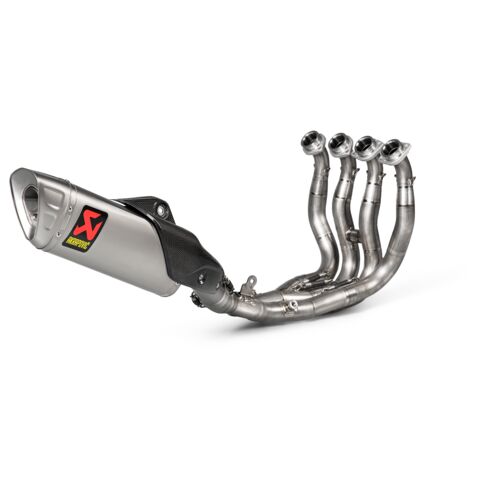
For racers and serious track-day riders, a full titanium system is the end game, and Akrapovic’s Evolution Line is the benchmark. This version for the Yamaha R1 and R1M is built from lightweight titanium and saves 5.8 kg (58%) over the stock system. It’s finished with a carbon fiber heat shield and tuned for both power and Akrapovic’s racing sound.
Akrapovic designed this kit for R1s fitted with a Yamaha Racing Kit, so it’s squarely a race part. It’s also the most expensive exhaust on this list by a wide margin. If you’re not chasing lap times on a dedicated track bike, a slip-on gets you most of the sound and looks for a fraction of the price.
Pros
- Huge weight saving in titanium
- Race-proven engineering
- Carbon heat shield and top-tier finish
Cons
- Race use only
- Very expensive
- Needs a tune and race kit to make sense
Best aftermarket exhaust systems for ADV bikes
The best aftermarket exhaust systems for ADV bikes are bike-specific slip-ons from the top adventure-bike exhaust brands: Akrapovic, Arrow, LeoVince and SC-Project, plus the Vance & Hines Adventure Hi-Output 450 above for the Pan America and Yoshimura’s RS-12 ADV for bikes like the Yamaha Ténéré 700. On a big adventure bike, a slip-on is usually the smart choice: it keeps the stock headers and catalytic converter, saves weight high up at the back of the bike, and changes the sound without a full rebuild. Before you buy, check clearance with your panniers or pannier racks, and whether the version you want is homologated for road use where you ride.
Akrapovic Slip-On Line for BMW R1300GS / Adventure
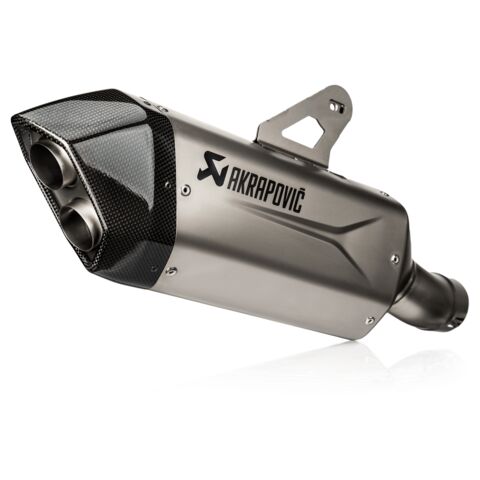
Akrapovic’s Slip-On Line is also made for BMW’s R1300GS and GS Adventure (the same listing covers the R1300R and RS). It’s the same recipe as pick 1: a bespoke design, carbon fiber parts made in-house, a CNC-machined inlet cap and silicone-shielded stainless springs. No fuel remapping is required, though RevZilla recommends a fuel controller for the best results. Akrapovic also sells headers for this bike if you want to go further.
Arrow Maxi Race-Tech for BMW R1200GS / R1250GS / Adventure

Arrow built the Maxi Race-Tech for big sport-touring and adventure bikes. It’s a larger version of the Race-Tech, with the same diamond-shaped muffler, stainless steel internals and TIG welding, but more volume to suit high-output engines. Arrow says it saves significant weight and adds horsepower and torque, and it’s finished with a carbon fiber end cap. RevZilla also lists Maxi Race-Tech versions for the KTM 1190/1290 Adventure and earlier Africa Twin Adventure Sports.
LeoVince LV One EVO for KTM 790/890 Adventure and Husqvarna Norden 901

LeoVince is the value pick among ADV exhaust brands. The LV One EVO has an AISI 304 stainless inlet cap, internal chambers and mid-pipe, a compact oval body in sandblasted stainless or carbon fiber, and a carbon fiber end cap and clamp. LeoVince says it’s tuned to work with the stock fuel settings and saves substantial weight over the stock exhaust. This fitment covers the KTM 790 and 890 Adventure, 890 SMT and Husqvarna Norden 901.
SC-Project
SC-Project is an Italian exhaust maker that builds everything in Italy and works with MotoGP, Moto2 and Superbike teams. It makes slip-ons for many adventure bikes and publishes its EU homologations on its site. RevZilla doesn’t stock SC-Project, so buy from one of the official distributors the company lists, and check fitment and road approval for your exact model.
How to choose a motorcycle exhaust
An exhaust changes how your bike sounds, how it looks, how much it weighs and, with the right tuning, how it makes power. It can also change whether your bike is legal on the road. Here’s what to think through before you buy.
What makes a high-quality motorcycle exhaust?
A high-quality motorcycle exhaust is designed for your specific bike, built from stainless steel, titanium or carbon fiber with clean TIG welds, and backed by real test data from the maker. The best value comes from name-brand slip-ons like the LeoVince LV Corsa or LV One EVO, which give you that build quality for far less than a titanium full system. Look for proper baffling or removable sound inserts, replaceable packing, quality springs and clamps, and a road-legal (homologated or SAE J2825) version if you ride on the street.
Slip-on or full system?
A slip-on replaces only the muffler and keeps your stock headers (and usually the catalytic converter). It’s the cheapest, easiest upgrade: most take an hour or less with basic hand tools, and many don’t need fuel tuning. You get a big change in sound and looks and some weight saving, but only small power gains, often single-digit percentages.
A full system replaces everything from the cylinder head back: headers, mid-pipe and muffler. That’s where real power and big weight savings come from, but it costs more, takes longer to install (often a few hours), and almost always needs a fuel tune. Many full systems also remove the catalytic converter, which is why so many are labeled for race use only.
A 2-into-1 is a type of full system, popular on Harleys, that merges both cylinders into a single muffler. It usually gives the biggest torque gain on V-twins.
Materials: stainless, titanium or carbon
Stainless steel is durable, affordable and easy to repair, and it’s what most headers and many mufflers use. Titanium is much lighter and turns those blue-gold colors near the headers, but it costs more. Carbon fiber is used for muffler sleeves, end caps and heat shields because it’s light and looks great, though it can be damaged by heat and impacts. Chrome and black finishes, common on Harley pipes, are mostly about style. Matte black coatings can discolor near the headers over time.
Fuel tuning
Engines are tuned from the factory to run with the stock exhaust. Free up the flow and the engine can run lean, which can cause popping on deceleration, hotter running and lost power. A slip-on often works fine without changes, but a full system or 2-into-1 almost always needs a fuel controller, ECU flash or tuner. Budget for that before you buy. If your exhaust is very free-flowing, you might be wondering about back pressure, which we explain in our guide to increasing exhaust back pressure.
Is an aftermarket exhaust legal?
In the U.S., the EPA’s rules make it illegal to remove or defeat emissions equipment on road vehicles, and many states have their own sound limits. Some states, notably California, require exhausts to carry an approval label. Several manufacturers now test their street products to the SAE J2825 sound standard, and some, like the Vance & Hines Adventure Hi-Output 450, are certified 50-state compliant. Anything labeled “race use only” or “closed course” isn’t intended for public roads. Read the EPA’s vehicle certification information and your state’s rules before buying. A loud exhaust that gets you pulled over, fails inspection or annoys your neighbors isn’t much of an upgrade.
Sound: how loud is too loud?
Louder isn’t always better. A droning exhaust on a long highway ride wears you out, and constant high-frequency rasp can contribute to hearing damage over time. That’s why Khrome Werks’ absorptive baffles and removable sound inserts like those from Yoshimura are worth looking for. If you love a loud pipe, wear good earplugs anyway. Our motorcycle earbuds guide covers options that let you hear your intercom too.
Before you buy, listen to sound clips from riders with your exact bike, because the same muffler sounds very different on a parallel twin, an inline four or a big V-twin. Pay attention to the sound at steady highway speed, not just revving in a garage, since that’s what you’ll live with. Removable baffles, or “dB killers”, let you tame the volume for long trips or quiet neighborhoods, so check whether the exhaust you want comes with one or offers one as an option. Keep in mind that the gap between a mild and a loud setup is often just the baffle.
Fitment and heat
Exhausts are made for specific bikes and years, and sometimes specific header designs. The V&H Twin Slash, for example, fits only 2025–2026 Softails with the factory 2-into-1. Always check fitment for your exact model and year. Look at saddlebag and passenger peg clearance on touring and ADV bikes, and lean angle on sport bikes. Aftermarket pipes can run hotter or sit closer to your leg. See how hot a muffler gets for why heat shields matter.
How an exhaust changes the way your bike runs
An exhaust does more than carry gases away. Header length and diameter, collector design and muffler volume all shape how pressure pulses move through the system. That changes where in the rev range the engine makes its torque. That’s why a well-designed full system can add midrange on one bike and top-end on another, and why a cheap universal muffler can make a bike feel flat or stumble low down. Our explainer on how a motorcycle engine works covers the basics if you want to go deeper. The practical takeaway: buy a system designed for your exact bike, from a maker that publishes real test data, rather than a generic pipe with a clamp.
Universal and budget mufflers
Search online and you’ll find dozens of cheap “universal” carbon-look slip-ons. They’re tempting, but they rarely fit cleanly without adapters, often lack proper baffling, can crack or discolor quickly, and almost never meet any sound or emissions standard. A bike-specific slip-on from LeoVince, Yoshimura, Akrapovic, Vance & Hines or Two Brothers costs more up front but bolts on properly, holds its value and is far more likely to keep you out of trouble. If budget is tight, look at an open-box or used name-brand slip-on for your bike before buying a generic one.
Keep your stock exhaust
Don’t throw away your original pipes. You may need them for an inspection, a warranty claim or a move to a state with stricter rules, and many buyers pay more for a used bike that comes with its stock exhaust. Bag the parts and hardware, label them, and store them somewhere dry. If you ever sell the bike, offering both systems is a real selling point. It’s also worth noting in your records which tune you installed, so a dealer or the next owner knows what’s been changed.
Matching the look to the bike
Style is half the reason most riders change exhausts. Sport bikes usually suit a compact titanium or carbon muffler tucked up high. Cruisers and baggers look right with chrome or black 4- to 4.5-inch mufflers and slash, edge or round tips. ADV bikes and dual sports need tough stainless bodies that won’t mind mud and rocks. Most brands sell end caps and finishes separately, so you can change the look later without buying a new system.
Installation tips
Let the exhaust cool completely before you start, and use new gaskets on any header job. Penetrating oil helps with seized studs. Use anti-seize on exhaust bolts so the next job is easier, and re-check bolts and springs after the first ride once everything has heat-cycled. If you’re not comfortable working on your bike, a shop can fit and tune a full system in one visit. Our guide on how to work on your own motorcycle covers the basic tools.
FAQ
Does an aftermarket exhaust add horsepower?
A slip-on usually adds only a little power on its own. Yoshimura’s RS-12 on a CRF300L claims up to 7% at 5,000 rpm, while Vance & Hines claims 5 hp for its Pan America slip-on. Full systems with a proper tune give the biggest gains. Most of a slip-on’s appeal is sound, looks and weight.
Do I need to tune my bike after installing an exhaust?
For most slip-ons, it isn’t required, though a tune can improve the results. For full systems and 2-into-1s, plan on tuning. Without it, the engine may run lean, pop on decel and lose power.
Are slip-on exhausts street legal?
Some are and some aren’t. Look for SAE J2825 sound compliance, EPA or CARB approval, or a homologated version. Exhausts labeled race use only aren’t meant for public roads. Local rules vary, so check yours.
Will an aftermarket exhaust void my warranty?
In the U.S., a manufacturer generally has to show that an aftermarket part caused a problem before denying a warranty claim on it. Keep your stock exhaust and receipts, and ask your dealer if you’re unsure.
What’s the best exhaust for a Harley?
For a quick upgrade, a slip-on like the Vance & Hines Twin Slash (Softail) or Khrome Werks HP-Plus (Touring). For the most torque, a tuned 2-into-1 like the Two Brothers Ghost. See our dedicated guide to the best performance exhausts for Harley-Davidson.
How long does an exhaust install take?
A slip-on usually takes under an hour with basic tools. A full system can take a few hours, especially if old header studs are seized, plus time for tuning.
Related reading: how to increase exhaust back pressure, the best Honda Grom exhausts and how hot a motorcycle muffler gets.
Verdict
Most riders should start with a quality slip-on: the Akrapovic Slip-On Line if you want the best, the LeoVince LV Corsa if you want value, and the Vance & Hines Twin Slash or Khrome Werks HP-Plus on a Harley. Step up to a full system like the Yoshimura AT2 or Two Brothers Ghost only when you’re ready to tune and you understand the legal side. ADV riders should look hard at the compliant V&H Adventure Hi-Output 450. Fitment details are on Akrapovic and Vance & Hines. Whatever you choose, keep your stock pipes, and keep up with basic maintenance so the engine stays happy.
Browse all our accessory guides.