Throttle Buff is reader-supported: we may earn a commission when you buy through links on this page. Read our affiliate disclosure.
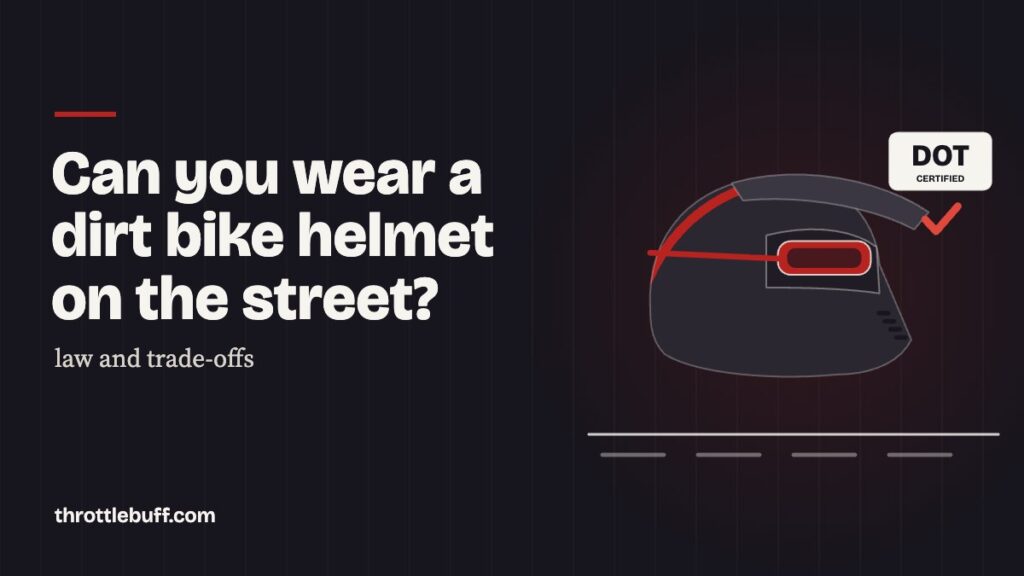
Yes, you can wear a dirt bike helmet on the street in the US, as long as it carries a DOT certification label. The federal helmet standard covers every helmet made for motorcyclists, so a certified motocross helmet is as legal on the road as a full-face. The catch is comfort: a dirt helmet has no face shield, a peak that catches the wind at speed and nothing to seal out noise and weather.
So the real question is not whether you can, but how far and how fast you plan to ride in it. Here is what the law checks, what changes once you are on pavement, and when a different helmet is the better tool.
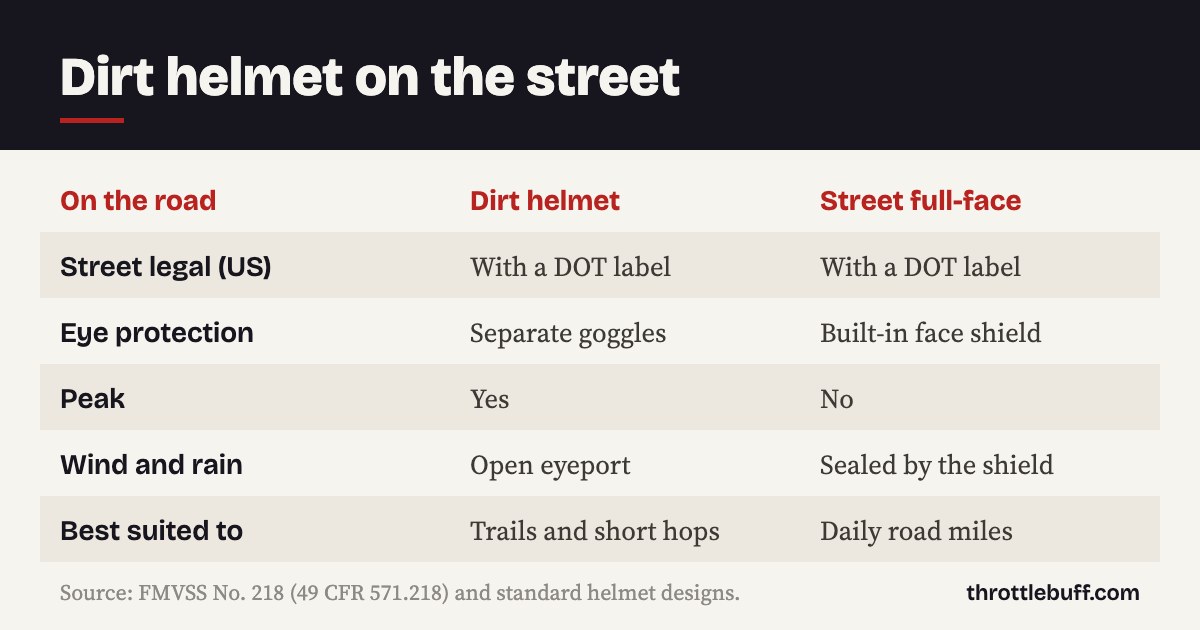
Dirt bike helmet vs street helmet on the road
| On the road | Dirt bike helmet | Street full-face | Dual-sport helmet |
|---|---|---|---|
| Street legal in the US | Yes, with a DOT label | Yes, with a DOT label | Yes, with a DOT label |
| Eye protection | Separate goggles | Built-in face shield | Face shield, and many accept goggles |
| Peak | Yes | No | Yes, usually removable |
| Chin bar | Extended, for airflow at low speed | Close to the face | In between |
| Wind, rain and cold | Open eyeport lets them in | Sealed by the shield | Sealed with the shield down |
| Best suited to | Trails and short road links | Daily road miles and highways | Mixed road and dirt rides |
Can you wear a dirt bike helmet on the street? What the law says
US law does not sort helmets into dirt and street. Federal Motor Vehicle Safety Standard No. 218 applies to “all helmets designed for use by motorcyclists and other motor vehicle users”, and a maker certifies a helmet by fitting a permanent label. That label shows the maker or brand, the model, the letters DOT, “FMVSS No. 218” and the word “CERTIFIED”. If your motocross helmet has it, it meets the same federal standard as a road helmet. Our guide on how to tell if a helmet is DOT approved shows where to look and how to spot a fake.
Two parts of the standard explain why a certified dirt helmet is fine on the road. It demands peripheral vision of at least 105 degrees to each side, which the wide goggle opening clears easily. It also limits rigid projections on the outside of the shell to 0.20 inch (5 mm), so a peak cannot be a rigid part of the shell.
Two things to check before you rely on it:
- Look for the label, do not assume. An off-road helmet sold without DOT certification is not legal for the road in a state that requires a helmet.
- State rules sit on top. Helmet laws differ by state, and some states write eye protection into law as well. Our helmet laws by state lookup has the detail.
Outside the US the label changes but the idea does not. In countries that use the UN rule, the helmet needs an ECE approval label instead, as explained in ECE 22.06 vs DOT. Snell certification is voluntary and sits on top of either: the Snell Foundation says its M standard is for “motorcycling and other motorsports”, so the same Snell sticker appears on road and off-road helmets.
What a dirt bike helmet is like on the street
Goggles instead of a shield
A dirt helmet leaves your face open, so goggles are not optional on the road. They keep out dust, insects and stones, but they do not seal the helmet the way a shield does, and your nose, cheeks and chin stay in the wind. Pick a pair that fits the eyeport without gaps. Our best motorcycle goggles guide covers road-friendly options.
The peak at speed
The peak is there to block roost and low sun at trail speeds. On a faster road it works like a small sail: the wind pushes on it when you look ahead and tugs when you turn your head to check a lane. Around town you may never notice. On a highway you will.
Wind, noise and weather
Dirt helmets are built to move as much air as possible while you work hard at low speed. On the street that same airflow means wind noise, cold in winter and a wet face in rain. If quiet matters to you, a sealed road helmet is the fix, and our quietest motorcycle helmets guide lists the ones built for it.
When a dual-sport helmet makes more sense
If your rides mix real road miles with dirt, a dual-sport helmet is designed for exactly that. It keeps the peak and the roomy chin bar but adds a face shield, and many let you remove the peak for highway stretches or lift the shield and wear goggles off road. See our best dual-sport helmets for current models. If the helmet will stay mostly in the dirt, our best dirt bike helmets guide lists the certification each pick carries, and types of motorcycle helmets compares every style side by side.

FAQ
Are dirt bike helmets street legal?
In the US, yes, when the helmet carries a DOT label showing it is certified to FMVSS No. 218. A helmet with no DOT label is not.
Can you wear a motocross helmet on a street bike?
Yes. The standard is about the helmet, not the bike. Expect more wind on your face and more noise than with a full-face, and wear goggles.
Do you need goggles with a dirt bike helmet on the road?
For practical purposes, yes. The helmet has no shield, and some states require eye protection by law.
Is a dirt bike helmet as safe as a street helmet?
A DOT-certified dirt helmet has met the same federal standard as a DOT-certified street helmet. The difference on the road is the open face area and the lack of a shield, not the certification.
Can you take the peak off a dirt bike helmet for street riding?
On most helmets the peak is held on by screws and can be removed, but check the owner manual first. FMVSS No. 218 labels tell owners to “make no modifications”, so only remove parts the maker says are removable.
Verdict
A DOT-labelled dirt bike helmet is legal on the street and perfectly workable for short road links between trails. For regular commuting or highway miles, the open eyeport, the peak and the noise wear thin quickly. If you ride both, buy a dual-sport helmet. If you ride mostly road, a full-face from our best motorcycle helmets guide will be quieter, warmer and drier.
Browse all our helmet guides.