
Throttle Buff is reader-supported: we may earn a commission when you buy through links on this page. Learn more.
To tell if a motorcycle helmet is DOT approved, check the back of the shell for a certification label that reads, top to bottom, the maker’s name, the model, “DOT”, “FMVSS No. 218” and “CERTIFIED”. Then look inside for a permanent manufacturer label with the size and the month and year it was made. A real DOT helmet also weighs about 3 pounds and has a firm foam liner about an inch thick. A sticker on its own proves nothing, because fake DOT stickers are sold online. If the helmet is very light, has a thin or soft liner, or has a label that only says “DOT”, treat it as suspect.
This guide is research-based. We did not test helmets ourselves. Everything below comes from the federal standard (FMVSS No. 218, 49 CFR 571.218), NHTSA’s consumer guidance and NHTSA rulemaking notices, checked in November 2026.
What “DOT approved” really means
“DOT approved” is a common phrase, but it isn’t quite accurate. NHTSA, the part of the US Department of Transportation that writes the rule, does not approve helmets before they go on sale. Manufacturers test their own helmets and certify that they meet Federal Motor Vehicle Safety Standard No. 218. That standard covers impact absorption, penetration resistance, chin strap strength and how much of the head the helmet covers.
NHTSA checks the market afterward. Each year it buys helmets, usually at random, and has them tested. Complaints help decide which ones. A helmet that fails can lead to a recall and be pulled from stores. Every helmet sold for road use in the US must meet FMVSS 218, so “DOT certified” is the legal minimum, not a premium feature. For how DOT compares with stricter tests, see our ECE 22.06 vs DOT guide.
Check 1: the DOT label on the back
Since May 13, 2013, the certification label has had to follow strict rules. According to the regulation (49 CFR 571.218, S5.6.2), a genuine label:
- Shows five things in this order: the manufacturer’s name or brand, the model designation, “DOT”, then “FMVSS No. 218” and “CERTIFIED”.
- Has big “DOT” letters: at least 0.38 inch (1 cm) tall. The “FMVSS No. 218” and “CERTIFIED” text must be at least 0.09 inch tall.
- Sits in a fixed spot: on the outside of the shell, centered left to right, with the middle of “DOT” 1 to 3 inches above the bottom edge at the back.
- Carries nothing else: no logos, slogans or extra text on the label itself, and the lettering must contrast with the background.
- Is permanent: it should be firmly attached and readable, not a loose decal you can peel off with a fingernail.
The model name matters most. NHTSA added it in 2011 because sellers were putting generic “DOT” stickers on novelty helmets. A label with a model name lets you search that exact helmet. A label that only says “DOT” is fine on a helmet made before May 2013, but on anything newer it’s a red flag.
Check 2: the manufacturer label inside
Every compliant helmet also has a second, separate label inside. It has to be permanent and readable without pulling out the padding. It must list:
- The manufacturer’s name
- The size, as a number (for example 57–58 cm), not just “M” or “L”
- The month and year of manufacture
- The shell and liner materials
- Cleaning agents, paints and adhesives that are safe to use
- A warning not to modify the helmet, and an instruction to replace it after a severe impact
No inside label is one of the warning signs NHTSA lists. The date of manufacture also tells you how old the helmet is. Our guide to motorcycle helmet expiration explains when to replace one.
Check 3: weight, liner, strap and shape
Labels can be faked, so NHTSA also points to physical signs. These are rules of thumb, not legal limits, but novelty helmets fail most of them.
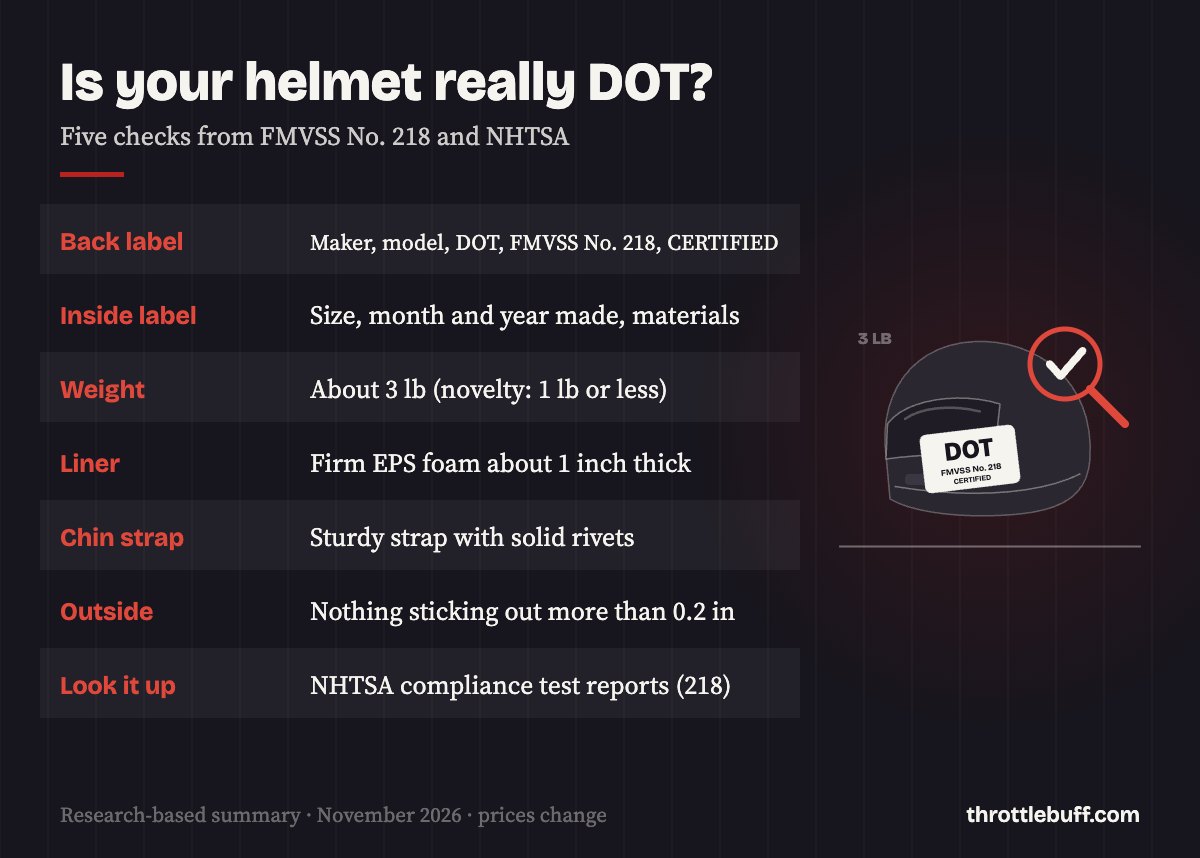
| What to check | DOT-compliant helmet | Novelty helmet warning sign |
|---|---|---|
| Weight | About 3 lb | 1 lb or less |
| Inner liner | Firm polystyrene (EPS) foam about 1 inch thick | Soft padding, thin foam or no liner |
| Chin strap | Sturdy strap with solid rivets | Flimsy strap, plastic buckle that breaks easily |
| Outside surface | Nothing sticking out more than 0.2 inch (5 mm), apart from visor fasteners | Spikes, horns or rigid decorations |
| Back label | Maker, model, DOT, FMVSS No. 218, CERTIFIED | Only “DOT”, a crooked sticker or no label |
| Inside label | Maker, size, date, materials, care warnings | Missing |
| Marketing | Lists the standards it meets | “Thinnest”, “lightest” or “for novelty use only” |
Size gives novelty helmets away too. A thin shell with no real liner sits close to the head, so these helmets look much smaller than a real helmet. Some German Army and skull-cap styles are compliant, though, so shape alone isn’t proof either way. Check the labels and the liner.
Check 4: look it up
NHTSA publishes its helmet test reports in a compliance test reports database. Helmet reports are filed under standard 218 and list the maker and model. Searching the model name from the back label tells you whether NHTSA has tested that helmet and how it did. NHTSA notes that a single report isn’t a final ruling, and most helmets on sale have never been picked for testing, so no result doesn’t mean a problem. A failure is worth knowing about, though.
It also helps to search the model on the maker’s own site and on a major retailer. If you can’t find the helmet anywhere except an auction listing, be careful.
Fake DOT stickers and novelty helmets
A novelty helmet is one sold “for display” or “not for highway use” that doesn’t meet FMVSS 218. In its 2011 rule, NHTSA said that novelty helmets it tested failed “all or almost all” of its performance tests. That is why sellers stick fake labels on them. A DOT sticker sold on its own, for you to put on any helmet, is not a certification. Only the manufacturer can certify a helmet, and putting a sticker on a novelty helmet doesn’t change how it performs in a crash.
In 2015 NHTSA proposed adding a legal definition of a motorcycle helmet and simple roadside checks such as liner thickness. In May 2025 it withdrew that proposal and said no new rule is expected soon, so the label rules above are still what applies in November 2026. Some states don’t require adult riders to wear a helmet. Where they do, it must be a compliant one. Check yours in our helmet laws by state guide.
What about ECE 22.06 and Snell labels?
Many good helmets also carry an ECE 22.06 label sewn onto the chin strap (an “E”, a country number and a code starting “06”) or a Snell M2025 sticker inside. Both are good signs, but in the US the DOT label is still the legal requirement for road use, and Snell warns that fake Snell stickers exist too. Our helmet safety ratings guide explains what each test does differently.
Buying a helmet you can trust
The simplest way to avoid fakes is to buy a known brand from a major retailer. Certified full-face helmets start around $100 to $150 from brands like Bell, HJC and Scorpion. Our best helmets under $100 and under $200 guides list current DOT models.
FAQ
Where is the DOT sticker on a motorcycle helmet?
On the outside of the shell at the back, centered, with the “DOT” letters 1 to 3 inches above the bottom edge. Some helmets have it under a clear coat, but that isn’t required.
Can I buy a DOT sticker and put it on my helmet?
You can buy one, but it doesn’t make the helmet certified or legal. Only the manufacturer can certify a helmet to FMVSS 218.
Is a helmet with only a “DOT” sticker fake?
Not if it was made before May 13, 2013, when the longer label became required. On a newer helmet, a label without the maker, the model and “FMVSS No. 218” is a warning sign.
Are novelty helmets illegal?
Selling a novelty helmet isn’t always illegal if it’s clearly marked as not for road use. Wearing one doesn’t count as wearing a helmet in states with a helmet law, and it gives you little protection in a crash.


