Throttle Buff is reader-supported: we may earn a commission when you buy through links on this page. Read our affiliate disclosure.
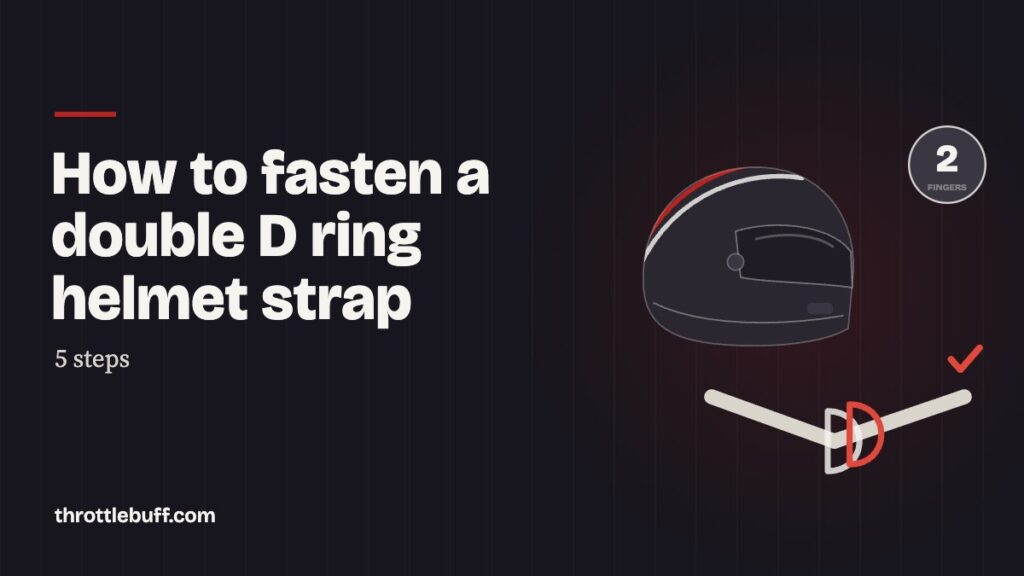
To fasten a double D ring helmet strap, thread the strap end through both rings, fold it back over the outer ring, feed it through the inner ring only and pull it snug. The strap is tight enough when no more than two fingers fit between it and your chin. The snap on the end only stops the loose strap flapping. It does not hold the helmet on.
It takes ten seconds once your hands know it, and it is worth getting right: a helmet that is not fastened properly can come off in a crash. Below are the steps, the mistakes that leave a strap looking fastened when it is not, and how the double D ring compares with ratchet and quick-release buckles.
Double D ring and other helmet buckles compared
| Buckle | How it fastens | Adjusted every ride? | Where you usually find it |
|---|---|---|---|
| Double D ring | The strap is pinched between two metal rings | Yes, you set the tension each time | Sport, race and many premium helmets |
| Micrometric (ratchet) | A toothed tab clicks into a sprung latch | In small steps, after the strap length is set once | Touring, modular and commuter helmets |
| Quick release | A metal tongue clicks into a buckle, like a seat belt | No, the strap length is set once | Some open-face and budget helmets |
Whatever the buckle, a helmet sold for road use in the US has to pass the same strap test. Under FMVSS No. 218 the retention system is loaded with 50 pounds for 30 seconds and then a further 250 pounds for 120 seconds. It must not separate, and it may not stretch more than 1 inch between the two loads. Our guide to helmet safety ratings explains the other tests behind each label.
How to fasten a double D ring helmet: step by step
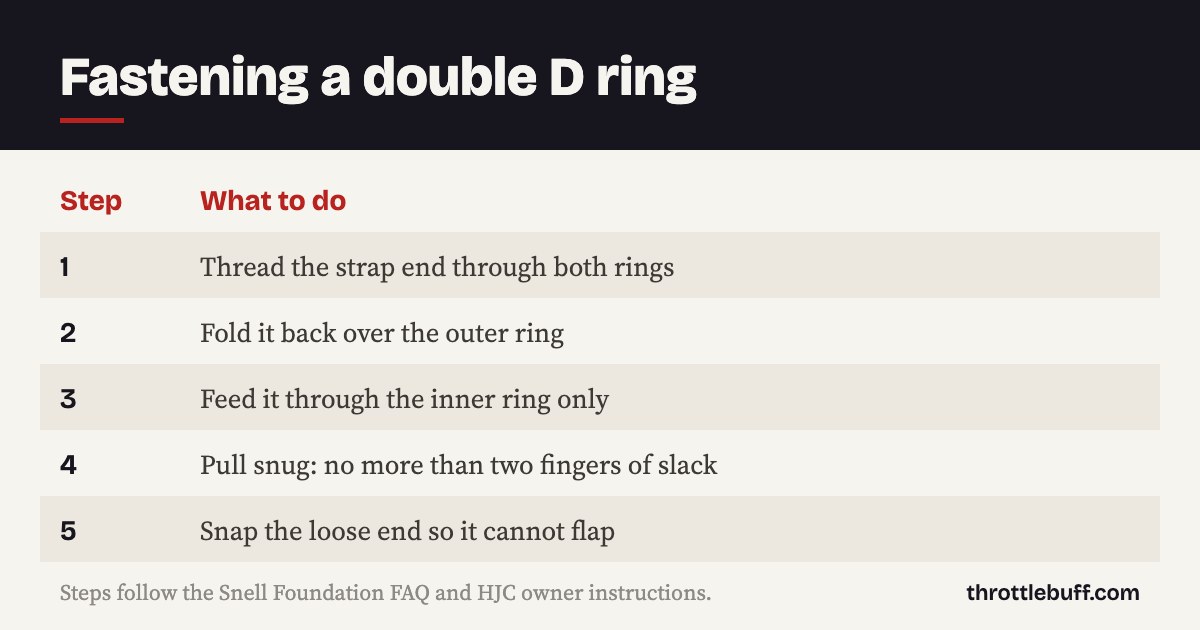
1. Thread the strap through both rings
Put the helmet on and find the two rings on one side and the long strap on the other. Pass the strap end through both rings together, from the side nearest your neck outward. Keep the strap flat, with no twist.
2. Fold it back over the outer ring
Separate the rings with a fingertip. Bring the strap end back over the outer ring, the last one it came through.
3. Feed it through the inner ring only
Push the end back through the inner ring, so it comes out between the two rings. This is the step that makes the buckle work: under load the rings squeeze together and grip the strap. The Snell Foundation describes it the same way: through both rings, then back over one and through the other.
4. Pull it snug
Pull the loose end until the strap sits firmly under your jaw. Snell’s test is that the strap should not be loose enough to let more than two fingers through under your chin. HJC puts it more strongly: as tight as possible without causing pain, with no slack in the strap.
5. Snap down the loose end
Press the snap on the strap end onto its stud so the tail does not whip against your neck or jacket. To take the helmet off, undo the snap and pull the tab on the ring, or lift the outer ring, to release the tension.
Mistakes that leave a D ring strap unfastened
- Relying on the snap. HJC’s instructions say not to rely on the snap to secure the helmet, because it is there only to stop the strap flapping. A strap that is snapped but not threaded is not fastened.
- Stopping after step 1. A strap that only passes through both rings will slide straight back out. It has to come back through the inner ring.
- Leaving it loose for comfort. If you can pull the strap forward over your chin, it is too loose.
- Threading it twisted. A twisted strap digs in and does not sit flat between the rings.
- Riding with a frayed strap. Check the webbing and stitching when you clean the helmet. Our helmet cleaning tips cover the strap, and helmet expiration explains when wear means replacement.
Check the fit once it is fastened
With the strap done up, try to roll the helmet forward off your head by lifting the back edge. It should stay on. If it rolls off with the strap snug, the helmet is the wrong size or shape for you, and no strap will fix that. Start again with how to size and buy a helmet, and remember that a new lid loosens a little as the padding settles, as covered in how to break in a motorcycle helmet.
Why racers use the double D ring
The double D ring has no moving parts and no spring, so there is little to wear out or jam, and it tightens to your exact fit every time. It is also the buckle racing demands: Dainese notes that the FIM’s FRHPhe-02 racing homologation requires a chin strap with a double D ring fastening. That is why track-focused helmets use it, while a ratchet buckle, which is easier with gloves on, is common on the lids in our best modular helmets guide.
A side benefit: the rings give a cable or carabiner-style helmet lock something solid to pass through when you park. See our best motorcycle helmet locks.

FAQ
How do you tighten a double D ring helmet?
Pull the loose end of the strap away from the rings. The rings grip more firmly as the strap is loaded, so it will not slip back once snug.
How tight should a D ring helmet strap be?
Snug under the jaw. Snell says no more than two fingers should fit between the strap and your chin, and HJC says there should be no slack.
No. The snap only keeps the strap end from flapping. The helmet is fastened only when the strap is threaded back through the rings.
Is a double D ring safer than a ratchet buckle?
Both have to pass the same retention test on a DOT-certified helmet. The double D ring is required for FIM-homologated race helmets and adjusts to an exact fit each time. A ratchet is quicker to use.
How do you undo a double D ring quickly?
Unsnap the loose end, then pull the tab on the ring, usually red, or lift the outer ring away from your neck. The strap loosens at once.
Can you fasten a D ring with gloves on?
It is easier bare-handed. Fasten the strap first and put your gloves on last.
Verdict
Through both rings, back over the outer one, through the inner one, pull snug, snap the tail. Do it the same way every ride and it becomes automatic. If the strap is right and the helmet still moves, the fit is the problem, and our best motorcycle helmets guide is the place to start looking for a better match.
Browse all our helmet guides.