
Throttle Buff is reader-supported: we may earn a commission when you buy through links on this page. Read our affiliate disclosure.
To waterproof a motorcycle jacket again, wash it with a small amount of liquid detergent, dry it, then give it 20 minutes of warm tumble-dryer heat to wake up the factory water-repellent finish. Only if water still soaks into the outer fabric after that do you need a new treatment, sprayed on and set with heat. Always check the care label first, because the limits differ by jacket.
The good news is that a jacket that has started to soak up rain has usually not lost its waterproofing. It has lost its DWR, the durable water-repellent finish on the outer fabric, and that can be restored at home.
What the makers say about washing and reproofing
| Step | Gore-Tex | KLIM | REV’IT! |
|---|---|---|---|
| Wash | 40°C (105°F), small amount of liquid detergent, rinse twice | Warm water, mild liquid detergent, extra rinse cycle | Gore-Tex gear at 40°C. Other textiles at 30°C maximum, gentle cycle |
| Never use | Powder detergent, fabric softener, stain remover, bleach | Chlorine bleach | Powder detergent, fabric softener, bleach, solvents |
| Dry | Line dry, or tumble on a warm, gentle cycle | Dry completely on medium heat | Gore-Tex gear: line dry or warm tumble. Other textiles: drip dry, no dryer |
| Reactivate the finish | 20 minutes in the dryer once dry, or a warm iron over a towel, no steam | An extra 20 minutes in the dryer | 20 minutes in the dryer, Gore-Tex gear only |
| New DWR treatment | Spray-on or wash-in when water no longer beads, then heat | Heat-activated spray-on. Wash-in is not recommended | Not covered on its care page |
Sources: Gore-Tex outerwear care instructions, KLIM care instructions and REV’IT! wash and care, read in November 2026. Notice that REV’IT! gives two different sets of limits depending on the membrane, and says the label sewn into the garment overrides everything else. The same goes for any brand.
Why a waterproof jacket starts soaking up water
Most waterproof textile jackets have two defenses. A membrane inside the fabric stops water getting through, and a DWR finish on the outside makes rain bead up and roll off. Gore-Tex lists what wears the finish down: abrasion, dirt, sunscreen, insect repellent, detergent residue and smoke.
When the finish goes, the outer fabric “wets out”: it darkens, gets heavy and feels cold. Gore-Tex is clear that a waterproof jacket is still waterproof when the DWR wears off, because the membrane is rated without it. KLIM says the same, that you will still be dry inside, but adds the reason to care on a motorcycle: a soaked shell pulls heat out of you, since water conducts heat 23 times as fast as air. On a cold, wet ride that matters as much as the layers in our guide to staying warm on a motorcycle.
How to waterproof a motorcycle jacket, step by step
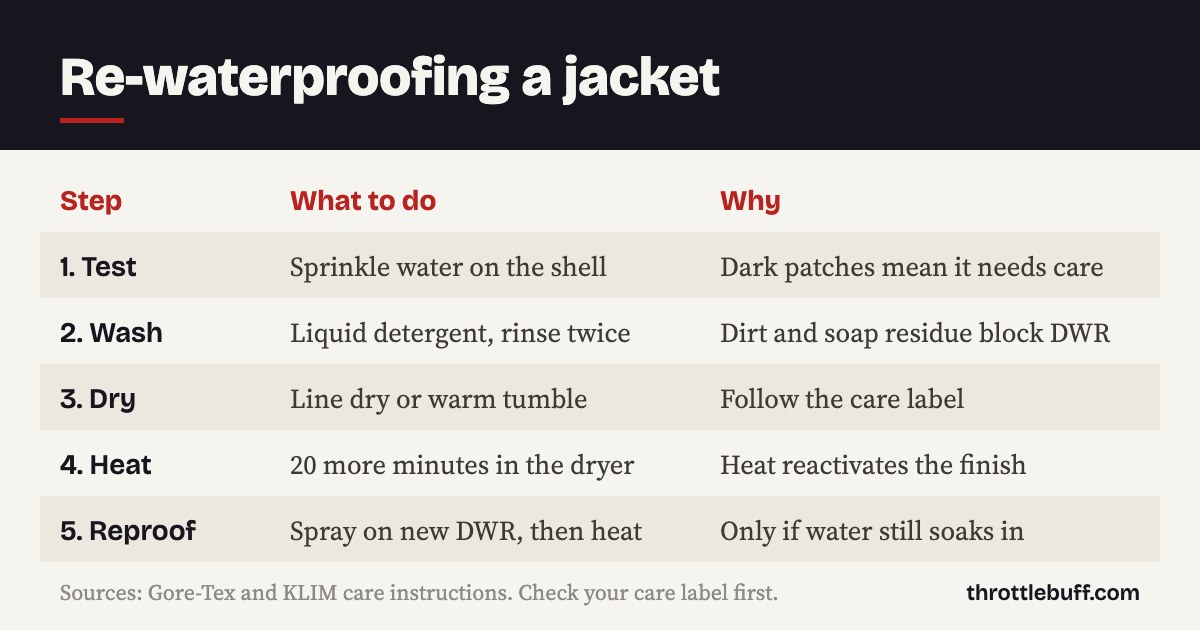
1. Test it with water
Sprinkle water over the dry jacket, including the shoulders, forearms and chest. If it beads and runs off, the finish is fine. If it soaks in and leaves dark patches, carry on.
2. Strip and close the jacket
Take out the armor and any removable liners, then close every zipper, flap and hook-and-loop tab. Open hook-and-loop snags fabric in the drum.
3. Wash it
Use a small amount of liquid detergent, or a wash made for technical textiles, at the temperature on the label. Rinse twice. KLIM explains why: leftover soap attracts water and works against the finish. Skip powder, fabric softener and bleach. REV’IT! warns that softeners destroy the function of the membrane.
4. Dry it the way the label allows
Line dry, or tumble on a warm, gentle cycle if the label permits. Never dry a jacket on a radiator or next to a heater.
5. Add heat to reactivate the finish
Once the jacket is dry, give it 20 more minutes in the dryer on warm. Gore-Tex and KLIM both give that figure. No dryer, or a label that forbids one? Gore-Tex’s alternative is a warm iron with no steam and a towel between the iron and the fabric.
6. Test again, and reproof only if needed
Repeat the water test. Often the wash and heat are enough. If water still soaks in, apply a new DWR treatment made for technical outerwear, following the bottle, then heat the jacket again for 20 minutes so the treatment sets.
Spray-on or wash-in?
Gore-Tex says both work, and points out that a spray lets you put extra on the areas that take the most wear, such as shoulders, elbows and knees. KLIM goes further and does not recommend wash-in products, because they coat every surface, inside as well as out, which can hurt comfort and performance. For a motorcycle jacket with a fixed lining, a spray on the outside is the safer choice. The same steps work for textile riding pants.
When reproofing will not fix it
A DWR treatment only helps the outer fabric shed water. If rain reaches your base layer while the shell is still beading, or comes in at a seam, zipper or cuff, the finish is not the cause. Contact the maker about the warranty or plan for a replacement. If it is time for a new one, start with our best motorcycle jackets guide or the four-season jacket picks, and see textile vs mesh vs leather for how the materials differ.
What about leather jackets?
Leather is a different job. REV’IT! tells owners to wipe leather with a damp cloth and lukewarm water, let it dry at room temperature, then use a leather cleaner and conditioner. It never goes in a washing machine. Conditioned leather copes with a shower but is not waterproof in the way a membrane jacket is, so riders in leather jackets usually carry a rain layer. Our tips for riding a motorcycle in rain cover the rest.

FAQ
How do I re-waterproof a textile motorcycle jacket?
Wash it with liquid detergent, rinse twice, dry it and add 20 minutes of warm dryer heat. If water still soaks in, spray on a new DWR treatment and heat it again.
How often should I reproof a motorcycle jacket?
There is no fixed interval. KLIM’s rule is to wash when water stops beading or the gear looks or smells dirty. Reproof only when washing and heat no longer bring the beading back.
Can I tumble dry a motorcycle jacket?
Only if its label says so. Gore-Tex and KLIM allow warm tumble drying, but REV’IT! says no dryer for its textile jackets without a Gore-Tex membrane.
Why is my waterproof jacket soaking up water?
The water-repellent finish on the outer fabric has worn off or is clogged with dirt. The membrane underneath normally still keeps you dry.
Does fabric softener damage a waterproof jacket?
Yes. Gore-Tex says not to use it, and REV’IT! says softeners destroy the function of the membrane.
Verdict
Start with the cheap fix: a proper wash, a double rinse and 20 minutes of warm heat restore the finish on most jackets. Buy a spray-on DWR only if the water test still fails, and treat the shoulders and arms most heavily. If the jacket leaks while water is still beading on the outside, no bottle will fix it, and it is time to talk to the maker.
Browse all our riding gear guides.