
Throttle Buff is reader-supported: we may earn a commission when you buy through links on this page. Read our affiliate disclosure.
The most common motorcycle helmet buying mistakes are choosing on looks, guessing your size, ignoring head shape and buying used. All four leave you with a helmet that fits badly or cannot be trusted, and fit and certification are what protect you in a crash. The fix is simple: check the certification label first, the fit second and everything else after that.
New riders make these mistakes more than anyone, because a first helmet is usually bought in a hurry alongside a bike, a course and the rest of the gear. Below are nine mistakes, what each one costs you and what to do instead. Fit and labelling advice comes from NHTSA, the US road safety agency, and from helmet makers. We research and compare gear; we did not test helmets for this guide.
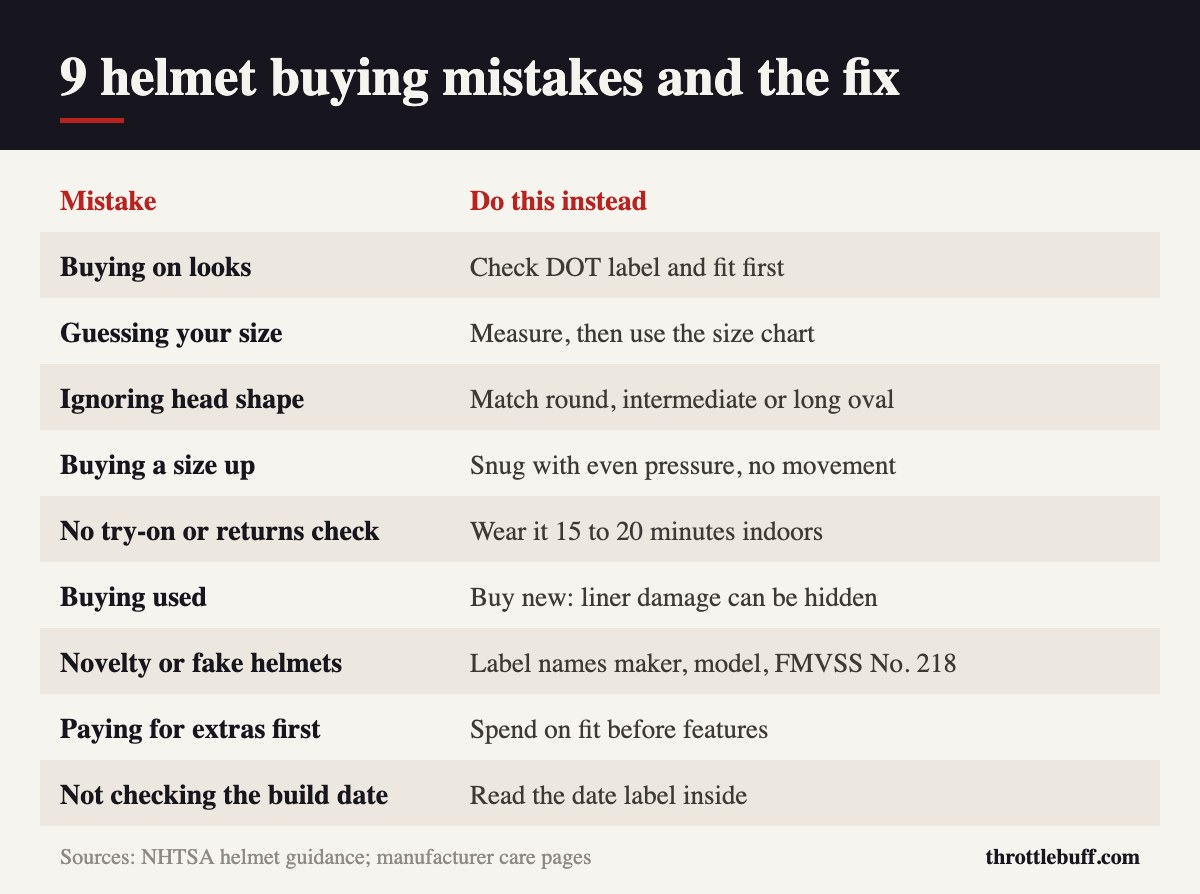
Motorcycle helmet buying mistakes at a glance
| Mistake | What it costs you | Do this instead |
|---|---|---|
| Buying on looks | A helmet that looks right but fits or protects poorly | Check the DOT label and the fit before the graphics |
| Guessing your size | A helmet that moves on your head | Measure your head and use that brand’s size chart |
| Ignoring head shape | Pressure points on the forehead or temples | Match round oval, intermediate oval or long oval |
| Buying a size up for comfort | A loose helmet once the padding settles | Choose snug, even pressure with no movement |
| Skipping the try-on and the returns check | Being stuck with a helmet that hurts | Wear it indoors for 15 to 20 minutes with the tags on |
| Buying used | Hidden damage to the foam liner | Buy new from an authorized seller |
| Falling for a novelty or fake helmet | Little or no crash protection | Read the label: maker, model, DOT, FMVSS No. 218, CERTIFIED |
| Paying for extras before fit | Less budget for the helmet that fits best | Fit and certification first, features second |
| Not checking the build date | Starting the clock on an old helmet | Find the date label inside before you keep it |
9 helmet buying mistakes new riders make
1. Buying on looks
Graphics and colour are the first things you see on a shop wall or a product page, so they tend to make the decision. They should come last. Shortlist helmets that are certified and fit your head, then pick the one you like the look of from that list. Style also covers helmet type: an open-face lid may suit the bike, but it leaves your chin and face uncovered. Our guide to the types of motorcycle helmets sets out what each one covers.
2. Guessing your size
Hat size and “I am usually a medium” are not good enough, because every brand cuts its sizes differently. NHTSA’s helmet guide says to use a cloth tape, start just above your eyebrows and circle the thickest point at the back of your head, then check that number against the maker’s size chart. Our helmet size calculator turns the measurement into a size for the main brands.
3. Ignoring head shape
Two riders with the same measurement can need different helmets. NHTSA describes three shapes: round oval, intermediate oval, which is the most common, and long oval. Look down on your head in a mirror or ask a friend, and judge the shape of your head, not your face. A helmet built for the wrong shape presses on the forehead or the sides of the head however carefully you pick the size.
4. Buying a size up for comfort
A new helmet that feels roomy in the shop is usually too big. NHTSA says a correctly sized helmet is a little tight, with even pressure around the head and no uncomfortable pressure points, and it should not move when you shake your head. The comfort padding also packs down with use, so a helmet only gets looser. If you are between sizes, try the smaller one first. Our guide on how to break in a motorcycle helmet explains what settles and what does not.
5. Skipping the try-on and the returns check
Thirty seconds in front of a mirror tells you very little. Wear the helmet for 15 to 20 minutes indoors, with the tags on and the chin strap done up. Even snugness is fine. A sharp spot on the forehead or temples is not, and it will not go away. If you buy online, read the returns and exchange terms before you order, and keep the box and tags until you are sure. The steps in how to size and buy a helmet cover the full fit check.
6. Buying used
A second-hand helmet looks like an easy saving, but you cannot see its history. The foam liner absorbs an impact by crushing, and it does not recover, so a helmet that has been dropped hard or crashed can look fine and protect far less. The padding has also shaped itself to someone else’s head. New certified helmets start at about $120, so the saving is small. See are cheap motorcycle helmets safe for what a budget helmet has to pass.
7. Falling for a novelty or fake helmet
Not every helmet on sale is a real one. NHTSA warns that novelty helmets do not meet the federal standard and will not protect you in a crash, and that fake DOT labels are sold to put on them. A compliant helmet has a label on the outside back with the manufacturer or brand, the model, DOT, FMVSS No. 218 and CERTIFIED. NHTSA’s guide on how to identify unsafe motorcycle helmets lists the other signs, and our page on how to tell if a helmet is DOT approved shows what to look for.
8. Paying for extras before fit
Bluetooth, a drop-down sun visor, a carbon shell and a famous logo all push the price up. None of them helps if the helmet does not fit. Price is not a safety score either: the UK government’s SHARP crash-test scheme says there is no connection between star rating and price. Set a budget for the best-fitting certified helmet, then add features with whatever is left. How much to spend on a motorcycle helmet breaks down what each price tier adds, and helmet safety ratings explains DOT, ECE 22.06, Snell and SHARP.
9. Not checking the build date
Helmets wear out with age as well as use, and makers give replacement guidance. Shoei, for example, recommends replacing a helmet five years after it was first bought. Closeout stock can be a good deal, but check the manufacture date label inside the helmet so you know what you are getting. Our guide to motorcycle helmet expiration shows where to find the date and when to replace.
What to look for when buying a motorcycle helmet
Turn the nine mistakes round and you have a short checklist. Work through it in this order:
- Certification. A DOT label on the back that names the maker and model. ECE 22.06 or Snell on top is a bonus.
- Type. A full-face helmet covers the most, which is why most new riders start with one.
- Shape and size. Measure, check the brand’s chart and match your head shape.
- The wear test. Snug, even pressure for 15 to 20 minutes and no movement when you shake your head.
- Date and seller. A recent manufacture date, bought new from an authorized dealer with a clear returns policy.
- Features and looks. Only now compare vents, visors, weight and graphics.
If you want a shortlist that already passes the first two checks, our picks for a first motorcycle helmet start at about $120.

FAQ
What is the biggest mistake when buying a motorcycle helmet?
Getting the fit wrong. A helmet that is too big can move or roll on your head, and a certified shell cannot do its job if it is not sitting where it should. Measure your head, match your head shape and do a proper wear test before you look at anything else.
Should I buy a motorcycle helmet online?
You can, as long as you measure first, buy from the brand or an authorized dealer and check the returns terms before you order. Try the helmet on indoors with the tags attached, and send it back if you feel pressure points or it moves when you shake your head.
Is it OK to buy a used motorcycle helmet?
It is not a good idea. You cannot confirm whether a used helmet has been dropped or crashed, and damage to the foam liner is often invisible. The padding has also worn to fit another head. A new certified budget helmet is the safer way to save money.
How do I know what size motorcycle helmet I need?
Wrap a cloth tape around your head just above the eyebrows and around the thickest point at the back, then compare the measurement with the size chart for the exact brand and model. Sizes differ between brands, so repeat the check every time you change brand.
Is an expensive helmet safer for a new rider?
Not reliably. Every road helmet sold in the US has to meet the same DOT standard, FMVSS No. 218, whatever it costs. Extra money mostly buys lower weight, less noise and more features, so a new rider is better served by a well-fitting certified helmet at a sensible price.
Verdict
Most helmet buying mistakes come from doing things in the wrong order. Check the label, then the fit, then the date and the seller, and only then the features and the paint. Do that and a first helmet at almost any budget will be one you can trust and wear all day.
Browse all our helmet guides.


