
Throttle Buff is reader-supported: we may earn a commission when you buy through links on this page. Learn more.
The quietest motorcycle helmets you can buy in the US are the Schuberth C5 modular and Schuberth S3 full face. Schuberth is the only major brand that publishes noise figures, and it claims 85 dB(A) at 100 km/h (62 mph) for both. The Shoei RF-1400, Shoei Neotec 3 and Sena Phantom ANC are also widely reported as quiet. But no helmet is quiet enough on its own. Studies put the noise inside most helmets at around 100 dB at highway speed, which can damage your hearing within minutes. Wear earplugs whatever helmet you choose.
Quick picks
-
Best overall
- Type
- Modular
- Maker noise claim
- 85 dB(A) at 100 km/h
- About
- $799
-
Quietest full face
- Type
- Full face
- Maker noise claim
- 85 dB(A) at 100 km/h
- About
- $599
-
Noise cancelling
- Type
- Full face with intercom
- Maker noise claim
- Up to 20 dB less ambient noise
- About
- $649
-
- Sport full face: Shoei RF-1400
- Premium modular: Shoei Neotec 3
- Touring with sun visor: Shoei GT-Air 3
- Arai pick: Arai Regent-X
- Modular under $600: HJC RPHA 91
This guide is research-based. We did not measure these helmets ourselves. We used makers’ published noise claims, acoustic research on helmet noise, and what major reviewers and owners report. A maker’s dB figure is measured on its own terms, usually on a naked bike at one speed, so treat it as a guide, not a ranking. Prices are approximate US street prices in November 2026.
How loud is it inside a motorcycle helmet?
Louder than most riders think. A few key findings:
- A 1994 study by Lower and colleagues for the UK Institute of Acoustics measured about 78–90 dB(A) at 30 mph on the road, rising to 114–116 dB(A) at 120 mph. Above about 55 mph, noise rose about 15.5 dB each time speed doubled.
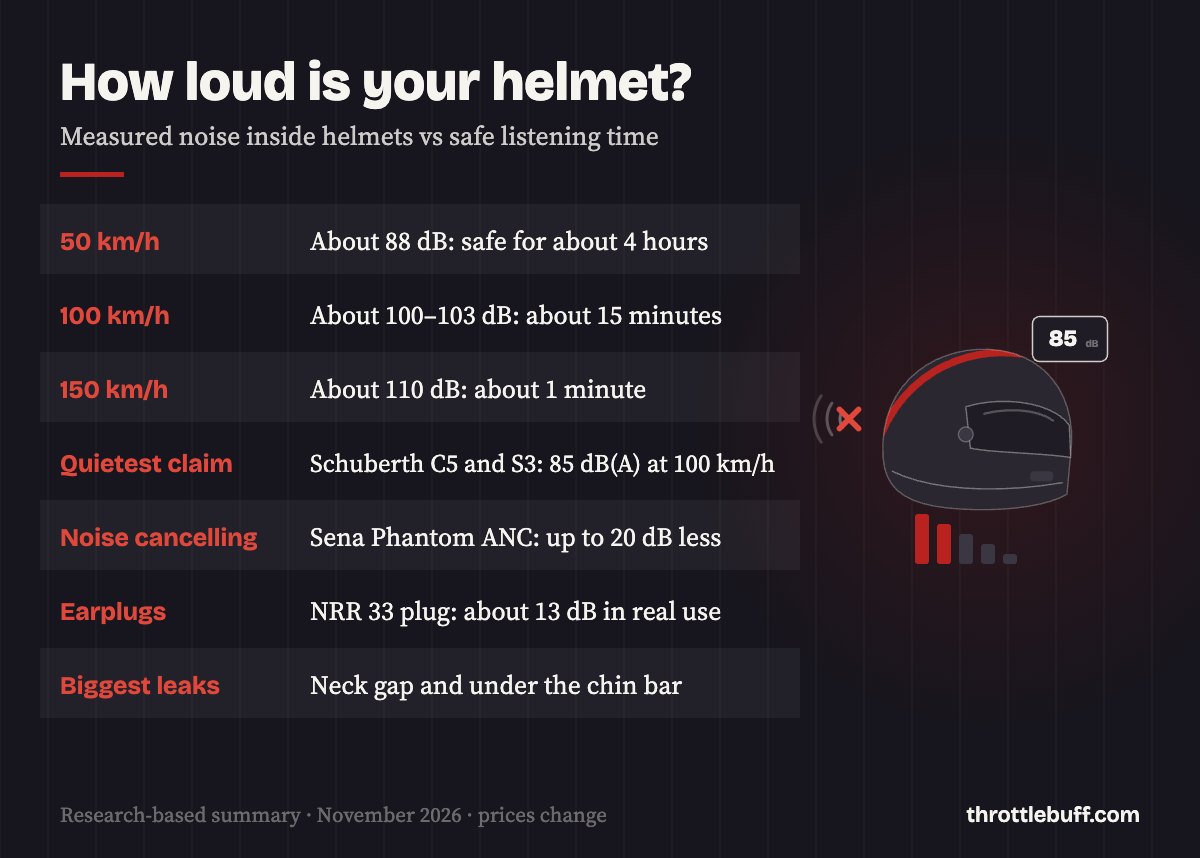
- Dutch magazine Promotor tested 10 modular helmets and found averages of 88 dB at 50 km/h, 103 dB at 100 km/h and 110 dB at 150 km/h. Even the quietest measured 100 dB at 100 km/h.
- Rider Magazine found every helmet it tested let in more than 100 dB at 70 mph.
For comparison, the US workplace safety agency NIOSH recommends no more than 85 dBA averaged over 8 hours, and the safe time halves for every 3 dB more. That means about 2 hours at 91 dB, 30 minutes at 97 dB and only 15 minutes at 100 dB. A full day on the highway in any helmet is well past that.
Where helmet noise comes from
Most of the noise is wind, not the engine or exhaust. Researchers found that:
- Turbulence matters more than shell shape. The rough air coming off your windscreen or your shoulders is the main source. With a low screen or none, it hits the neck area. With a tall screen, it hits the visor and the top of the helmet.
- The neck and chin are leak points. Sealing the gap at the neck cut noise by up to about 5 dB in the 1994 study. A 2011 University of Bath study found the area under the chin bar is a key source of noise.
- Your bike changes the ranking. In the same study, helmets changed order on different bikes and screens. A helmet that is quiet on a naked bike can be louder behind a touring screen.
- Helmets block high pitches best. Research presented at INTER-NOISE 2017 found helmets block little low-frequency rumble, and a closed visor adds only 3–8 dB of reduction.
So fit, a snug neck roll and a chin curtain can matter as much as the helmet model.
Quietest motorcycle helmets: comparison
| Helmet | Type | Maker noise claim | Certification | About |
|---|---|---|---|---|
| Schuberth C5 | Modular | 85 dB(A) at 100 km/h | DOT (ECE 22.06 outside US) | $799 |
| Schuberth S3 | Full face | 85 dB(A) at 100 km/h | DOT | $599 |
| Shoei RF-1400 | Full face | None published | DOT, Snell M2025 | $550 |
| Shoei Neotec 3 | Modular | None published | DOT | $950 |
| Sena Phantom ANC | Full face with intercom | Up to 20 dB less ambient noise | DOT (ECE 22.06 outside US) | $649 |
| Shoei GT-Air 3 | Full face, sun visor | None published | DOT | $780 |
| Arai Regent-X | Full face | None published | DOT, Snell | $660 |
| HJC RPHA 91 | Modular | None published | DOT | $590 |
| HJC i91 | Modular | None published | DOT | $270 |


The quietest helmets in 2026
1. Schuberth C5: quietest modular helmet
Schuberth is known for quiet helmets because it develops them in its own wind tunnel, and it’s the only big brand that publishes a noise figure. It claims 85 dB(A) at 100 km/h on a naked bike for the C5. That’s a maker’s figure, not an independent test, but reviewers including It’s Better on the Road and WebBikeWorld also rank the C5 among the quietest modulars. It has a flip-up chin bar, a drop-down sun visor and is built to take Schuberth’s SC2 intercom, with the antenna and speakers integrated. In the US it’s DOT certified and costs about $799. Schuberth’s older C3 Pro claimed 82 dB, but it’s no longer current.
2. Schuberth S3: quietest full face
The S3 is Schuberth’s sport-touring full face, and it carries the same 85 dB(A) at 100 km/h claim as the C5. A full face has no chin bar hinge, which removes one place for air to leak in. It has a drop-down sun visor and works with the SC2 intercom. It’s DOT certified, and solid colors cost about $599, with graphics about $699. If you don’t need a modular, this is the cheapest way to get Schuberth’s quiet design. Schuberth’s E2 adventure modular is about 2 dB louder than the C5, according to Schuberth, and costs about $849.
3. Shoei RF-1400: quiet sport full face
Shoei doesn’t publish dB figures, but the RF-1400 is the helmet reviewers most often name as the quietest sport full face. Shoei says its shell has about 4% less drag and 6% less lift than the RF-1200, and it comes with a tight-fitting shield and Pinlock insert. It’s DOT and Snell M2025 certified and costs about $550. A snug fit at the neck makes a big difference, so get the size right. See our RF-1400 review for details.
The Neotec 3 is Shoei’s top modular. Reviewers rank it just behind the Schuberth C5 for quiet among modulars. It has a sun shield, a chin curtain and is built to take Sena’s SRL3 intercom, which fits flush with the shell. It’s DOT certified. At about $950 it’s expensive, but it’s a common choice for long-distance riders. Shoei sells replacement chin curtains if yours wears out.

5. Sena Phantom ANC: best active noise cancelling
The Phantom ANC takes a different approach. Instead of only blocking wind noise, it uses microphones and speakers to cancel it, like noise-cancelling headphones. Sena claims up to 20 dB less ambient noise. It also has a built-in Mesh and Bluetooth intercom. Active noise cancelling works best on low, steady sounds, which is the kind helmets block least, so it fills a real gap. It’s DOT certified in the US and costs about $649. Sena’s newer Phantom KV is covered in our Phantom KV guide. Schuberth’s C5 ANC isn’t sold in the US yet.
6. Shoei GT-Air 3: quiet touring full face with sun visor
The GT-Air 3 is Shoei’s touring full face with a drop-down sun visor. Riders often describe it as quiet for a helmet with a sun visor, which adds a cavity in the shell. It’s ready for Sena’s SRL3 intercom and is DOT certified. It costs about $780. Shoei sells a GT-Air 3 chin curtain for about $20 that helps cut noise from below. Our GT-Air 3 vs RF-1400 comparison explains which suits you.

7. Arai Regent-X: quiet Arai for the money
Arai doesn’t publish noise figures, and its helmets are known more for fit and comfort than silence. The Regent-X is a good middle ground: a simpler Arai full face with a snug neck area, DOT and Snell certified, for about $660. It suits riders with an intermediate oval head who find Shoeis tight. Read our Shoei vs Arai comparison for how the brands differ.

8. HJC RPHA 91: quiet modular under $600
The RPHA 91 is HJC’s premium modular. Reviewers list it among the quieter modulars, behind the Schuberth C5 and Shoei Neotec 3. HJC publishes no noise figure. It has a sun visor, is ready for HJC’s Smart intercoms and is DOT certified. It costs about $590, which is a lot less than the Shoei or Schuberth.

9. HJC i91: best budget quiet modular
No budget helmet is truly quiet, but the i91 is a sensible choice under $300. It’s a modular with a sun visor, it’s DOT certified and it costs about $270. Pair it with good earplugs and it’s fine for commuting. It also comes in sizes up to 5XL, which most quiet helmets don’t (see our helmets for big heads guide).

Which quiet helmet should you buy?
- Long highway days on a naked or sport bike: the Schuberth S3 or Shoei RF-1400. With no screen, noise comes mostly from the neck, so a snug full face with a good neck roll helps most.
- Touring behind a tall screen: the Schuberth C5 or Shoei Neotec 3. Behind a screen the turbulence hits the visor and crown, so a tight shield seal matters. Try adjusting the screen height before blaming the helmet.
- You ride with an intercom all day: the Sena Phantom ANC, or a C5 or Neotec 3 with its matching built-in system. Quieter helmets let you run the speakers at lower volume, which is better for your hearing.
- On a budget: an HJC i91 plus a pair of filtered earplugs costs under $300 and will protect your hearing better than a $900 helmet worn without plugs.
- Glasses wearers: glasses arms break the seal around your ears and let in noise. See our helmets for glasses wearers guide for models with glasses channels.
Earplugs: the cheapest way to a quieter ride
Every source agrees: no helmet protects your hearing at highway speed without earplugs. Hearing protectors in the US carry a Noise Reduction Rating (NRR), and the best foam plugs reach about NRR 32–33. In real use you get less than the label. OSHA’s rule of thumb is to subtract 7 and halve it, so an NRR 33 plug gives about 13 dB, turning 100 dB into about 87 dB. Poorly fitted plugs can lose 20 dB or more, so roll foam plugs tight and push them in fully.
Reusable filtered plugs like Alpine MotoSafe cut wind roar while letting you hear traffic and your intercom. They cost about $20. Our guide to motorcycle earbuds and earplugs covers more options.

How to make any helmet quieter
- Get the right size and shape. A loose helmet lets air in at the neck and cheeks. Our helmet sizing guide shows how to check.
- Fit a chin curtain and neck roll. These close the gaps where the most noise gets in. Many brands sell them separately for $20 to $40.
- Adjust your windscreen. A screen that sends turbulent air right at your helmet can be louder than no screen. Try raising or lowering it, or adding a deflector.
- Close the vents on the highway. Open vents add whistle at speed.
- Keep the shield seal in good shape. A worn seal or a shield that doesn’t close fully adds noise.
- Use earplugs every ride. Even with the quietest helmet and speakers, keep your intercom volume low.
FAQ
What is the quietest motorcycle helmet?
Based on published figures, the Schuberth C5 and S3, at a claimed 85 dB(A) at 100 km/h. Among brands that don’t publish figures, the Shoei RF-1400 and Neotec 3 are most often named as quiet.
Are modular helmets louder than full face helmets?
Often slightly, because the chin bar hinge is another place for air to get in. Good modulars like the Schuberth C5 are as quiet as many full face helmets.
Do noise-cancelling helmets work?
They reduce low, steady noise, which normal helmets block least. Sena claims up to 20 dB less ambient noise for the Phantom ANC. They don’t replace earplugs at highway speed.
How many decibels is a motorcycle helmet at 70 mph?
Around 100 dB or more in most tests. Rider Magazine found every helmet it tested let in more than 100 dB at 70 mph.


