
Throttle Buff is reader-supported: we may earn a commission when you buy through links on this page. Read our affiliate disclosure.
How we chose: this guide is research-based, built from manufacturer specifications, safety certifications and owner feedback rather than hands-on testing. How we research.
The best motorcycle shoes for most riders in 2026 are the TCX Street 3 WP: CE-certified to EN 13634, waterproof, D3O ankle protection and a sole you can walk around town in all day. For hot weather, the REAX Fulton Air and Alpinestars Faster 4 flow far more air, and the SEDICI Podio 2 is the best way to get certified protection on a tight budget.
Quick picks
-
-
Best sporty and lightweight
- Best for
- Sporty riding
- Upper
- Knit/microfiber
- Price
- $$$
-
Best low-top style
- Best for
- Low-top style
- Upper
- Leather
- Price
- $$
-
Best for hot weather
- Best for
- Hot weather
- Upper
- Perforated leather
- Price
- $$
- Best value high-top: Street & Steel Kickstarter 2 CE
- Best budget: SEDICI Podio 2 CE
- Best waterproof leather: Alpinestars J-6 WP
- Best premium street style: SIDI Lynx
Riding shoes are sneakers built for motorcycles. They look like normal shoes, but they hide ankle armor, a stiffer sole, a reinforced toe and heel, and a shift pad, and the good ones are tested to the same European standard as riding boots. Our old list mixed in work boots and generic footwear that aren’t made for riding. This 2026 rewrite covers eight current CE-rated riding shoes that RevZilla stocks. Specs come from manufacturer and retailer data. We haven’t worn them ourselves, so we tell you what each shoe is built for and who it suits.
Motorcycle shoes compared
| Shoe | Best for | Upper | Waterproof | Ankle protection | CE | Price |
|---|---|---|---|---|---|---|
| TCX Street 3 Faded WP | Overall | Suede | Yes (T-Dry) | D3O inserts | EN 13634:2017 | $$$ |
| Alpinestars Faster 4 | Sporty riding | Knit/microfiber | No | Dual-density protectors | EN 13634:2017 | $$$ |
| Icon Carga CE | Low-top style | Leather | No | D3O inserts | EN 13634:2017 (1 2 2 1) | $$ |
| REAX Fulton Air CE | Hot weather | Perforated leather | No | Ankle cups | CE | $$ |
| Street & Steel Kickstarter 2 | Value high-top | Pebbled leather | No | AXIAL AVP cups | CE | $ |
| SEDICI Podio 2 CE | Budget | Microfiber | No | Internal protectors | EN 13634:2017 (1 2 2 2) | $ |
| Alpinestars J-6 WP | Waterproof leather | Leather/suede | Yes | MX-derived protector | CE | $$$$ |
| SIDI Lynx | Premium street style | Microfiber | No | CE protectors | CE protectors | $$$ |
The best motorcycle shoes of 2026
1. TCX Street 3 Faded WP: best overall

TCX’s Street line is the riding shoe a lot of riders end up owning, because it gets the balance right: enough protection to matter, and comfortable enough that you forget you’re wearing moto gear. The Street 3 Faded WP is the waterproof version with a garment-dyed suede upper, so it looks worn-in and casual from day one.
Protection comes from D3O inserts over the ankle bones, reinforced toe and heel areas, and TCX’s ZPLATE midsole shank, which keeps the shoe stiff side to side (so it resists crushing and twisting) while still flexing when you walk. Note that TCX dropped the impact-resistant toe on this version. The sole is oil-resistant Groundtrax rubber with a 4/10 stiffness rating, and the footbed is OrthoLite, which is about as close to a regular sneaker as riding shoes get. TCX’s T-Dry membrane keeps rain out while letting sweat escape, and the whole shoe is certified to CE EN 13634:2017.
RevZilla customers note a wide footbed, which is good news for riders who find Alpinestars and REAX too narrow.
Pros
- Waterproof and breathable T-Dry membrane
- D3O ankle inserts and CE EN 13634:2017 certification
- Comfortable enough to wear all day off the bike
- Wider fit than many riding shoes
Cons
- No impact-resistant toe on this version
- Suede needs care to keep looking good
2. Alpinestars Faster 4: best sporty and lightweight

The Faster 4 is what you’d get if a race-boot team designed a sneaker. Its upper is seamless knit and microfiber with thermo-welded panels, which keeps it light and breathable, and it stands about 7.5 inches tall, so it covers more of your ankle than most shoes here. The sole is a flat paddock style borrowed from Alpinestars’ car-racing shoes, giving you good feel on the pegs.
Protection is more serious than the looks suggest. Dual-density ankle protectors sit between the upper and the lining, with an extended TPU ankle piece on the outside. There’s TPR (thermoplastic rubber) on the outer calf, toe slider, toe box and heel counter, and an asymmetric toe design that protects the shift area. A soft microfiber flex point at the back lets you walk and tuck your feet naturally, and an integrated shank and heel-damping midsole add support. It closes with laces plus a hook-and-loop strap, so your laces stay out of the way, and it’s certified to CE EN 13634:2017.
Pros
- Light, breathable knit construction
- Taller than most riding shoes
- TPR sliders and shift protection
- Lace plus strap closure keeps laces tidy
Cons
- Not waterproof
- Sporty looks won’t suit every outfit
3. Icon Carga CE: best low-top style
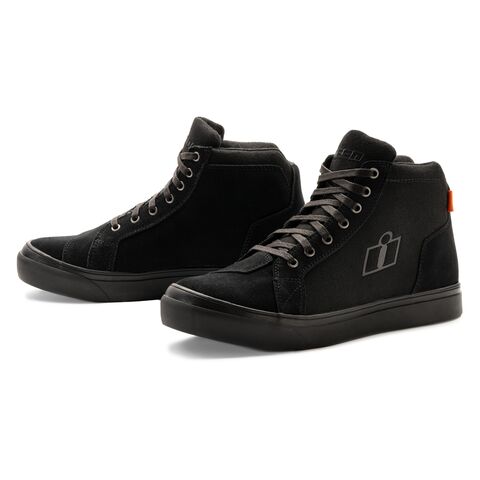
The Icon Carga looks like a skate shoe, and that’s the point. If you ride to work or school and want a shoe nobody will notice, this is it. It’s a 6-inch low-top with a genuine leather upper, waxed laces and classic Icon styling.
Inside, D3O ankle inserts reduce impact forces, and a reinforced shifter overlay stops the left toe from wearing through. The outsole is oil- and slip-resistant, and the insole is high-rebound EVA foam. Icon is unusually clear about certification: the Carga is tested to EN 13634:2017 at level 1 2 2 1 with SRA slip resistance. Those four numbers cover upper height, abrasion, impact cut and transverse rigidity, which we explain in the buying guide below.
The trade-off with any low-top is coverage. It protects less of your ankle than a high-top, so it’s best for city riding rather than long, fast highway days.
Pros
- Looks like a regular skate shoe
- D3O ankle inserts
- Clearly stated EN 13634 levels
- Oil and slip-resistant sole
Cons
- Low-top means less ankle coverage
- Not waterproof
4. REAX Fulton Air CE: best for hot weather

REAX is RevZilla’s own brand, and the Fulton Air is one of the most popular riding shoes it sells. It’s a high-top in natural nubuck leather with triple-stitched construction. Perforated panels in the non-impact zones and a moisture-wicking liner keep your feet from cooking in summer traffic.
Protective ankle cups, a reinforced heel cup and toe box, and a full-length composite midsole for torsional protection give you real protection in a shoe that still walks well. A fully padded collar with a flex panel lets the high-top bend at the ankle. The padded, gusseted tongue has a webbing loop that holds your laces in place so they won’t catch on your pegs or shifter, and the dual-compound sole has a high-grip pattern.
RevZilla notes that customers find the Fulton Air narrow, so riders with wide feet should try the TCX instead. There’s also a Fulton Air Vintage version in brown with a gum sole if you prefer a classic look.
Pros
- Perforated leather keeps feet cool
- High-top coverage with a walkable flex collar
- Lace keeper stops snags
- Composite midsole for torsional protection
Cons
- Runs narrow
- Perforations mean it isn’t waterproof
5. Street & Steel Kickstarter 2 CE: best value high-top

The Kickstarter 2 is a classic blacked-out hi-top that looks right on a cruiser, a café racer or a standard. It’s made from 1.8–2 mm pebbled full-grain leather, which is thicker than a fashion sneaker and breaks in nicely over time. Perforations on the sides, tongue and gusset let some air through.
For a shoe in the lowest price tier, the protection list is solid. AXIAL AVP ankle cups sit in the lining, with AXIAL armor reinforcing both the inside and outside ankle bones. There’s a full-length composite midsole for torsional protection, a reinforced heel and toe, and reflective details at the rear pull tab and heel. The thermo-molded flat sole has a high-grip mini-lug pattern, and a lace holder keeps laces secure.
Street & Steel says it fits true to size, but the footbed is average width out of the box and may feel narrow until the leather softens.
Pros
- Thick full-grain leather at a low price
- AXIAL ankle cups on both sides
- Reflective heel details
- Classic hi-top style suits cruisers
Cons
- May feel narrow at first
- Not waterproof
6. SEDICI Podio 2 CE: best budget
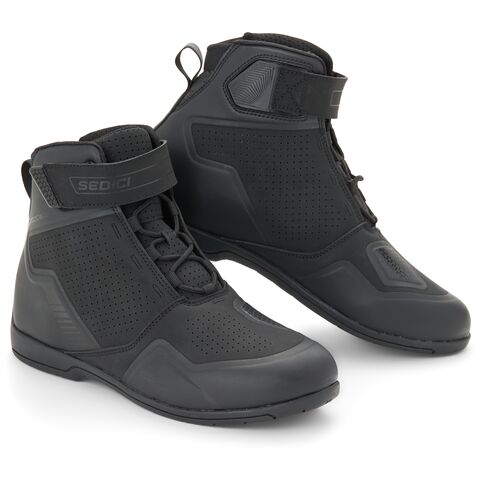
SEDICI is Cycle Gear’s house brand, and the Podio 2 replaces both the old Sportiva and the original Podio. It’s an over-the-ankle paddock-style shoe aimed at hot weather, with a microfiber upper, lots of perforation and a moisture-wicking mesh liner. The sole is a driving-shoe design with a slight lift at the heel, and SEDICI rates its stiffness at 5/10, so it’s a little firmer than the TCX. The footbed is wider than the old Sportiva’s.
Protection includes internal ankle protectors, reinforced heel cups and toe box, a full-length reinforced shank, a sonic-welded toe shifter panel, and reflective inserts for low light. A lace strap keeps laces away from the controls. It’s certified 1 | 2 | 2 | 2 to EN 13634:2017, which is a stronger rating than some shoes that cost far more. Replaceable EVA insoles with arch support finish it off.
Pros
- Lowest price on this list
- EN 13634:2017 rated 1 2 2 2
- Breathable for summer
- Reflective inserts and lace strap
Cons
- Microfiber feels less premium than leather
- Not waterproof
7. Alpinestars J-6 WP: best waterproof leather

The J-6 WP is a casual leather shoe that happens to be waterproof and CE certified. The upper mixes full-grain leather and suede with a waterproof membrane built into the shoe, with a leather tongue and collar, padding at the tongue and heel, and metal eyelets. From a few feet away, it reads as a smart casual shoe rather than riding gear.
The protection is hidden. A dual-density, MX-derived ankle and heel protector sits between the upper and lining. Internal toe and heel reinforcement and a reinforced midsole add structure, and the rubber cup sole is molded to the upper. The EVA and Lycra footbed is removable.
It’s the priciest shoe here. Alpinestars and RevZilla also note it runs slightly small and narrow, and it isn’t recommended for wide feet, so size up or pick the TCX if that’s you.
Pros
- Waterproof leather that looks like a normal shoe
- MX-derived ankle and heel protector
- Removable footbed
- CE certified
Cons
- Most expensive pick
- Runs small and narrow

SIDI is better known for race and touring boots, and the Lynx brings that know-how to a street shoe. It has a premium microfiber upper and an extended lacing closure that holds the shoe tightly on your foot, which helps keep it on in a slide. SIDI’s patented Fortex technology and reinforced panels in key impact zones add durability, and CE-certified protectors are built in discreetly.
The sole uses SIDI’s Concrecto compound, designed for grip on the pegs and comfortable walking. SIDI sizes are European, so check RevZilla’s size chart before ordering. Note that the listing describes the protectors as CE certified rather than the whole shoe as EN 13634 certified. If full certification matters to you, the TCX, Alpinestars Faster 4, Icon Carga and SEDICI list it outright.
Pros
- Secure extended lacing
- Clean, premium styling
- Grippy Concrecto sole
Cons
- EU sizing takes care to get right
- Listing cites CE protectors, not a full-shoe EN 13634 rating
How to choose motorcycle shoes
Legs and feet are among the most commonly injured areas in motorcycle crashes, and a regular sneaker can tear open or come off in a slide. A real riding shoe protects the bones that hit first, and it stays on. Here’s what to look for.
CE certification and EN 13634 explained
EN 13634 is the European standard for motorcycle footwear, and it’s what “CE certified” should mean on a riding shoe. A certified shoe is tested for four things, shown as four numbers. The first is upper height: 1 is a short shoe, 2 is a boot. Then come abrasion resistance, impact cut resistance and transverse rigidity (resistance to crushing side to side), each scored 1 or 2, with 2 being better. So the Icon Carga’s “1 2 2 1” is a short shoe with top marks for abrasion and cut resistance and the basic level for crush resistance, while the SEDICI Podio 2’s “1 2 2 2” scores top marks on all three. Riding shoes usually score 1 for height because they’re shoes, not boots. Some brands only list “CE” without the levels; ask the retailer or check the label inside the tongue.
Ankle protection
Look for armor over both ankle bones (the malleoli), ideally on the inside and outside. D3O and similar soft armors stay flexible until they’re hit, then firm up, so they’re comfortable to walk in. High-tops like the REAX Fulton Air and Faster 4 cover more of the ankle than low-tops like the Icon Carga.
Sole, shank and grip
A riding shoe needs a sole that’s stiff enough to protect your foot from crushing and twisting, but flexible enough to walk in. Look for a reinforced shank or midsole (TCX’s ZPLATE, the composite midsoles on REAX and Street & Steel). Oil-resistant rubber matters at gas stations and in parking lots. A flatter sole gives you more feel on the pegs, while a lugged sole grips better on loose ground.
Shift pad, laces and closures
Your left toe takes a beating from the shifter. Most riding shoes add a reinforced overlay or welded panel there, which stops the leather from wearing through. Laces are a snag risk: look for a lace keeper, lace strap or hook-and-loop cover, and tuck loose ends in before you ride.
Waterproof or vented?
Waterproof shoes like the TCX Street 3 WP and Alpinestars J-6 WP use a membrane that keeps rain out but runs warmer. Vented shoes like the REAX Fulton Air and SEDICI Podio 2 are far cooler but soak through in a storm. If you commute year-round, go waterproof. If you mostly ride in summer, go vented and keep rain covers handy. Our guide to riding a motorcycle in the rain has more tips.
Shoes or boots?
Riding shoes are a compromise. They protect far better than sneakers, but a full boot covers more of your shin and ankle and resists twisting better. For track days, long highway trips and adventure riding, wear boots. See our picks for the best motorcycle boots and cruiser boots. For commuting, city riding and short trips where you’ll walk around at the other end, riding shoes make far more sense. Match them with riding jeans or riding pants long enough to cover the top of the shoe.
Fit
Riding shoes should fit snugly at the heel so they don’t twist off in a crash, with a little room at the toe. Several brands run narrow (REAX, Alpinestars J-6), while TCX runs wider. European sizing on Alpinestars, TCX and SIDI doesn’t always match U.S. sizes, so check each brand’s chart. If you’re building a full kit, our guide on how much to spend on motorcycle gear helps set a budget.
Caring for riding shoes
Riding shoes last longer with a little care. Brush suede and nubuck after rides and treat it with a suede protector. Clean smooth leather and condition it a couple of times a season so it doesn’t crack. Let wet shoes dry at room temperature, not on a heater, which can shrink leather and weaken glue. Replaceable insoles (most shoes here have them) are cheap to swap when they flatten. Keep an eye on the shift pad and sole edges, since that’s where wear shows first.
When to replace them
Replace riding shoes after any crash where they hit the ground hard, even if they look fine. Armor and stitching can be damaged where you can’t see it. Also replace them when the sole is worn smooth, the shift pad has worn through, or the heel no longer holds your foot firmly. Our guide on what to do after a motorcycle crash covers checking the rest of your gear too.
Need more ankle support for gravel roads and long trips? Our guide to motorcycle boots you can walk in adds short adventure boots to the mix.
FAQ
Are motorcycle shoes safe?
A CE-certified riding shoe is much safer than a sneaker or work boot. It’s designed to resist abrasion and impact, and to stay on your foot. It isn’t as protective as a full riding boot because it covers less of your leg, so choose boots for high-speed or long-distance riding.
What does EN 13634 mean on riding shoes?
It’s the European standard for protective motorcycle footwear. Certified shoes are tested for abrasion resistance, impact cut resistance and transverse rigidity, and labeled with levels for each (1 or 2, higher is better), plus a height rating.
Can I just wear sneakers on a motorcycle?
You can, but most sneakers have thin uppers, flexible soles and no ankle protection, and many come off in a crash. Laces can also catch on pegs and controls. Riding shoes look similar but add armor, a stiffer sole and a shift pad.
Are motorcycle shoes comfortable for walking?
Most modern riding shoes are. Look for a moderate sole stiffness (TCX rates the Street 3 at 4/10, SEDICI the Podio 2 at 5/10), a cushioned footbed and a flex point at the ankle.
Do motorcycle shoes need to be waterproof?
Only if you ride in the rain often. Waterproof membranes keep you dry but run warm. Vented shoes are better for summer riding.
Verdict
For one pair that does everything, buy the TCX Street 3 Faded WP. It’s waterproof, fully certified and comfortable enough to wear all day. Summer riders should look at the REAX Fulton Air or Alpinestars Faster 4, and if you’re on a tight budget, the SEDICI Podio 2 gets you an excellent EN 13634 rating for the least money. Whatever you choose, check the CE label, get the fit right at the heel, and wear proper boots for big trips. Brand details are on Alpinestars and Icon, and NHTSA’s motorcycle safety page covers why full gear matters. New riders can start with our beginner gear guide and our breakdown of textile vs mesh vs leather gear.
Browse all our riding gear guides.


