Throttle Buff is reader-supported: we may earn a commission when you buy through links on this page. Read our affiliate disclosure.
Motorcycle intercom range runs from about 0.4 mile (700 m) on an entry-level Bluetooth unit to about 1 to 1.2 miles (1.6 to 2 km) between two riders on a current mesh unit. The bigger figures on the box, up to 5 miles (8 km), are group totals that only apply when several riders relay the signal. Every one of those numbers is a best case for open terrain.
That is why two riders can lose each other well short of the advertised distance and a group of eight can stay connected over several miles. Here are the makers’ own figures side by side, what the small print says, and how much range different kinds of riding actually call for.
Motorcycle intercom range by model
| Intercom | Type | Rider to rider | Group maximum |
|---|---|---|---|
| Cardo Packtalk Edge | Mesh (DMC) and Bluetooth | Up to 1 mile (1.6 km) | Up to 5 miles (8 km), relayed rider to rider |
| Sena 50S | Mesh and Bluetooth | Up to 1.2 miles (2 km) | Up to 5 miles (8 km), with at least 6 riders at 1 mile intervals |
| Cardo Freecom 4X | Bluetooth | Up to 0.75 mile (1.2 km) | Not published (up to 4 riders) |
| Sena 5S | Bluetooth | Up to 0.4 mile (700 m) | Two riders only |
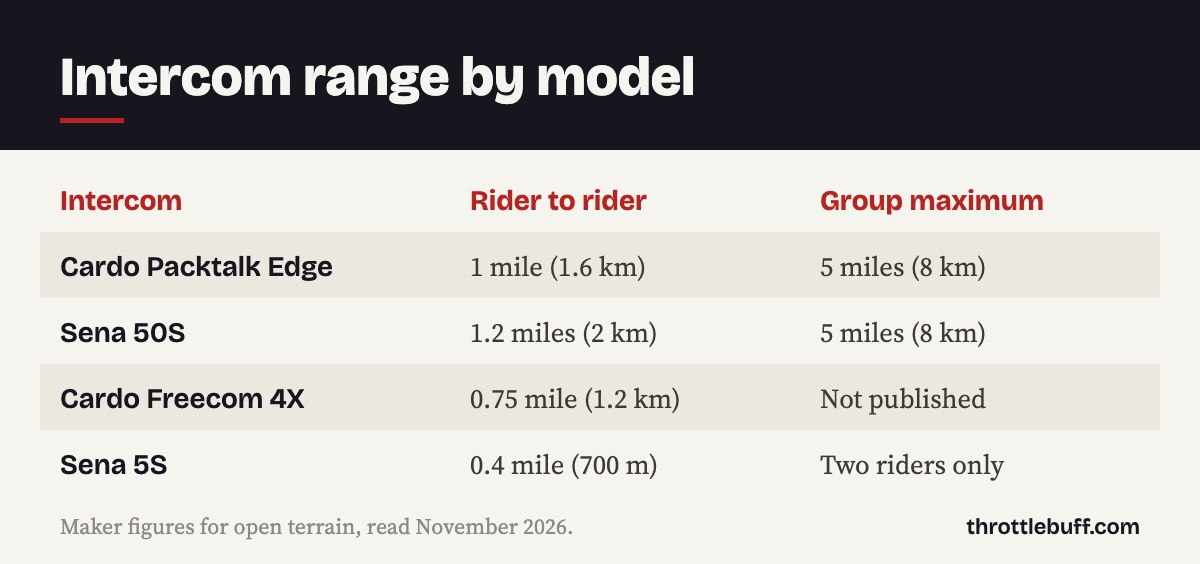
Figures are from Sena and Cardo product pages, read in November 2026. For every current model, see our Sena comparison chart and Cardo comparison chart.
What the range number means
The headline figure is the furthest two units can talk under ideal conditions. Sena states its 1.2 mile figure as range “in open terrain”. Cardo says of its group figure that “real-world range shifts with terrain and obstacles”. Neither maker publishes a figure for town, forest or mountain roads.
In practice, treat the rider-to-rider number as a ceiling. Anything solid between two riders eats into it: hills, buildings, a rock cutting, a line of trucks. As a rough guide, if you can still see the rider you are talking to, you are probably in range. Once a ridge or a few bends come between you, do not count on it, whatever the box says.
Rider to rider vs group range
A mesh intercom turns every rider into a relay. Cardo describes its Dynamic Mesh Communication as a network where any rider can pass the signal to any other, and that is how a Packtalk group holds “up to 8 km (5 miles) in open conditions as the signal hops from rider to rider”. Sena prints the condition next to its own 5 mile claim for the 50S: a minimum of six riders at 1 mile (1.6 km) intervals.
So the group figure is not extra reach for two riders. Between any two units, mesh goes about as far as a good Bluetooth intercom, and the Sena 50S lists the same 1.2 miles for both modes. Our mesh vs Bluetooth intercom explainer covers the other differences.
What happens when you ride out of range
On mesh, the network repairs itself. Cardo says that if one rider drops out or rides out of range, the network reroutes around them without dropping the group. A Bluetooth group is a chain, so one rider falling out of range can split everyone behind them from everyone ahead. That difference matters more than raw distance on a ride where the group stretches and bunches all day.
When range stops mattering: intercom over the phone network
The newest option sidesteps radio range altogether. Sena’s Wave Intercom carries the conversation over the cellular network through a phone app, so friends you have added stay connected however far apart they are, as long as each phone has coverage. Sena says the system switches riders to a mesh channel when the cellular network is unavailable, and it estimates data use at about 9 MB an hour. The trade-off is plain: no signal, no cellular intercom, which is exactly where remote rides tend to go.
How much intercom range do you need?
Rider and passenger, or two bikes riding close
Range hardly matters. A two-rider Bluetooth unit such as the Sena 5S, at up to 0.4 mile, covers a pillion or a riding partner who stays in sight. See our Sena 5S review and the best budget Bluetooth headsets.

A small, fixed group
For up to four riders who stay fairly close, a Bluetooth unit with more reach is enough. The Cardo Freecom 4X lists up to 0.75 mile. Our Cardo Freecom 4X review has the detail.

Bigger groups and rides that spread out
This is where mesh earns its price, because each extra rider extends the network. The Cardo Packtalk Edge and Sena 50S both list up to 5 miles across a group. Our Sena 50S review and Cardo vs Sena comparison can help you choose a side, and the best motorcycle intercom guide ranks the current field.


FAQ
What is the range of a motorcycle intercom?
Between two riders, about 0.4 mile on entry-level Bluetooth units and 1 to 1.2 miles on current mesh units, in open terrain. Mesh groups can cover up to 5 miles by relaying the signal.
Does mesh have more range than Bluetooth?
Not between two riders. The Sena 50S lists 1.2 miles for both. Mesh reaches further only across a group, because riders in between pass the signal along.
Why is my intercom range shorter than advertised?
Advertised range is for open terrain. Hills, buildings, trees and traffic between riders all cut it. Also check that the unit’s antenna, if it has a fold-out one, is raised.
Can a motorcycle intercom work over any distance?
Only over the phone network. App-based systems such as Sena’s Wave Intercom are limited by cellular coverage instead of radio range.
Do Sena and Cardo units reach each other at full range?
Across brands they connect over Bluetooth only, not mesh, so expect Bluetooth distances and a smaller group. Fitting matters too: see how to install an intercom in your helmet.
Verdict
Read the rider-to-rider figure, not the group figure, and treat it as a best case. For two riders almost any current intercom reaches far enough. For a group that spreads out, mesh is what keeps everyone talking, and for friends in different places entirely, a cellular intercom is the only thing that will.
Browse all our intercom guides.