Throttle Buff is reader-supported: we may earn a commission when you buy through links on this page. Learn more.
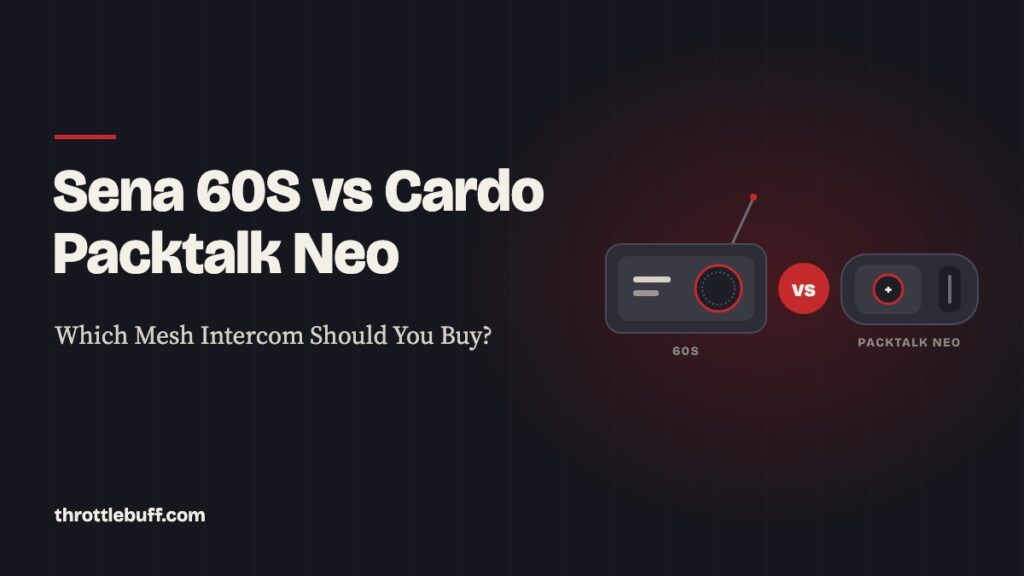
The Sena 60S vs Cardo Packtalk Neo choice comes down to two things: about $80 and the brand your riding group already uses. The Packtalk Neo is the cheapest way into Cardo’s full mesh network. It has the same mesh, speakers and battery as the Packtalk Edge, but no magnetic mount and no charging while riding. The Sena 60S costs more and gives you longer battery life, bigger mesh groups, a magnetic mount and Wave app intercom. We compared both using manufacturer specs, current US prices and owner feedback.


Specs from Cardo and Sena. Prices change often, so check the current price before you buy.
Sena 60S vs Packtalk Neo specs side by side
The Packtalk Neo vs Sena 60S spec sheets are closer than the price gap suggests. Both have 40 mm branded speakers, mesh intercom and app updates. The real differences are battery, mounting, group size and warranty.
| Spec | Cardo Packtalk Neo | Sena 60S |
|---|---|---|
| US price, single | $359.95 | $439 |
| US price, dual pack | $669.95 | $829 |
| Mesh system | 2nd gen Dynamic Mesh (DMC) | Mesh Intercom 3.0, works with Mesh 2.0 |
| Mesh riders | Up to 15 | Up to 24 in Group Mesh; Open Mesh virtually unlimited |
| Mesh range | 1.6 km (1 mi) unit to unit, up to 8 km (5 mi) across a group | Up to 2 km (1.2 mi) in open terrain |
| Bluetooth | 5.2, two channels | 5.3 |
| Talk time | Up to 13 h | 17 h mesh / 24 h Bluetooth |
| Charging | USB-C; no charging while riding | USB-C; 1.5 h to full |
| Speakers | 40 mm, Sound by JBL | 40 mm, 2nd gen Harman Kardon |
| Weather rating | IP67 (dust and water) | IPX7 (water) |
| Main unit size | 84 × 46 × 23 mm | 94 × 52 × 27 mm |
| Main unit weight | 47 g | 68 g |
| Mount | Clickable mount | Magnetic mount |
| Extra intercom | Bluetooth link to Sena units (via firmware) | Wave intercom over phone data |
| App | Cardo Connect | Sena Motorcycles |
| Warranty | 2 years | 3 years |
Prices from the Cardo and Sena US stores, checked 5 November 2026. Retailer prices are often lower.
Mesh range and group riding
How many riders each supports
The Neo uses Cardo’s second generation Dynamic Mesh, which holds up to 15 riders. Cardo quotes 1.6 km between two units, and up to 8 km from the front of the group to the back because the signal hops between riders. If a rider drops out, the mesh re-forms on its own and nobody has to re-pair.
The 60S runs Sena’s Mesh 3.0 with two modes. Group Mesh is a private group of up to 24 riders. Open Mesh lets any number of Sena mesh riders on the same channel talk, which suits big club rides where people come and go. Sena quotes 2 km between units in open terrain.
For a group of two to eight riders, both systems are more than enough. The 60S only pulls ahead on large organised rides.
Which other units each one works with
This matters more than any spec. The Neo meshes with the Packtalk Edge and Packtalk Pro, since all three run the same second generation DMC. A mixed Neo, Edge and Pro group loses no range or rider capacity.
The 60S meshes with the Sena 50S, 50R and 60S EVO through its Mesh 2.0 compatibility. That’s useful if friends bought 50 Series units a few years ago. Our Sena 50S vs 60S comparison covers the differences.
If your group mostly uses one brand, buy that brand. It settles the decision faster than anything else on this page.
Battery life and charging
The Sena 60S has the better battery: 17 hours on mesh and 24 hours on Bluetooth, against up to 13 hours on the Neo.
Talk time matters most on multi-day trips and long touring days. On a 12-hour day with breaks you’ll rarely have the intercom on the whole time, so 13 hours covers most riders. The catch is that the Neo can’t charge while you ride. If you finish a long day and forget to plug it in overnight, you start the next day on a flat unit. The 60S’s extra four hours on mesh, and its 1.5-hour full charge, give you more margin.
If the Neo’s battery is your only concern, the Packtalk Edge uses the same 13-hour battery but adds charging while riding over USB-C, for about $80 more.
Sound and microphone
Both units use 40 mm speakers: JBL on the Cardo and second generation Harman Kardon on the Sena. On paper they’re evenly matched. Owner feedback generally rates both as clear at highway speeds and loud enough to use with earplugs.
How it sounds in practice depends more on your helmet than on the unit. Speakers sitting in deep ear pockets, close to your ears, make a bigger difference than switching between JBL and Harman Kardon. If sound quality is your priority, the 60S EVO’s Sound by Bose tuning is the upgrade to consider rather than either of these two.
Both units have hands-free voice control. Cardo’s Natural Voice Operation responds to “Hey Cardo” without a button press. The 60S has improved voice commands and multitasking, so you can keep music playing during an intercom conversation.
This section is based on manufacturer specs and owner reports, not side-by-side testing.
Size, mounting and helmet fit
The Neo is the smaller unit by a clear margin: 84 × 46 × 23 mm and 47 g, against 94 × 52 × 27 mm and 68 g for the 60S. That’s a centimetre longer, 6 mm taller and 4 mm thicker. Sena’s unit sticks out noticeably further from the shell. You’ll notice it most on compact sport helmets, open-face helmets and 3/4 helmets, where there’s less shell to hide it.
The mounts differ too. The 60S uses a magnetic mount: the unit snaps on and off one-handed, and the dual pack includes two clamps, so moving it between a summer and a winter helmet takes seconds. The Neo uses a clickable mount that is secure but slower to swap. If you own more than one helmet, the 60S is easier to live with.
For speaker placement and cable routing, see our guide on how to install an intercom in your motorcycle helmet.
Waterproofing and durability
The Neo is rated IP67 and the 60S IPX7. Both survive being submerged in water (1 m for 30 minutes), so heavy rain won’t hurt either. The difference is the first digit: the Neo’s “6” means it is also tested and sealed against dust, while the 60S’s “X” means it wasn’t tested for dust. For dirt roads, ADV and trail riding, that tips the balance towards the Neo.
On warranty, the 60S is covered for 3 years and the Neo for 2 years.
Can a Cardo Packtalk Neo talk to a Sena 60S?
Yes, but only one to one over Bluetooth, not in a shared mesh. Cardo’s second generation units, including the Neo, received a firmware update that lets them make a Bluetooth intercom connection to a Sena unit that supports Bluetooth intercom, which the 60S does. Riders report that the Cardo unit usually has to start the call.
A Neo and a 60S can’t join each other’s mesh groups. One workaround is to bridge a Cardo mesh group and a Sena mesh group through a single Bluetooth link between one rider on each side. It works, but it’s more setup than a mixed group usually wants to deal with.
The 60S also has Wave, which carries intercom audio over phone data through the Sena app, so range isn’t a limit. Wave is a Sena feature, so it doesn’t help Neo riders.
For the full cross-brand breakdown, see Cardo vs Sena.
Price and value: single, dual pack and the 60S EVO
At Cardo’s and Sena’s own US stores, the Neo is $79 cheaper for one unit ($359.95 vs $439) and $159 cheaper for a dual pack ($669.95 vs $829). For two riders, that gap pays for a decent set of earbuds or most of a pair of gloves. Retailer prices move often, so check the current price before you buy.
Should you buy the Sena 60S EVO instead?
The Sena 60S EVO launched in May 2026 at $459 single and $879 dual, just $20 and $50 more than the 60S. It adds Sound by Bose speakers, longer talk time (19 hours on mesh, 27 hours on Bluetooth) and a limited lifetime warranty on the main unit. If you’ve settled on Sena, the EVO is the better buy at this price difference unless you find the 60S heavily discounted.
Should you spend more on the Packtalk Edge?
The Packtalk Edge costs about $80 more than the Neo and has the same mesh, speakers and battery. It adds the magnetic Air Mount, charging while riding and a third year of warranty. Pay the extra if you tour long distances or swap helmets. Compare it with Sena’s newest unit in Packtalk Edge vs Sena 60S EVO.
Which should you buy?
- Solo commuter: Packtalk Neo. You don’t need the 60S’s battery or group size, so keep the money.
- Two-up couple: Packtalk Neo dual pack, unless you swap helmets often, in which case the 60S’s magnetic mount is worth paying for.
- Weekend group rides: buy whatever your group uses. If it’s a new group, the Neo keeps the cost per rider down.
- Multi-day touring: Sena 60S (or the 60S EVO), for longer talk time and faster recharging.
- Adventure and off-road: Packtalk Neo, for the dust rating and smaller unit, or the Edge if you need to charge on the bike.
FAQ
Is the Cardo Packtalk Neo worth it?
Yes, for most riders. It has the same second generation mesh, 40 mm JBL speakers and 13-hour battery as the Packtalk Edge for about $80 less. You give up the magnetic mount, charging while riding and one year of warranty. If none of those matter to you, the Neo is the best value in Cardo’s mesh range.
Is the Sena 60S better than the Packtalk Neo?
It’s better equipped but not better for everyone. The 60S has longer battery life, larger mesh groups, a magnetic mount, Wave intercom and a 3-year warranty. The Neo is smaller, lighter, dust-rated and $79 cheaper. Choose based on what your group rides and how long your days are.
Which has better battery life, the Packtalk Neo or the Sena 60S?
The Sena 60S has the longer battery life: 17 hours on mesh and 24 hours on Bluetooth, against up to 13 hours for the Packtalk Neo. The 60S also fully recharges in about 1.5 hours. The Neo can’t charge while riding.
Can a Packtalk Neo join a Packtalk Edge mesh group?
Yes. The Neo, Edge and Pro all run Cardo’s second generation Dynamic Mesh, so they join the same group at full range and rider capacity without compatibility problems.
Is the Sena 60S discontinued now that the 60S EVO is out?
No. As of November 2026, Sena still sells the 60S on its US store at $439 single and $829 dual, alongside the 60S EVO at $459 and $879.
Verdict
The Packtalk Neo is the value pick. You get full Cardo mesh, a dust rating and the smallest unit here for $359.95. The Sena 60S is the touring pick, with more battery, a magnetic mount and bigger groups for $439, though at that price the 60S EVO is the Sena most riders should buy. Whichever you choose, match your group’s brand first.
Browse all our intercom and Bluetooth guides.