Throttle Buff is reader-supported: we may earn a commission when you buy through links on this page. Learn more.
The Sena 60S EVO is the better buy for most riders: it has about 50% more mesh talk time (19 hours vs 13), Bose-tuned audio, a limited lifetime warranty and works with both Sena mesh generations, for only about $20 more. The Cardo Packtalk Edge is the pick if your riding group already runs Cardo, if you want IP67 dust and water protection, or if you prefer Cardo’s quick-release magnetic mount and its reputation for a very stable group mesh.
This comparison is research-based. Specs and US list prices come from Cardo and Sena, checked in November 2026. We haven’t tested these units ourselves; where a manufacturer doesn’t publish a figure, we say so.
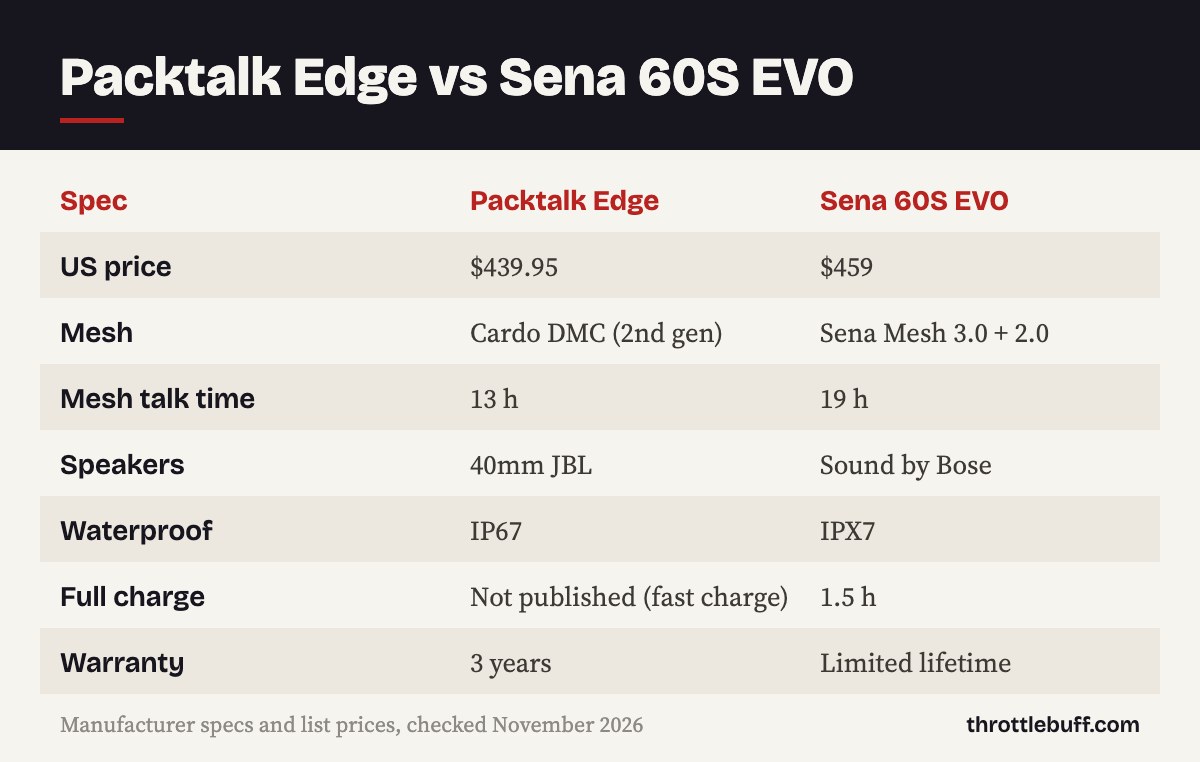
Packtalk Edge vs 60S EVO at a glance
| Spec | Cardo Packtalk Edge | Sena 60S EVO |
|---|---|---|
| US list price (single) | $439.95 | $459 |
| Mesh system | Cardo DMC, 2nd gen | Sena Mesh 3.0, also Mesh 2.0 |
| Max mesh riders | Up to 15–31 (Cardo’s pages differ) | 24 in a group mesh; open mesh unlimited |
| Bluetooth intercom | Yes, one-to-one | Yes, up to 4 riders |
| Range | 1.6 km unit to unit, up to 8 km across a group | Up to 2 km |
| Talk time | 13 h | 19 h mesh / 27 h Bluetooth |
| Charging | Fast charge: 20 min gives 2 h; charge while riding | 1.5 h to full |
| Bluetooth version | 5.2 | 5.3 |
| Audio | 40mm JBL speakers | Sound by Bose |
| Weather rating | IP67 (dust and water) | IPX7 (water) |
| Weight | Not published by Cardo | 68 g |
| Mount | Magnetic Air Mount | Magnetic mount |
| Phone-data intercom | No | Wave intercom (Sena app) |
| Warranty | 3 years | Limited lifetime |


Mesh intercom and group riding
This is the biggest decision, because Cardo and Sena mesh systems don’t talk to each other. If your regular group rides Cardo, buy the Edge; if they ride Sena, buy the 60S EVO. Mixing brands means falling back to a one-to-one Bluetooth link, which loses the main benefit of mesh.
Cardo’s 2nd-gen DMC is known for being self-healing: riders who drop out of range rejoin automatically, and the group can stretch up to 8 km. Sena’s Mesh 3.0 supports up to 24 riders in a private group and an open mode with no rider limit, and the 60S EVO can switch to Mesh 2.0 to join older Senas such as the 50S, 50R and 30K. Sena’s Wave intercom also lets you talk to anyone running the Sena app over a phone data connection, whatever headset they use.
Winner: tie. Pick whatever your group uses. For a mixed or growing group, Sena’s backward compatibility and Wave give it a slight edge.
Battery life and charging
The 60S EVO wins clearly on battery: Sena rates it at 19 hours of mesh talk time against 13 hours for the Edge. That’s the difference between needing a top-up on a long day and not. The Edge fights back with charging while riding and a fast charge that gives about two hours of talk time from 20 minutes on a cable. The 60S EVO charges fully in 1.5 hours.
Winner: Sena 60S EVO.
Audio quality
The Edge uses 40mm JBL speakers; the 60S EVO uses Sena’s Sound by Bose tuning. Both are well regarded in published reviews, and both let you swap in other speakers. Real-world audio depends heavily on speaker placement and helmet noise, so getting the speakers centred over your ears matters more than the brand. If audio is your top priority, note that Cardo’s Packtalk Pro has bigger 45mm JBL speakers.
Winner: too close to call on specs alone.
Durability and weather
Both are rated for immersion in water. The Edge’s IP67 rating also covers dust, which counts for adventure and dirt riders, while the 60S EVO’s IPX7 rating doesn’t include a dust test. Sena’s limited lifetime warranty is stronger than Cardo’s three years, though.
Winner: Edge for dust protection; 60S EVO for warranty.
Controls and features
Both support voice commands, so you can answer calls and change music without touching the unit, and both use magnetic mounts that make it easy to move the unit between helmets. The Edge is the only Cardo that works with Edgephones, Cardo’s in-helmet audio format. The 60S EVO adds Wave intercom and Bluetooth intercom for up to four riders.
Winner: Sena 60S EVO, narrowly, for Wave and four-way Bluetooth.
Which should you buy?
| Choose the Cardo Packtalk Edge if… | Choose the Sena 60S EVO if… |
|---|---|
| Your riding group already uses Cardo | Your riding group already uses Sena |
| You ride dusty trails and want IP67 | You want the longest battery life |
| You can charge while riding on long days | You want a limited lifetime warranty |
| You want Edgephones support | You want to talk to riders on any brand via Wave |
Alternatives
- Cardo Packtalk Pro ($499.95): the Edge plus crash detection and 45mm JBL speakers. See our Cardo comparison chart.
- Cardo Packtalk Neo ($359.95): the same mesh and battery as the Edge for less, without the magnetic mount.
- Sena 50S (about $379): the value Sena mesh pick. See our Sena 50S vs 60S comparison and the full Sena comparison chart.
FAQ
Can a Cardo Packtalk Edge connect to a Sena 60S EVO?
Yes, but only as a one-to-one Bluetooth intercom link, not in a mesh group. Cardo DMC and Sena Mesh aren’t compatible.
Which has better battery life, Packtalk Edge or Sena 60S EVO?
The Sena 60S EVO: up to 19 hours of mesh talk time vs 13 hours for the Edge. The Edge can charge while you ride, which narrows the gap on long days.
Is the Packtalk Edge waterproof?
Yes. It’s rated IP67, which covers both dust and immersion in water. The 60S EVO is rated IPX7 for water.
Which is better for group rides?
Both are excellent mesh intercoms. The deciding factor is what your group uses, because the two brands’ mesh networks don’t connect.
Is the Sena 60S EVO worth it over the 60S?
The EVO adds Bose audio, two extra hours of mesh talk time (19 vs 17) and a limited lifetime warranty. Our Sena 60S EVO review covers it in full.
Verdict
On paper, the Sena 60S EVO is the stronger all-rounder: longer battery, a better warranty and more ways to connect, for about $20 more. The Cardo Packtalk Edge is still an excellent intercom and the right choice for Cardo groups and dusty adventure riding. Whichever you choose, buy the same brand as the people you ride with.