Throttle Buff is reader-supported: we may earn a commission when you buy through links on this page. Read our affiliate disclosure.
How we chose: this guide is research-based, built from manufacturer specifications, safety certifications and owner feedback rather than hands-on testing. How we research.
The best motorcycle passenger helmet for most riders is the Sena Outrush 2, a modular with a built-in mesh intercom and a drop-down sun visor, so your passenger can talk to you without clamping anything on. The HJC i91 is the best value modular, and the light Bell Custom 500 open-face or the compact Bell Lithium Mips full-face are the most travel-friendly helmets to pack. A good passenger helmet does three jobs: it protects someone who has no control over the bike, it stays comfortable for hours while they sit upright in the wind, and it lets rider and passenger talk. That last part matters more than most riders expect. A passenger who can say “slow down”, “I need a break” or “look at that” has a far better day on the back.
Quick picks
-
Best overall
Modular with built-in mesh intercom
- Type
- Modular
- Sun visor
- Yes
- Approx. price
- ~$379
-
Best value modular
- Type
- Modular
- Sun visor
- Yes, oversized
- Approx. price
- ~$270
-
Best for long tours
- Type
- Full-face
- Sun visor
- Yes
- Approx. price
- Mid-range
-
Best adventure-style modular
- Type
- Modular ADV
- Sun visor
- Yes
- Approx. price
- ~$310
- Best budget full-face: Bell Lithium Mips
- Best budget with Bluetooth option: Sedici Strada 3
- Best travel-friendly / open-face: Bell Custom 500
- Best premium: Shoei RF-1400
This guide picks the best motorcycle passenger helmets for 2026, plus travel-friendly options for riders who rent bikes on trips and don’t want to wear a rental-shop helmet. Our picks are based on manufacturer specifications, safety certifications, retailer listings and published owner and expert reviews. We haven’t done our own crash or wind-tunnel testing.
Passenger helmets compared
| Helmet | Type | Sun visor | Intercom | Certification | Approx. price |
|---|---|---|---|---|---|
| Sena Outrush 2 | Modular | Yes | Built-in Mesh 3.0 + Bluetooth 5.2 | DOT / ECE | ~$379 |
| HJC i91 | Modular | Yes, oversized | Ready for HJC Smart (Sena-made) units | DOT | ~$270 |
| Scorpion EXO-T520 | Full-face | Yes | EXO-COM ready, large speaker pockets | DOT | Mid-range |
| Scorpion EXO-AT960 | Modular ADV | Yes | EXO-COM ready | DOT + ECE 22.06 | ~$310 |
| Bell Lithium Mips | Full-face | Yes | Add a clamp-on unit | DOT / ECE 22.06 | ~$200–$240 |
| Sedici Strada 3 | Full-face | Yes | Parlare version has Sena built in | DOT + ECE | ~$255–$330 |
| Bell Custom 500 | Open-face (3/4) | No | Add a clamp-on unit | DOT + ECE | ~$205 |
| Shoei RF-1400 | Full-face | No | Add a clamp-on unit | Snell + DOT | ~$550 on sale |
Prices are typical listings in November 2026 and change often. Always check the certification on the exact version you buy, because some helmets are sold in both DOT and ECE variants.
What makes a good passenger helmet?
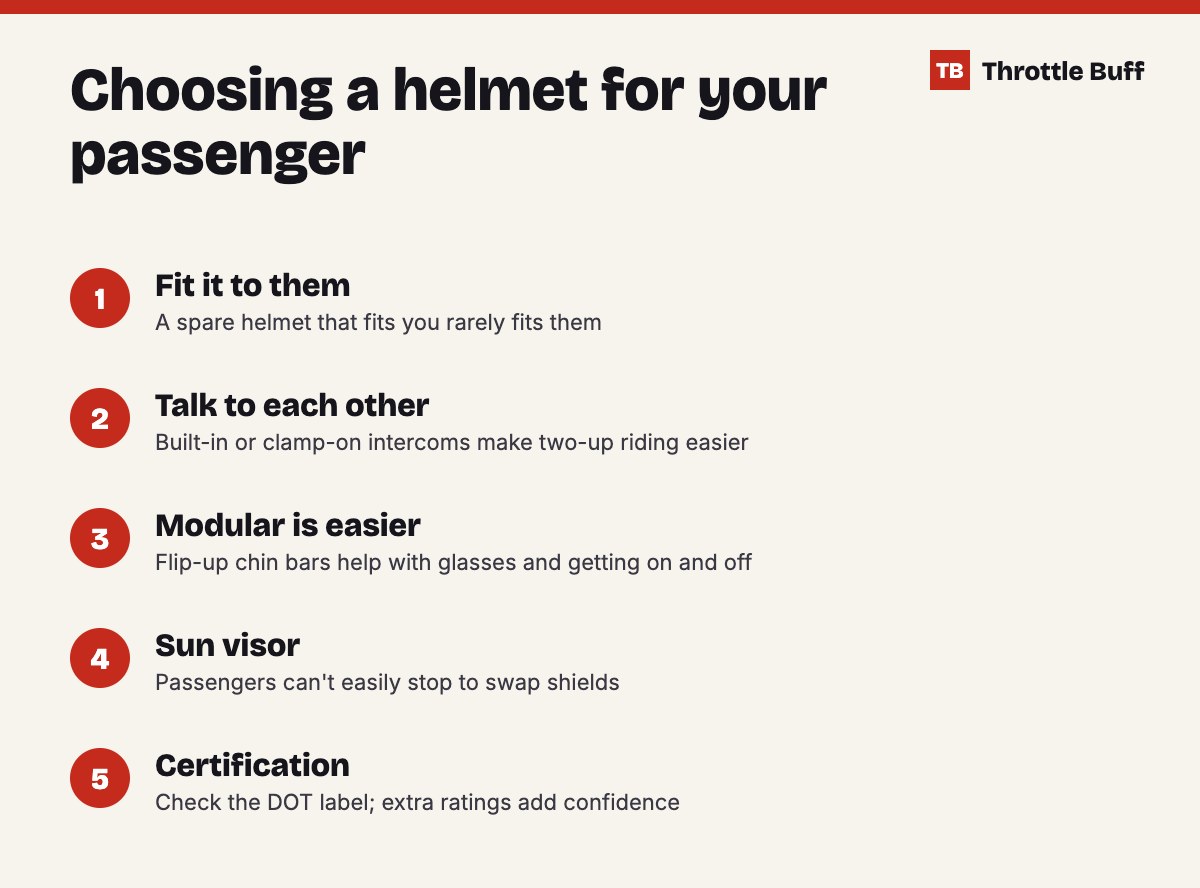
Passengers ride differently from riders. They sit higher and more upright, so they catch more wind and turbulence over the rider’s shoulders. They can’t brace against the bars, so their neck takes more of the load on long days. And they spend a lot of time looking around, which makes a wide field of view and a quiet helmet worth paying for. Here’s what to prioritize:
- Fit first. A helmet that fits properly is safer than an expensive one that doesn’t. See how to size and buy a helmet.
- Light weight. Every extra 100 grams is felt on a long day, especially by smaller passengers.
- Communication. A built-in or intercom-ready helmet lets you talk without shouting.
- A drop-down sun visor. Passengers can’t easily stop to swap shields, and a flick-down visor handles changing light.
- Modular or open-face for chatting. Flipping up the chin bar at stops makes breaks, drinks and photos easier.
- Certification. Look for DOT in the US, and ECE 22.06 if you ride in Europe or want the newer standard. Read our guide to helmet safety ratings and NHTSA’s advice on choosing a DOT-compliant helmet.
1. Sena Outrush 2: best overall
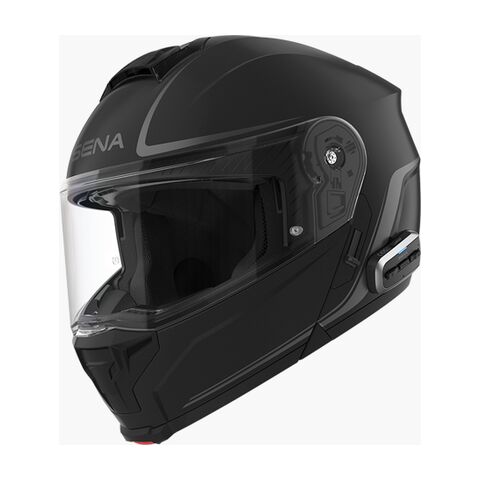
The Outrush 2 solves the biggest passenger problem straight out of the box: communication. Sena’s electronics are built into the shell, so there’s nothing to clamp on, no wires to route and nothing for the passenger to fiddle with. It uses Mesh Intercom 3.0 (up to about 1.2 km, with Open Mesh for unlimited riders and Group Mesh for up to 24) and Bluetooth 5.2 for phones and GPS, plus Sena’s Wave Intercom app for talking over a cellular connection. Sena quotes up to 20 hours of talk time, which covers even long touring days.
It’s a modular, so your passenger can flip up the chin bar at fuel stops, and it has a drop-down sun visor and a Pinlock-ready shield. It carries DOT and ECE homologation (including P/J dual homologation in Europe, meaning it’s approved to ride with the chin bar open). The trade-offs: it’s on the heavy side at around 1,800 grams, the shell is ABS/polycarbonate rather than fiberglass, and Sena dropped the FM radio from this version.
- Pros: built-in mesh and Bluetooth, long talk time, modular, sun visor
- Cons: heavy, electronics can’t be upgraded separately, no FM radio
2. HJC i91: best value modular

The HJC i91 is a modular helmet with an oversized drop-down sun visor and a price that usually sits around $270. It’s designed to take HJC’s Smart communicators, which are made by Sena, so you can add an intercom later and have it fit neatly. Sizing is a big plus for passengers: the i91 runs from XS to 5XL, which helps if you need one “spare” helmet that can fit different people.
As with most budget modulars, the trade-off is weight and some wind noise at highway speed compared with premium models. For a passenger who rides now and then, it’s hard to beat the value.
- Pros: great price, huge size range, sun visor, intercom-ready
- Cons: heavier and louder than premium modulars
3. Scorpion EXO-T520: best for long tours

The EXO-T520 is a sport-touring full-face built for long days. Its standout feature for passengers is Scorpion’s AirFit inflatable cheek pad system: a small pump lets your passenger snug up the fit, which helps smaller or narrower faces and reduces helmet lift in turbulence behind the rider. It has a drop-down SpeedView sun visor, an aerodynamic shell and large speaker pockets that work with Scorpion’s EXO-COM intercom or any clamp-on unit.
Because it’s a full-face rather than a modular, it’s generally quieter and more rigid in the chin area, which is worth having for a passenger who spends hours in the wind.
- Pros: adjustable inflatable fit, sun visor, roomy speaker pockets
- Cons: no flip-up chin bar for chatting at stops
4. Scorpion EXO-AT960: best adventure-style modular
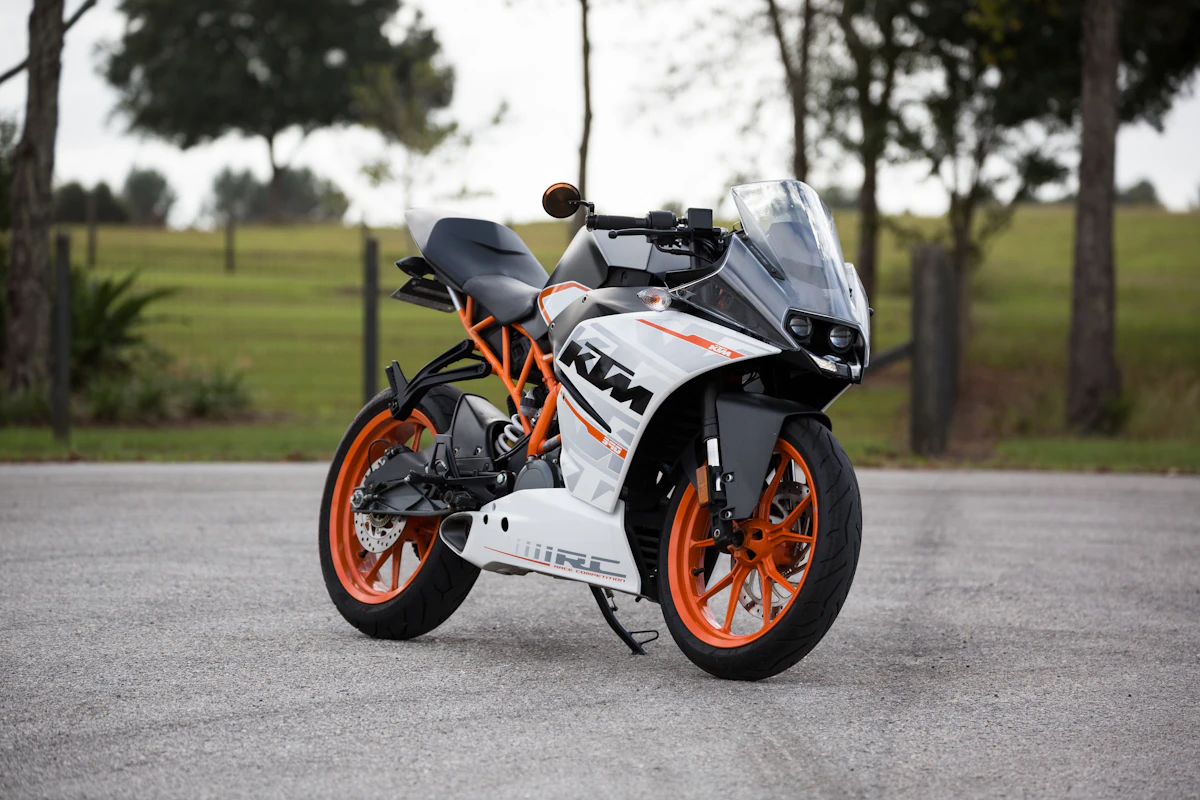
If you ride two-up on an adventure bike, the EXO-AT960 is a modular with ADV styling. It has a drop-down sun visor, a removable peak (take it off for highway riding, where peaks can catch wind) and compatibility with the EXO-COM communication kit. It’s certified to both DOT and ECE 22.06 and usually sells for around $310. The modular chin bar makes it easy for a passenger to chat and drink at stops on long trips.
- Pros: DOT + ECE 22.06, sun visor, removable peak, modular
- Cons: the peak adds buffeting at speed unless removed
5. Bell Lithium Mips: best budget full-face
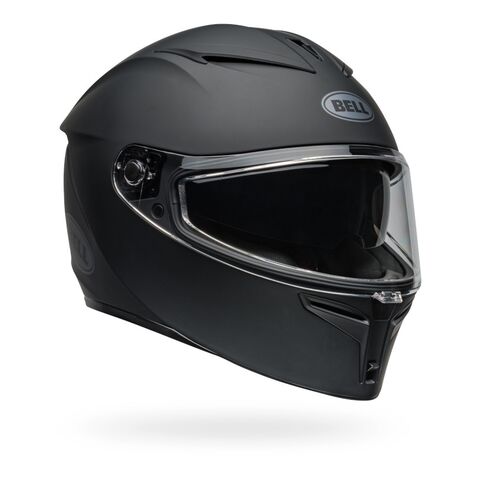
The Bell Lithium Mips is a lot of helmet for around $200 to $240. It has a polycarbonate shell in three shell sizes, a drop-down sun shield and a Mips liner designed to reduce rotational forces in angled impacts. It’s ECE 22.06 certified as well as DOT. UK reviewers weighed the Mips version at about 1,660 grams, which is reasonable for the price. If you want a solid full-face for an occasional passenger without spending much, start here.
- Pros: low price, Mips, sun shield, ECE 22.06
- Cons: no built-in comms, louder than premium helmets
6. Sedici Strada 3: best budget with Bluetooth option
The Sedici Strada 3 is RevZilla’s house-brand full-face, and it’s popular with passengers because it’s comfortable and inexpensive. It comes in four shell sizes from XXS to XL, which helps smaller passengers get a helmet that doesn’t look or feel oversized. The Strada 3 Parlare version has a Sena Bluetooth system built in, giving you integrated communication for around $330, well below most smart helmets. It’s DOT and ECE certified; check whether the variant you choose is ECE 22.06.
- Pros: great value, small sizes, built-in Sena option
- Cons: sizes stop at XL
7. Bell Custom 500: best travel-friendly and open-face
The Bell Custom 500 is a classic open-face (3/4) helmet that weighs only about 982 grams in size medium and comes in five shell sizes, so it stays compact even in larger sizes. That makes it the easiest helmet here to pack in luggage or carry on a plane, and the lightest on a passenger’s neck around town. It’s DOT and ECE certified and costs around $205.
The trade-off is protection: an open-face helmet doesn’t protect the chin and jaw, and it’s noisier and more tiring on the highway. We’d pick it for cruiser passengers on short, slower rides and for travelers who need something light, not for long highway tours. Pair it with goggles or a snap-on shield.
- Pros: very light, compact, five shell sizes, affordable
- Cons: no chin protection, wind and noise at speed

If you have a regular passenger who rides long distances with you, the Shoei RF-1400 is worth the money. It’s light for a premium full-face (about 1,650 grams in medium), quiet for its class and comes in five shell sizes for a well-proportioned fit. It’s certified to Snell and DOT. There’s no internal sun visor, so plan on a tinted or photochromic shield, and you’ll need to add a clamp-on intercom.
The RF-1400 has been around since 2020 and is now discounted to around $550, and Shoei has launched its successor in Japan. That makes it a strong deal right now.
- Pros: premium comfort and quietness, five shells, Snell
- Cons: no sun visor, intercom is extra
Best travel-friendly helmets for renters and travelers
The best travel-friendly helmet is light, compact and certified for the country you’re riding in. The Bell Custom 500 (about 982 grams in medium, five shell sizes) is the easiest to pack, while the Bell Lithium Mips and Sedici Strada 3 are the best compact full-face options. If you rent bikes on vacation or ride as a passenger on tours abroad, you’ll usually be offered a rental helmet. Many riders prefer to bring their own, for good reasons: shared helmets have often been worn by dozens of people, the fit is a lottery, and the certification may not be one you recognize. Here’s what to look for in a helmet you’ll travel with:
- Weight and bulk. An open-face or compact full-face with multiple shell sizes is easiest to pack. The Bell Custom 500 is the lightest pick here; the Bell Lithium Mips and Sedici Strada 3 are good compact full-face options.
- Removable, washable liner. You’ll be sweating in hot places and won’t always be able to dry gear.
- The right certification for where you ride. Many countries outside the US require ECE (22.05 or 22.06). A DOT-only helmet may not be legal in some places, so check before you fly. Helmets with both DOT and ECE, such as the EXO-AT960, Lithium Mips and Custom 500, are the safest bet.
- A soft helmet bag. Airlines typically allow a helmet as carry-on or personal item, but rules vary, so check with your airline. Pack gloves and a neck tube inside the helmet to save space, and don’t check it in a hard-sided case loose, where it can be knocked around.
- A clamp-on intercom. A small universal unit lets you talk to your rider on any rental bike.
Never travel with a helmet that’s been dropped hard or is past its useful life. See when motorcycle helmets expire.
Modular, full-face or open-face for a passenger?
Modular helmets are the most popular passenger choice because the chin bar flips up for talking, eating and drinking at stops. They’re usually heavier and a bit noisier than a full-face. Full-face helmets give the most protection and are typically lighter and quieter, which matters on long highway rides. Open-face helmets are light and airy but don’t protect the face and chin. For most two-up touring, a modular or full-face is the right call. Our comparison of modular vs full-face helmets goes into more detail, and our guide to types of motorcycle helmets covers the rest.
Communication: built-in or add-on?
You have two routes. A helmet with built-in electronics, like the Sena Outrush 2 or Sedici Strada 3 Parlare, is the simplest for a passenger: charge it and go. The downside is that you can’t upgrade the electronics without replacing the helmet. A clamp-on unit works with any helmet that has speaker pockets and moves with you to your next helmet. If you already ride with a Cardo or Sena unit, matching your passenger’s unit to yours gives the best connection; see our comparison of Cardo vs Sena and our guide to the best motorcycle intercoms. A mesh unit such as the Cardo Packtalk Edge is a good partner for any helmet on this list.
How to fit a helmet on your passenger
- Measure the widest part of the head, about an inch above the eyebrows, and use the brand’s size chart.
- The helmet should feel snug all round with even pressure on the cheeks and no hot spots on the forehead.
- With the strap fastened, try to roll the helmet forward off the head. It shouldn’t come off or move more than slightly.
- Wear it for 15 to 20 minutes indoors. Pressure points that show up then will be much worse after two hours.
If your passenger has long hair, our guide to wearing a helmet with long hair helps with comfort.
Don’t forget the rest of the passenger’s gear
A good helmet is the start. Passengers need an armored jacket, gloves, long pants and boots that cover the ankle just as much as riders do. Start with our guide to motorcycle gear for beginners, and if you’re carrying younger riders, see the best kids’ motorcycle helmets. Riders shopping for themselves at the same time can browse the best motorcycle helmets and best modular helmets.
FAQ
Do motorcycle passengers need a different helmet from the rider?
No, any properly certified, well-fitting motorcycle helmet is fine for a passenger. Passengers do benefit more from light weight, a sun visor and intercom readiness because they sit higher in the wind and can’t easily stop to adjust things.
Do passengers legally have to wear a helmet?
It depends on where you ride. Many US states require helmets for passengers even when adult riders are exempt (the IIHS helmet law table lists each state), and most countries require helmets for everyone. Check local law, and wear one regardless.
How much should I spend on a passenger helmet?
A good certified helmet starts around $200, which buys options like the Bell Lithium Mips. Spend more for lower weight, less noise and built-in communication. See how much to spend on motorcycle gear.
Are modular helmets safe for passengers?
Yes, when they’re certified and the chin bar is locked closed while riding. Some, like the Sena Outrush 2, are P/J homologated in Europe for riding with the chin bar open, but closed is safer.
What’s the best travel-friendly motorcycle helmet?
For packing, a light open-face such as the Bell Custom 500 is easiest. For better protection, a compact full-face like the Bell Lithium Mips or Sedici Strada 3 is a good compromise. Make sure it meets the certification required where you’re riding.
What’s the best helmet for a passenger on long highway trips?
A full-face is usually quieter and more rigid than a modular on long highway days. The Scorpion EXO-T520 suits long tours with its adjustable AirFit cheek pads and drop-down sun visor, and the Shoei RF-1400 is quiet for its class at about 1,650 grams in medium. If your passenger wants to chat at stops, the Sena Outrush 2 modular is the better fit.
Can I just use a rental helmet?
You can, but fit and hygiene are hit and miss, and you won’t know the helmet’s history. Bringing your own is safer and more comfortable.
Related reading: how to get your kids riding.
Verdict
For most two-up riders, the Sena Outrush 2 is the easiest way to give your passenger a comfortable, communicating helmet. The HJC i91 is the best value modular, the Scorpion EXO-T520 suits long tours, and the Bell Lithium Mips or Sedici Strada 3 cover tighter budgets. Travelers who rent bikes abroad should look at the light Bell Custom 500, and regular long-distance passengers will appreciate the Shoei RF-1400 while it’s discounted.
Browse all our helmet guides.