Throttle Buff is reader-supported: we may earn a commission when you buy through links on this page. Read our affiliate disclosure.
D3O armor is motorcycle body armor made from D3O, a rate-sensitive impact material that stays soft and flexible when you move but stiffens in the instant of a hit to absorb and spread the force. It is made by the UK company of the same name and sold as inserts for jackets, pants and gloves, and as back protectors. Like any armor, how well a D3O pad protects you depends on its CE level, not the brand name: check the label for EN 1621-1 or EN 1621-2 and Level 1 or Level 2.
That is why two D3O pads can perform very differently. Below is how the material works, what the CE numbers on the label mean, and how D3O compares with the foam and plastic armor it often replaces. For a full shortlist of protectors, see our best motorcycle armor guide.
D3O armor and the CE levels
| Standard | Level 1 average | Level 2 average |
|---|---|---|
| Limb armor (EN 1621-1) | 35 kN or less | 20 kN or less |
| Back armor (EN 1621-2) | 18 kN or less | 9 kN or less |
| Test energy | 50 J impact | 50 J impact |
| Lower number means | Less force through | Less force through |
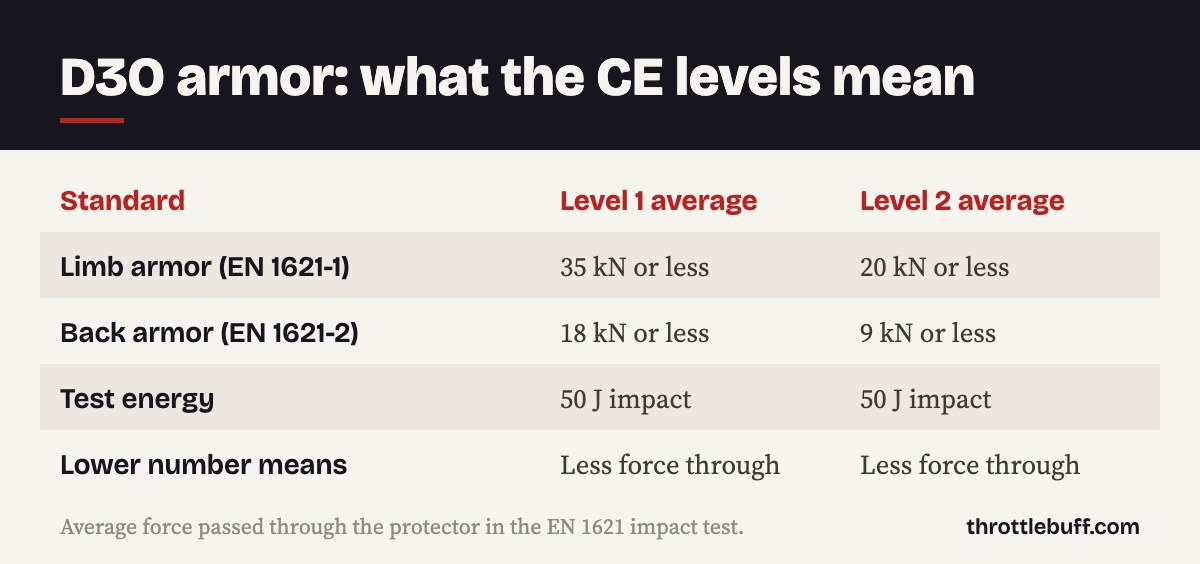
In the European impact test, a 5 kg striker hits the protector with 50 joules of energy, and a sensor underneath measures how much force gets through. The lower the average force, the better the protection, and Level 2 has to pass far less force than Level 1. Our explainer on AAA rated motorcycle gear covers the separate EN 17092 rating for the garment itself.
What is D3O made of?
D3O describes its materials as designed to absorb and dissipate energy in response to blunt force impact. It works on non-Newtonian principles: at rest the material is soft enough to bend with your knee or elbow, and under a sudden impact it stiffens to spread the energy over a larger area. The company grew out of experiments by materials scientists Richard Palmer and Philip Green that began in 1999, and the formulas are its own, so it does not publish a full recipe.
In practice, this means:
- Comfort. A D3O pad flexes and warms to your body, so it is easier to forget it is there than a hard plastic cup.
- Low profile. D3O’s thin pads, such as its LP2 range, slide into pockets in riding jeans and slim jackets without the bulk of thick foam.
- Protection set by the test, not the feel. A soft pad can feel weak in your hand. What counts is the force figure it passed in the lab, which is the CE level on its label.
How does D3O armor work in a crash?
Most of the force in a motorcycle crash arrives in a fraction of a second, at a joint that hits the ground or the bike. Rate-sensitive materials respond to that speed: the faster the hit, the stiffer they get. That stiffening turns a sharp, focused blow into a wider, slower push, which is exactly what the CE test measures. Other makers use similar viscoelastic materials, and conventional foam and hard shell armor can reach the same CE levels; D3O’s main selling point is reaching them in a thinner, more flexible pad.
Is D3O armor better than regular armor?
Not automatically. A Level 2 foam protector passes less force than a Level 1 D3O protector, so compare the label first and the material second. Where D3O usually wins is comfort and fit: a pad that flexes with your joint is more likely to stay in place and more likely to be worn at all. Also check:
- Coverage. The standard has Type A and Type B sizes; Type B covers a larger area. Bigger is better as long as it still fits the pocket.
- Position. Armor only works on the joint. Our guide to how motorcycle pants should fit shows where knee and hip armor should sit when you are on the bike.
- Pocket fit. Inserts must match the pocket size in your garment, or they slide.
Upgrading to D3O inserts
Many riding jeans and budget jackets come with thin foam pads. Swapping them for CE Level 2 inserts is one of the cheapest protection upgrades you can make, provided they fit the pockets.
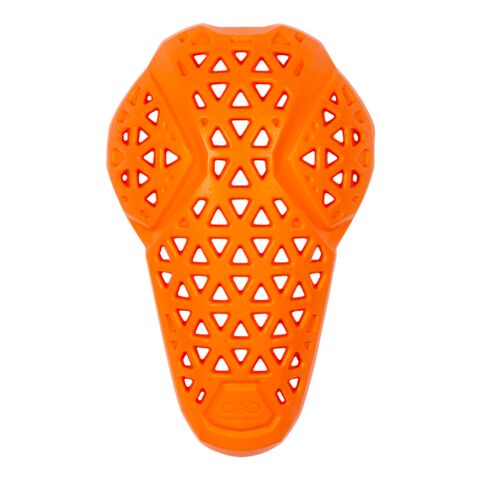
Icon’s D3O LP2 knee inserts are a common example: CE Level 2 certified and low profile, made for the knee pockets in riding jeans and pants. Measure your pocket before you order. Our guide to knee pads under jeans compares them with sleeves and strap-on guards, and our motorcycle jeans guide lists jeans with armor pockets.
Price tier: $ means under $50.
For your back, D3O also makes full back protectors, such as its Ghost range, and many jackets have a back pocket that takes a separate insert. Our back protector guide compares current options, and armored riding shorts cover your hips under normal trousers.

FAQ
Is D3O armor CE certified?
D3O motorcycle protectors are sold with CE certification to EN 1621-1 for limbs or EN 1621-2 for the back. The level, 1 or 2, depends on the individual protector, so check its label.
Is D3O Level 1 or Level 2?
Both exist. D3O makes Level 1 and Level 2 protectors, and the level is printed on each pad, so read the label rather than assuming.
How long does D3O armor last?
Follow the garment or protector maker’s replacement advice, and replace any pad that is torn, cracked or out of shape. Remove inserts before washing the garment unless the label says otherwise.
Can I put D3O armor in any jacket?
Only if the pad fits the jacket’s armor pockets and sits on the joint. Check the pocket size and the insert’s dimensions before buying.
Is D3O worth it?
If it replaces thin foam or uncertified pads, yes. If your gear already has CE Level 2 armor that fits well, switching to D3O mainly buys comfort, not more protection.
Verdict
D3O armor is a soft, flexible impact material that stiffens on impact, which makes it comfortable, thin and easy to wear. Judge it the same way as any armor: by the CE standard and level on the label, the coverage, and whether it sits on your joint. A CE Level 2 D3O insert is a worthwhile upgrade over thin foam; the label, not the brand, tells you how much it protects. You can read more on the maker’s own D3O impact protection page.
Browse all our riding gear guides.