Throttle Buff is reader-supported: we may earn a commission when you buy through links on this page. Read our affiliate disclosure.
What gear do you need for the MSF course? A DOT-approved helmet (3/4 or full-face at many sites), eye protection, full-fingered gloves, a long-sleeved shirt or jacket, long sturdy pants such as denim, and boots that cover your ankles. Most training sites lend helmets and supply the motorcycle, so a first-timer can often pass the gear check with gloves, boots and clothes they already own.
Quick picks
-
-
Best budget gloves
- Gear
- Gloves
- Key spec
- CE Level 1, hard knuckles
- Price
- $
-
Best footwear
- Gear
- Footwear
- Key spec
- CE 13634, D3O ankle inserts
- Price
- $$
-
Best jacket
- Gear
- Jacket
- Key spec
- CE Class A, Level 1 armor
- Price
- $$
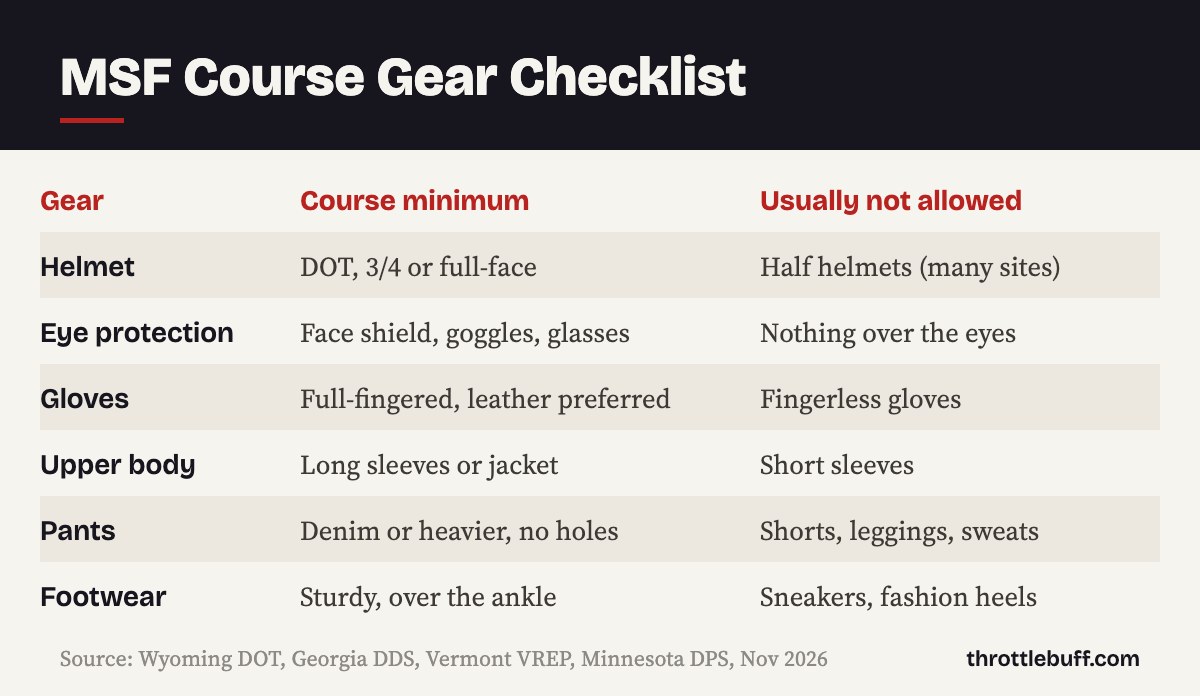
Requirements come from each state program, not one national list, so check your site’s page before class. The rules below come from the published requirements of Wyoming, Georgia, Vermont and Minnesota, which line up closely. Show up without the right gear and you can be sent home, and some states keep your fee.
What gear do you need for the MSF course?
| Gear | Course minimum | Starter pick | Key spec | Price |
|---|---|---|---|---|
| Helmet | DOT-approved; many sites require 3/4 or full-face | HJC i10 | Full-face, 3.7 lb | $$ |
| Gloves | Full-fingered, leather preferred | Alpinestars SMX-1 Air v2 | CE Level 1, hard knuckles | $ |
| Footwear | Sturdy, over the ankle | TCX Street 3 WP | CE 13634, D3O ankle inserts | $$ |
| Jacket | Long sleeves to the wrist | REV’IT! Eclipse 2 | CE Class A, Level 1 armor | $$ |
| Eye protection | Face shield, goggles or glasses | Helmet face shield | Clear for cloudy days | Included |
| Pants | Denim or heavier, no holes, not flared | Jeans you own | Covers legs to the boots | None |
Price tiers: $ is under $100, $$ is $100 to $250. Ratings quoted below are RevZilla owner ratings, November 2026.
Helmet
Every program asks for a DOT helmet. Wyoming allows only 3/4 or full-face and bans half helmets, and Vermont lists only 3/4 or full-face too. Georgia, Wyoming and Vermont all lend helmets, so you don’t have to buy one before class. If you do, our helmet sizing guide and state helmet law map help.
Eyes, hands and body
A face shield, goggles or glasses count as eye protection. Gloves must cover every finger; Wyoming and Vermont prefer leather. You need long sleeves to the wrist, and pants that reach your boots: Wyoming bans sweatpants, spandex and leggings, and Georgia rules out shorts and very baggy pants. Plain denim passes everywhere listed here.
Footwear
Boots must cover the ankle bone. Sneakers and canvas shoes won’t pass, and Georgia specifically rejects fashion boots with heels. Work boots usually pass; riding shoes add ankle armor and a shifter pad.
Starter gear worth buying for the course
1. HJC i10: budget full-face helmet

The i10 is one of the cheapest full-face helmets from a major brand. It uses a polycarbonate composite shell and multi-density EPS, weighs 3.7 lb in size medium and fits an intermediate oval head. The shield is Pinlock-ready, and grooves at the temples make room for glasses. Owners rate it 4.6 out of 5 across 467 RevZilla reviews. See how it stacks up in HJC i10 vs Bell Qualifier DLX.
Pros
- Full-face passes every site rule
- Glasses-friendly temple grooves
- Pinlock-ready shield
Cons
- Polycarbonate shell is heavier than fiberglass
- Anti-fog insert sold separately
2. Alpinestars SMX-1 Air v2: budget gloves

Leather and mesh short-cuff gloves with a hard polymer knuckle guard, foam palm padding and a CE Level 1 rating. Fingertips work on touchscreens. RevZilla notes that buyers find them small and often size up one. More options in our motorcycle gloves guide.
Pros
- Leather palm meets the “leather preferred” rule
- Hard knuckle protection
- Low price
Cons
- Runs small
- Short cuff leaves a gap at the wrist
3. TCX Street 3 WP: ankle-covering riding shoes

These look like casual sneakers but are certified to CE 13634:2017, cover the ankle and have D3O inserts over the ankle bones. A T-Dry membrane keeps them waterproof, which matters because courses run rain or shine. Owners rate them 4.7 out of 5. Compare others in best motorcycle shoes.
Pros
- Covers the ankle with armor
- Waterproof
- Easy to walk in all day
Cons
- Lighter protection than a full boot
- Laces need tucking away from the shifter
4. REV’IT! Eclipse 2: summer mesh jacket

Most courses run in warm months, and a long-sleeved shirt passes the check. A jacket protects you if you drop the bike. The Eclipse 2 is a mesh jacket certified CE Class A to EN 17092-4, with CE Level 1 shoulder and elbow armor and a pocket for an optional back protector. It’s slim-fitting, so size up if you wear layers. Textile vs mesh vs leather explains the trade-offs.
Pros
- CE Class A certified
- Fully vented for summer range days
- Back protector ready
Cons
- Slim fit
- Not waterproof
Tips for the gear check
- Pack rain gear: Minnesota tells students to bring it because classes run rain or shine.
- Arrive early. Wyoming turns away late arrivals.
- Bring water, sunscreen and a clear shield or glasses for cloudy mornings.
- Buy gloves and boots first; borrow the helmet. Then read how much to spend on motorcycle gear before buying the rest.

FAQ
Does the MSF course provide a helmet?
Most sites do. Georgia, Wyoming and Vermont all lend helmets, but bring your own if you have a DOT 3/4 or full-face lid that fits.
Can I wear sneakers to the MSF course?
No. Every program listed here requires footwear that covers the ankle.
Are jeans OK for the MSF course?
Yes. Long denim without holes meets the pants rule. Leggings, sweatpants and shorts don’t.
Do I need a motorcycle jacket?
No. A long-sleeved shirt passes, but a jacket with armor is the better choice.
Do I need my own motorcycle?
No. Minnesota, Georgia, Wyoming and Vermont all provide training motorcycles for the basic course. Minnesota also lets you ride your own street-legal 51–500cc bike if it passes inspection and is insured.
What happens if my gear doesn’t pass?
You can be removed from riding sessions. Wyoming and Georgia say you lose your payment.
Verdict
The gear you need for the MSF course is simple: DOT helmet, eye protection, full-fingered gloves, long sleeves, sturdy long pants and boots over the ankle. Borrow the helmet if your site lends one, and spend first on gloves and ankle-covering footwear such as the Alpinestars SMX-1 Air v2 and TCX Street 3 WP, which you’ll keep using after you pass. Next stop: our beginner gear guide and common beginner mistakes.
Browse all our how-to and safety guides.