Throttle Buff is reader-supported: we may earn a commission when you buy through links on this page. Read our affiliate disclosure.
Motorcycle pants should fit snug but not tight: close enough that the armor stays on your knees and hips in a crash, loose enough to swing a leg over the bike and ride for hours. The real test is on the bike, not in front of a mirror. Seated in your riding position, the knee armor should sit on your kneecaps, the hems should cover your boot tops, and nothing should pull at the waist or thighs.
That is the point protector maker D3O makes in its own fit guide: riding pants should look a little long when you stand, because your legs bend and the fabric rides up on the bike. If you are still choosing a pair, our best motorcycle riding pants guide lists current options by riding style.
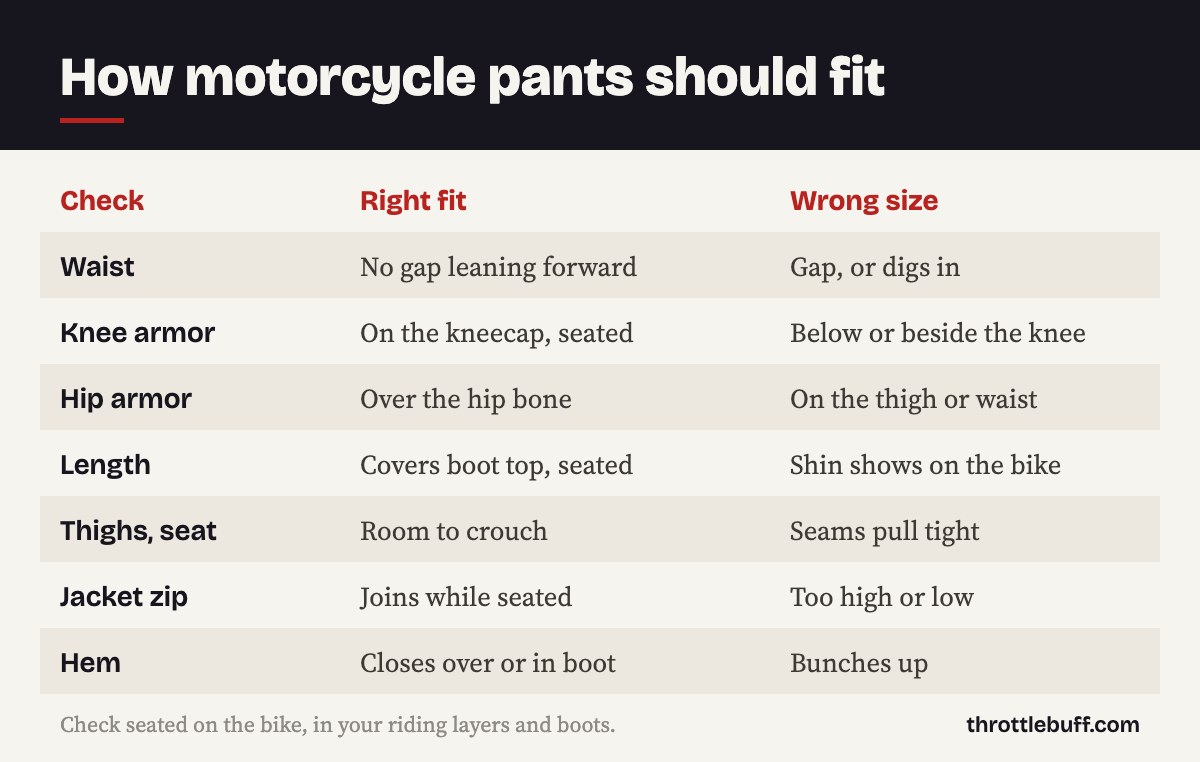
How should motorcycle pants fit: 7 checks
| Check | Right fit | Sign of the wrong size |
|---|---|---|
| Waist | Snug, with no gap at the back when you lean forward | Gap at the back, or it digs into your stomach when you tuck |
| Knee armor | Sits on the kneecap when you are seated on the bike | Slides below or to the side of the knee |
| Hip armor | Covers the hip bone | Sits on the thigh or up at the waist |
| Length | Looks a little long standing, covers the boot top seated | Shin or sock shows when you sit on the bike |
| Thighs and seat | Room to swing a leg over and crouch | Seams pull or you cannot lift your knee |
| Jacket zip | Connecting zip lines up with your jacket | Zip sits too high or low to join |
| Hem and boots | Closes over or into your boots as designed | Bunches, or will not close over the boot |
How to check the fit, step by step
Wear the base layer and boots you will ride in, then work through the checks in order. If you can, do it on your own bike; a chair works, but your riding position matters more than you think.
1. Start at the waist
Fasten the pants and any waist adjusters, then lean forward as if reaching for the bars. There should be no gap at the back and no pressure on your stomach. Sport riders tuck further forward, which is why ViaTerra suggests sizing up if the waist digs in when you lean.
2. Sit down and find your knee armor
This is the check that matters most. Seated in your riding position, the knee armor should cover your kneecap. If it sits below the knee, the pants are too long in the leg or the armor is in the wrong pocket. Many pants have two knee pocket positions or a height strap, so check the maker’s manual before you send them back.
3. Check the hips
Hip armor should sit over the bony point of your hip, not on your thigh or up at your belt. Not every pair has hip armor; if yours has empty pockets, they are worth filling.
4. Check the length on the bike
Standing, the hems should look a little long. Seated with your feet on the pegs, they should still cover the top of your boots. If you can see your shin or socks, the pants are too short.
5. Move like a rider
Swing a leg over the bike, stand on the pegs, crouch and stretch. The seams should not pull tight across the thighs or seat, and you should be able to lift your knee to your chest without the waist dropping.
6. Join the jacket
If your jacket and pants have a connecting zip, zip them together while seated. A short zip that only reaches when you stand is a sign the pants sit too low.
7. Check the boots
Touring and adventure pants usually close over the boot; sport and race pants often tuck inside it. Either way, the hem should close without bunching. Our best motorcycle boots guide is the place to start if you are buying boots too.
How tight should motorcycle pants be?
Tight enough that the armor cannot slide off the joint, and no tighter. The right amount changes with the style:
- Sport and race pants are cut close with pre-bent knees, so they can feel tight standing and right on the bike.
- Touring and adventure pants are looser to fit layers or jeans underneath; see our overpants for commuting guide.
- Riding jeans fit like normal jeans, but the armor still has to sit on your knees. Our best motorcycle jeans guide compares armored pairs.
Leave room for what you wear underneath. A thin base layer in summer and a thermal in winter can change the fit by a size; our guide to what to wear under motorcycle gear covers both.
Do not size by your jeans
Riding pants are sized by each brand’s own chart, usually from your waist and inseam measured in inches or centimetres. Measure your waist at your belly button and your inseam from crotch to ankle, then use the chart for that model. Check the protection label at the same time: pants certified to EN 17092 carry a class from A to AAA, which our AAA rated gear explainer decodes.

FAQ
Should motorcycle pants be tight or loose?
Snug. Loose enough to move and sit comfortably, tight enough that the knee and hip armor stay on the joint when you move.
Should motorcycle pants be long?
Yes, a little. They should look slightly long standing so they still cover your boot tops when you sit on the bike.
Where should knee armor sit on motorcycle pants?
On the kneecap with you seated in your riding position. If it sits below the knee, move it to the higher pocket or adjust the height strap.
Can I wear jeans under motorcycle pants?
With over pants cut for it, yes; size up to fit them. With close fitting pants, wear a thin base layer instead, or choose armored riding shorts under normal trousers.
Verdict
Judge motorcycle pants on the bike: knee armor on the kneecap, hems over the boots, no pull at the waist or thighs, and a jacket zip that still joins. Use the brand’s size chart, not your jeans size, and leave room for the layers you ride in. New to riding gear? Our motorcycle gear for beginners guide covers the rest of the kit.
Browse all our riding gear guides.