Throttle Buff is reader-supported: we may earn a commission when you buy through links on this page. Read our affiliate disclosure.
The simplest way to lock a helmet to a motorcycle is to hook its D-ring onto the bike’s built-in helmet lock, usually under the seat. If your bike has no lock, or your helmet has a ratchet buckle instead of D-rings, run a cable lock through the chin bar and around the frame. For anything longer than a quick stop, a locked top case or taking the helmet with you is safer.
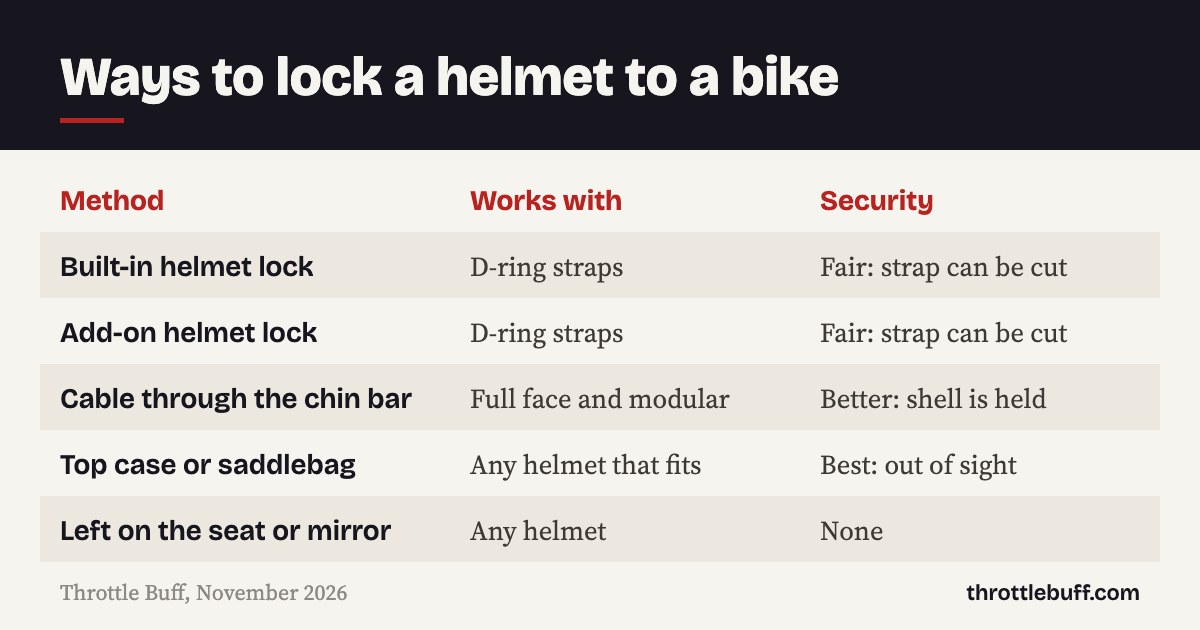
Which method works depends on how your chin strap fastens and what kind of helmet you wear. A hook that suits a D-ring strap is useless on a ratchet buckle, and an open face helmet has no chin bar to thread a cable through. The table below matches each method to the helmets it fits.
5 ways to lock a helmet, compared
| Method | Works with | What can defeat it | Best for |
|---|---|---|---|
| Built-in helmet lock or under-seat hook | Helmets with D-ring straps | Cutting the chin strap | Short stops where you can see the bike |
| Add-on helmet lock on the bars or frame | Helmets with D-ring straps. Ratchet buckles need a model with a cable or extension | Cutting the chin strap | Bikes with no factory lock |
| Cable or chain through the chin bar | Full face and modular helmets, any buckle | Cutting the cable | Longer stops, and ratchet-buckle helmets |
| Locked top case or hard saddlebag | Any helmet that fits inside | Breaking into the luggage | All-day parking and bad weather |
| Helmet left on the seat or mirror | Any helmet | Anyone walking past, or the wind | Nothing. Avoid it |
How to lock a helmet to a motorcycle: step by step
1. Check how your chin strap fastens
Look at the buckle. A double D-ring strap ends in two steel rings, and one of those rings is what a helmet lock hooks onto. A ratchet buckle, also called a micrometric buckle, has a toothed tongue and a clip but no closed ring, so it cannot hang on a hook. Our guide on how to fasten a double D-ring helmet shows what the rings look like.
2. Find your bike’s built-in lock
Many motorcycles have one. Look for a small key-operated lock on the side of the subframe below the seat, or for hooks or wire loops on the underside of the seat itself. On Harley-Davidson models with one, the service information places the helmet lock on the left side of the motorcycle under the seat.
3. Hook the D-ring and lock it
Harley-Davidson’s own procedure is three steps: lift the seat, put the D-ring from the helmet over the open hook, then latch and lock the seat. Key-operated side locks work the same way: open the lock, slip one D-ring over the pin, close it and take the key.
Before you walk away, check where the helmet hangs. It should rest against the seat or a side panel, not the exhaust, the chain or a hot engine case.
4. No built-in lock? Add one or use a cable
An add-on helmet lock clamps to the handlebar, an engine guard or the frame, or bolts on behind the license plate. Most hold a D-ring in the same way as a factory lock. Some include a short cable or a T-shaped extension bar for helmets without D-rings. Our best motorcycle helmet locks guide compares the main types.
A plain cable lock does the job too. Open the visor, pass the cable in through the eye port and out under the chin bar, then loop it around a part of the bike that cannot be unbolted in seconds: the frame, a grab rail or the fork leg. Do not loop it around a mirror stem or a luggage strap.
5. Take the helmet off the lock before you ride
This one comes straight from the manufacturer. Harley-Davidson’s note on its helmet lock reads: do not operate the motorcycle with a helmet in the helmet lock. Carry a spare helmet in luggage or strapped down on the passenger seat instead.
How secure is a helmet lock, really?
A D-ring lock stops someone lifting the helmet and walking off. It does not stop someone with a blade, because the only thing holding the helmet is the fabric chin strap.
A cable through the chin bar is a step up, because the shell itself is held and there is nothing soft to cut except the cable. A locked top case is better again: the helmet is out of sight and out of the rain. Use the hook while you pay for fuel, the cable for a lunch stop, and the top case or your own hands for a day at work.
The bike needs the same thinking. A helmet locked to a motorcycle that is not locked itself is only as safe as the bike, so see our guides to motorcycle disc locks and motorcycle alarm systems.
Locking different helmet types
Full face and modular helmets
These are the easiest. Both the D-ring method and the chin bar method work. On a modular helmet, close and latch the chin bar before you thread a cable through it.
Open face and half helmets
There is no chin bar, so the strap is your only anchor point. Use a D-ring lock, and treat it as a deterrent for short stops only. A saddlebag or backpack is often the better answer.
Helmets with ratchet buckles
Skip the hook. Use a cable through the chin bar, or an add-on lock sold with a cable or extension for ratchet straps. If you are still choosing a helmet, our overview of the types of motorcycle helmets explains how the designs differ.
Why the seat and the mirror are bad places for a helmet
Theft is only half of it. A helmet balanced on a seat or hung on a mirror is one gust or one nudge away from hitting the ground. A helmet’s shell and liner are built to manage a crash, as we explain in why helmets break on impact, so keep drops off the list. A hanging helmet also fills with rain. If yours gets soaked, our helmet cleaning tips cover drying the liner, and how to store a motorcycle helmet covers where to keep it at home.
The helmet is the one piece of gear that NHTSA urges every rider to wear on every ride.

FAQ
Can you lock your helmet to your motorcycle?
Yes. Use the bike’s built-in helmet lock if it has one, an add-on helmet lock, or a cable lock through the chin bar and around the frame.
How do you lock a helmet to a motorcycle seat?
Lift the seat, place the helmet’s D-ring over the hook underneath, then latch and lock the seat so the ring is trapped.
How do you lock a half helmet to a motorcycle?
Through the D-ring on the chin strap, using a built-in or add-on helmet lock. A half helmet has no chin bar for a cable, so for longer stops put it in a bag or saddlebag.
Is it safe to leave a helmet locked to a motorcycle?
For short stops, yes. For hours at a time, a locked top case or carrying it is safer.
Can you ride with a helmet on the helmet lock?
No. Harley-Davidson tells owners not to operate the motorcycle with a helmet in the helmet lock, and the same logic applies to any bike.
Verdict
To lock a helmet to a motorcycle, match the method to the stop. A D-ring on the built-in hook or an add-on lock is fine for a few minutes. A cable through the chin bar suits a longer break and any ratchet buckle. For a full day, lock the helmet inside luggage or take it with you.
Browse all our helmet guides.