Throttle Buff is reader-supported: we may earn a commission when you buy through links on this page. Read our affiliate disclosure.
The best photochromic motorcycle visor is the Shoei CWR-F2 Transitions shield if you own an RF-1400 or X-Fifteen: it is Pinlock-ready, costs about $230 and darkens from about 80% to 23% light transmission. Bell owners should get the Panovision ProTint (about $150), and AGV K6 owners have a Pinlock-ready shield of their own. Photochromic visors only fit the helmets they are made for, so start with the shield made for your helmet.
Quick picks
-
Best overall
Shoei CWR-F2 Transitions Shield
- Fits
- Shoei RF-1400, X-Fifteen
- Tint range
- 80% to 23% light
- Price
- About $230
-
Best for Bell
Bell Panovision ProTint Shield
- Fits
- Race Star, Pro Star, Star, SRT
- Tint range
- Not published
- Price
- About $150
-
Best for AGV
AGV K6 / K6 S Photochromic Shield
- Fits
- AGV K6, K6 S
- Pinlock
- 120 XLT MaxVision ready
- Price
- About $190
-
Best for modular
LS2 Horizon / Horizon II Photochromic Shield
- Fits
- LS2 Horizon, Horizon II
- Tint range
- Not published
- Price
- About $140
- Best for ADV: Klim Krios / Krios Pro Transitions Shield
- Cheapest OEM: HJC HJ-35 ShadeX Photochromic Shield
- For Arai owners: Arai VAS-V Pro Shade System
We chose these shields from research, not hands-on testing. We focused on OEM shields from the helmet makers, because they fit and seal properly, and compared published tint ranges, Pinlock compatibility, fitment, price and US availability at RevZilla. Most makers do not publish transition speeds, so we quote numbers only where the maker does.
Photochromic visors compared
| Shield | Fits | Pinlock-ready | Price |
|---|---|---|---|
| Shoei CWR-F2 Transitions | RF-1400, X-Fifteen | Yes | About $230 |
| Bell Panovision ProTint | Race Star, Pro Star, Star, SRT | Not stated | About $150 |
| AGV K6 / K6 S Photochromic | K6, K6 S | Yes (120 XLT) | About $190 |
| LS2 Horizon Photochromic | Horizon, Horizon II | Not stated | About $140 |
| Klim Krios Transitions | Krios, Krios Pro | Not stated | About $150 |
| HJC HJ-35 ShadeX | RPHA 1N | Not stated | About $110 |
| Arai VAS-V Pro Shade (not photochromic) | VAS-V helmets | n/a | About $102 |
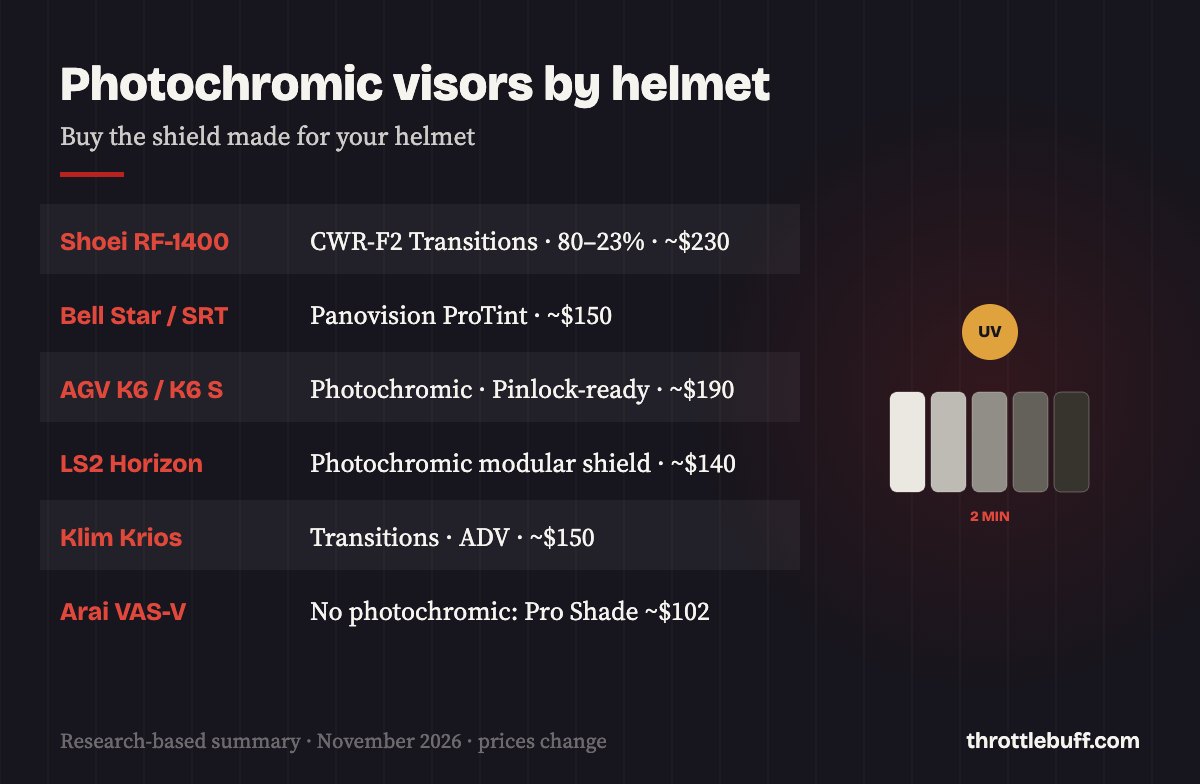
Fitment, specs and prices from Shoei, Bell, AGV, Klim, HJC, Arai and RevZilla listings checked in November 2026. Several shields were out of stock.
The best photochromic shields in detail
1. Shoei CWR-F2 Transitions: best overall

Shoei’s CWR-F2 Transitions shield is the best-documented photochromic visor you can buy. Shoei publishes its range: it lets through about 80% of light when clear and darkens to about 23% in sun. It fits the RF-1400 and X-Fifteen, and it takes the CWR-F2 Pinlock insert, so you can keep anti-fog protection on cold mornings.
Shoei says it fades back to 50% light transmission in about two minutes, which is typical for photochromic lenses and a reminder to slow down before tunnels and heavy shade. Shoei also lists it as not ECE 22.06 approved, which matters if you ride in Europe. RevZilla sells it for about $230. If you own an RF-1400, our Shoei RF-1400 review covers the rest of the helmet.
Pros
- Published 80% to 23% tint range
- Pinlock-ready
- Shoei optical quality
Cons
- Most expensive shield here
- Not ECE 22.06 approved
- Slow to clear in shade
2. Bell Panovision ProTint: best for Bell sport helmets

Bell calls its photochromic shield ProTint. It darkens in sunlight and clears in low light, so you can ride from morning to dusk without changing shields. This Panovision version fits the Race Star, Pro Star, Star (2016 and later) and the SRT and SRT Modular, which covers most of Bell’s sport and touring range.
Bell does not publish a tint range or transition speed, so we cannot compare it directly with Shoei. At about $150 it costs $80 less than the Shoei. Bell’s Race Star Flex DLX includes a ProTint shield in the box; see our Race Star Flex DLX review.
Pros
- Fits most Bell sport and touring helmets
- About $80 less than Shoei
- In stock at RevZilla
Cons
- No published tint specs
3. AGV K6 / K6 S Photochromic: best for AGV riders

AGV’s photochromic shield fits the K6 and K6 S, the lightest full-face helmet on the US market. It is Pinlock-ready for the 120 XLT MaxVision insert (sold separately) and costs about $190 at RevZilla.
Read the label before you buy: AGV marks this shield for racetrack and daytime use only. That means AGV does not want you to rely on it for night riding on the street, so carry a clear shield on trips that may run past sunset.
Pros
- Pinlock-ready
- Cheaper than Shoei
- Fits AGV K6 and K6 S
Cons
- AGV labels it daytime and track use only
4. LS2 Horizon Photochromic: best for a modular helmet

Photochromic shields for modular helmets are rare, which is why the LS2 Horizon version stands out. It fits both the original Horizon and the Horizon II, LS2’s popular touring modular, and RevZilla lists it at about $140.
LS2 does not publish tint numbers. Because the Horizon already has a drop-down sun visor, a photochromic shield is mainly for riders who want hands-free tint without the extra layer in front of their eyes.
Pros
- Rare modular option
- About $140
Cons
- No published specs
- Horizon already has a sun visor
5. Klim Krios Transitions: best for adventure riders

Adventure riders move between open sun and forest shade all day, which is exactly where a photochromic shield helps. Klim’s Transitions shield fits the Krios and Krios Pro, and Klim says it adjusts light transmission to conditions so you can see clearly at any time of day.
It costs about $150. RevZilla showed it out of stock in November 2026, so check Klim dealers too. Klim also makes Transitions shields for the K1R and TK1200.
Pros
- Made for changing ADV light
- Fits Krios and Krios Pro
Cons
- Out of stock at RevZilla when we checked
- No published specs
6. HJC HJ-35 ShadeX: cheapest OEM shield

At about $110, HJC’s ShadeX is the cheapest OEM photochromic shield we found. It fits the RPHA 1N race helmet only. We could not find an official HJC photochromic shield for the popular i10 or i90 in the US; listings for those are third-party copies, which we would avoid because optical quality and fit vary.
RevZilla showed it out of stock when we checked.
Pros
- About $110
- OEM fit and optics
Cons
- RPHA 1N only
- Out of stock when we checked
7. Arai VAS-V Pro Shade: the Arai alternative

Arai does not make a photochromic shield. Its answer is the Pro Shade, a tinted shade that clips to the VAS-V face shield and flips down when you need it, for about $102. It fits VAS-V helmets such as the Corsair-X, Signet-X, Quantum-X, Contour-X and Regent-X.
The advantage is speed: you flip it up instantly in a tunnel. The other Arai route is a Pinlock ProtecTINT insert, a photochromic Pinlock lens that sits inside a clear shield; Arai launched one in 2023, but US availability is patchy.
Pros
- Instant manual control
- Works at night with the shade up
Cons
- Not automatic
- Adds a second layer to the shield
How photochromic visors work
Photochromic shields contain molecules that darken when ultraviolet (UV) light hits them and clear again when the UV goes away. That has three practical effects riders should know about:
- They clear slowly. Shoei quotes about two minutes to fade back to 50% light. Riding from bright sun into a tunnel or forest can leave you looking through a dark shield for a while, so slow down.
- Temperature matters. Photochromic lenses darken more and clear more slowly in the cold, and stay lighter in heat.
- Windscreens can block the trigger. Many windshields filter UV, so a shield behind a tall touring screen may not darken fully.
Are tinted and photochromic visors legal?
US helmet law (DOT FMVSS 218) covers the helmet, not shield tint, so tint rules come from state laws. Several states restrict tinted eye protection at night; Louisiana, for example, says eye protection used at night must not be tinted. Check your state before relying on any tinted shield after dark.
In Europe, ECE 22.06 requires at least 80% light transmission for a visor to be used day and night, and tinted visors (at least 35%) are marked for daytime use only. A photochromic shield that darkens below that may not be approved, which is why Shoei lists its shield as not ECE 22.06 and AGV labels its shield for daytime and track use. Read more in ECE 22.06 vs DOT.
Photochromic shield vs sun visor vs tinted shield
- Photochromic shield: automatic and hands-free, but slow to clear, affected by cold and less effective behind a UV-blocking windscreen. Best for long daytime rides with changing light.
- Drop-down sun visor: instant and free if your helmet has one, and you can ride at night with it up. It adds a second layer in front of your eyes.
- Tinted shield: cheapest and darkest, but you must carry a clear one for dusk.
- Glasses or goggles: another option for open-face and ADV riders; see the best motorcycle glasses.
Whatever shield you choose, keep it clean and fog-free; our guide on how to stop helmet visor fogging covers Pinlock inserts and other fixes.
FAQ
Do photochromic visors work at night?
A photochromic shield should be at or near its clearest at night, because there is no UV to darken it. Shoei’s is about 80% light transmission when clear. Some makers still label their photochromic shields for daytime use only, so follow the label and your state’s rules.
How long does a photochromic visor take to change?
Darkening is usually quick, but clearing is slower. Shoei says its shield fades back to 50% light in about two minutes. Cold weather slows it further.
Will a photochromic visor fit my helmet?
Only if it is made for your helmet’s shield system. Shields are not interchangeable between brands, or even between some models from the same brand. Check the shield code (for example CWR-F2 or Panovision) in your manual.
Can I use a Pinlock with a photochromic visor?
Yes, if the shield is Pinlock-ready, like the Shoei CWR-F2 and AGV K6 shields. Use a clear Pinlock insert so it does not cut light further.
If you ride a Shoei RF-1400 or X-Fifteen, the CWR-F2 Transitions shield is the one to get. Bell riders should pick the ProTint, and Arai owners can use the Pro Shade until a photochromic option is easy to find in the US.