Throttle Buff is reader-supported: we may earn a commission when you buy through links on this page. Read our affiliate disclosure.
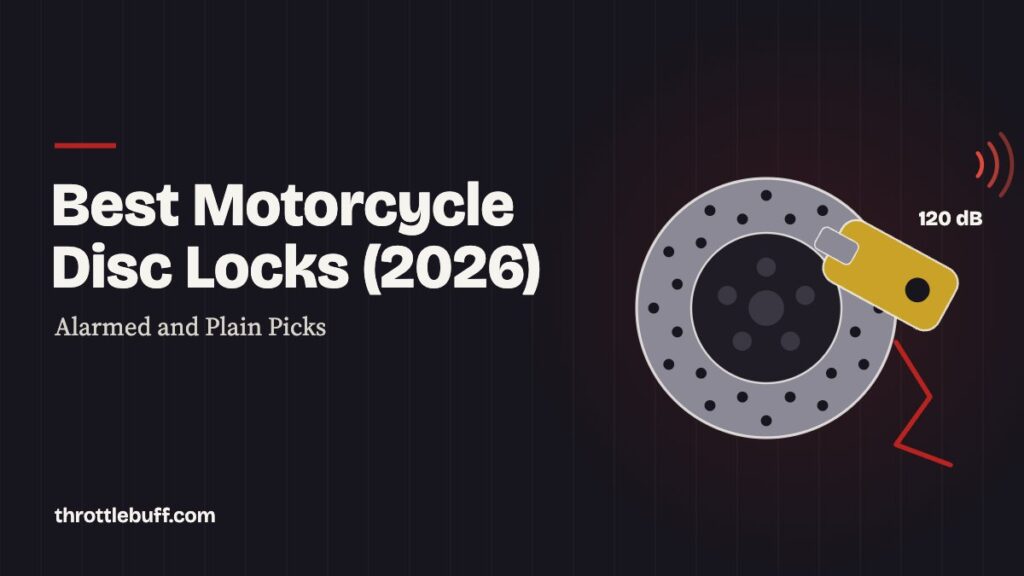
The best motorcycle disc lock for most riders is the Oxford Boss Alarm: a 14 mm pin, a 100 dB alarm and a Sold Secure Powered Cycle Gold rating for about $110. If you do not want an alarm, the Gold-rated Hiplok MDX is the pick, and if loudness matters most, the 120 dB Xena XX-10 is the loudest. Whatever you buy, check that the pin fits your rotor and use a reminder cable so you do not ride off with it on.
Quick picks
-
Best overall
- Pin
- 14 mm
- Alarm
- 100 dB
- Price
- About $110
-
-
-
Toughest plain lock
- Pin
- 14 mm shackle
- Alarm
- No
- Price
- About $110
- Thickest pin: Oxford Big Boss Disc Lock (16 mm)
- Mid-price pick: Kryptonite KryptoLok Disc Lock
- Budget alarm: Kryptonite Keeper Alarm Disc Lock
We chose these locks from research, not hands-on testing. We compared pin size, alarm volume, independent security ratings (Sold Secure in the UK, ART in the Netherlands), weight and current US prices from RevZilla and the makers. Security ratings come from the rating bodies or the manufacturer’s listing; where we could not confirm one, we say so.
Motorcycle disc locks compared
| Disc lock | Pin | Alarm | Rating | Price |
|---|---|---|---|---|
| Oxford Boss Alarm | 14 mm | 100 dB | Sold Secure Gold | About $110 |
| Hiplok MDX | 12 mm | No | Sold Secure Gold | About $120 |
| Xena XX-10 | 10 mm | 120 dB | Not confirmed | About $122 |
| Kryptonite New York | 14 mm | No | Gold with chain bundle | About $110 |
| Oxford Big Boss 16 mm | 16 mm | No | Not confirmed | About $81 |
| Kryptonite KryptoLok | 10 mm | No | Not found | About $70 |
| Kryptonite Keeper Alarm | 5.5 mm | 100 dB | Kryptonite 5/15 | About $60 |
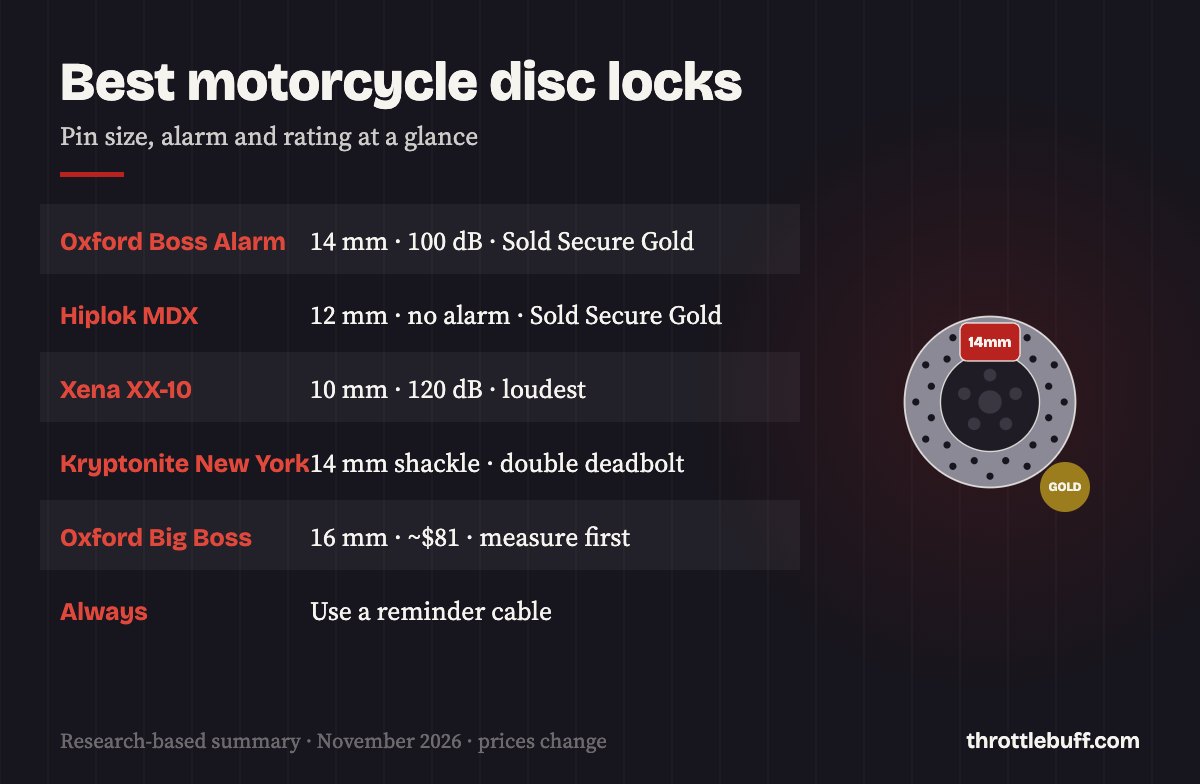
Specs and prices from RevZilla, Oxford, Hiplok, Kryptonite and Xena listings checked in November 2026. Xena stock in the US is unreliable.
The best disc locks in detail
1. Oxford Boss Alarm: best overall

The Oxford Boss Alarm gets the balance right: a thick 14 mm pin, a 100 dB alarm that sounds when the lock is moved, and a Sold Secure Powered Cycle Gold rating, the UK test lab’s high-security level for motorcycle locks. Very few alarmed disc locks sold in the US carry an independent rating like that.
A 14 mm pin is thick enough to resist bolt cutters better than the 5 to 10 mm pins on cheaper locks, but check that it fits through a hole in your rotor before you order (see how to measure below). RevZilla lists it at about $110.
Pros
- Sold Secure Powered Cycle Gold
- 14 mm pin
- Alarm deters tampering
Cons
- 100 dB is quieter than Xena
- Needs a rotor hole large enough for 14 mm
2. Hiplok MDX: best disc lock without an alarm

If you do not want to deal with alarm batteries or false alarms, the Hiplok MDX is the plain lock to get. Hiplok says it is Sold Secure Powered Cycle Gold rated, with a 12 mm pin and a weight of 983 grams, and it comes with a magnetic reminder tag that covers the keyhole and sticks to your bars or ignition so you do not ride off with the lock still on.
Gold testing does not include angle-grinder attacks; Hiplok’s heavier MD1000 is the Diamond-rated version for that. For a lock you carry every day, the MDX is easier to live with and costs about $120.
Pros
- Sold Secure Gold
- Magnetic reminder tag included
- No battery to maintain
Cons
- No alarm
- About 2 lb to carry
3. Xena XX-10: loudest alarm

Xena built its name on alarmed disc locks, and the XX-10’s 120 dB siren is the loudest we found, noticeably louder than the 100 dB alarms on Oxford and Kryptonite locks. It uses a 10 mm carbide-reinforced pin and a 7 mm jaw gap, which fits most motorcycle and scooter rotors.
The trade-off is pin thickness: 10 mm is thinner than the 14 mm Oxford Boss. Xena locks also sell out often. RevZilla showed it out of stock in November 2026, so check other sizes in the XX range (such as the XX15) if the XX-10 is unavailable.
Pros
- 120 dB alarm
- Fits most rotors
- Compact
Cons
- 10 mm pin
- Often out of stock
4. Kryptonite New York Disc Lock: toughest plain disc lock

The New York Disc Lock is Kryptonite’s heavy-duty option, with a 14 mm hardened shackle and a double deadbolt, and it weighs about 1 kg. Sold Secure rates it Gold for powered cycles when it is sold as a bundle with Kryptonite’s Fahgettaboudit chain, which tells you the lock itself is built to a high standard.
The U-shaped body is bulkier than a pin-style lock, so it takes more room in a jacket pocket or tank bag. RevZilla lists it at about $110.
Pros
- 14 mm hardened shackle
- Double deadbolt
- Kryptonite build quality
Cons
- Bulky
- No alarm
5. Oxford Big Boss: thickest pin for the money

If you want the thickest possible pin without spending over $100, the Oxford Big Boss has a 16 mm shackle, a hardened steel locking mechanism, an armored casing and a double-locking system, according to RevZilla’s listing. A 16 mm pin is the hardest to cut of any lock here.
The catch is fit: many sportbike and scooter rotors have holes smaller than 16 mm. Measure first. This RevZilla listing is the non-alarm version; Oxford also sells a Big Boss Alarm.
Pros
- 16 mm shackle
- About $81
- Double locking
Cons
- Will not fit small rotor holes
- No alarm on this version
6. Kryptonite KryptoLok: best mid-price lock

The KryptoLok is a solid everyday disc lock for about $70. Kryptonite lists a 10 mm pin and a weight of about 2 lb. It is a sensible choice for quick stops at work or the coffee shop, especially if your bike is also parked somewhere visible.
It has no alarm and we found no Sold Secure rating, so for overnight street parking we would step up to the Oxford Boss Alarm or Hiplok MDX.
Pros
- About $70
- 10 mm pin fits most rotors
Cons
- No alarm
- No independent rating found
7. Kryptonite Keeper Alarm: best budget alarm lock for scooters

The Keeper Alarm is small, light (about 0.9 lb) and cheap, with a 100 dB alarm. Its 5.5 mm pin fits the small vent holes on scooter and small-motorcycle rotors that thicker locks cannot use.
Kryptonite gives it 5 on its own 15-point security scale, which puts it firmly in the deterrent category. It is a good choice for a scooter or a second lock, not as the only security on an expensive bike. The non-alarm Keeper costs about $45.
Pros
- Fits small rotor holes
- 100 dB alarm for about $60
- Pocket-sized
Cons
- 5.5 mm pin is low security
- Kryptonite rates it 5 of 15
How to choose a motorcycle disc lock
Measure your rotor holes first
The pin has to pass through a hole in the brake rotor, so the right lock depends on your bike. Measure the smallest usable hole with calipers, or test with drill bits of known sizes, and choose a pin smaller than that. Also check the rotor thickness against the lock’s jaw gap (Xena’s is 7 mm). Scooters and small bikes often need a pin of 6 mm or less, while most big-bike rotors take 10 to 14 mm.
Thicker pins are harder to cut
Pin diameter is the simplest guide to strength. A 5 to 6 mm pin keeps honest people honest; 10 mm is a reasonable daily lock; 14 to 16 mm resists bolt cutters far better. Hardened steel and an armored body matter too, which is what security ratings test.
Security ratings explained
- Sold Secure (UK): the Powered Cycle category has Gold (resists heavy tools) and Diamond (adds a determined attack with power tools such as angle grinders).
- ART (Netherlands): rates locks from 1 to 5 stars. Dutch insurers usually require ART 4 or higher for motorcycles.
US brands rarely test to either, so a missing rating does not always mean a weak lock, but a rating is the only independent proof of strength.
Alarm or no alarm
An alarm adds a loud warning when someone moves the bike or the lock, which is a strong deterrent in public places. It also means a battery to check and the occasional false alarm from a passing truck. If you park in a garage or a quiet driveway, a plain lock plus a cover may be enough.
Always use a reminder cable
The classic disc-lock mistake is forgetting it is on and riding off, which can break the lock, the rotor or the fork, and can drop the bike. Clip a bright coiled reminder cable from the lock to your grip or lever every time. Hiplok includes a magnetic tag; Kryptonite and others sell reminder cables separately.
Front or rear rotor?
Both work. The front rotor is easier to reach and easy to see from the seat, which helps you remember it. The rear is harder for a thief to get at with tools. Whichever you choose, place the lock so it would hit the fork leg or caliper quickly if the wheel moves, rather than spinning around the disc.
A disc lock is only one layer
A disc lock stops the bike being rolled away, but it cannot stop thieves lifting it into a van. For street parking, add a chain to a fixed anchor, and consider one of the best motorcycle alarm systems for the bike itself. At home, a portable motorcycle garage keeps the bike out of sight. And while you are locking the bike, lock your lid too: see our best motorcycle helmet locks.
FAQ
Are motorcycle disc locks worth it?
Yes. They are cheap, light and fast to use, and they stop the most common theft: rolling the bike away. Pair one with a chain for longer stops.
What size disc lock do I need?
Choose a pin that passes through the smallest usable hole in your rotor, and a jaw gap wider than the rotor’s thickness. Measure before you buy.
Can you use a disc lock on the rear wheel?
Yes, as long as the rear rotor has suitable holes and you can reach it. Some riders prefer the rear because it is harder for a thief to attack.
What happens if you ride off with a disc lock on?
The lock hits the fork or caliper as the wheel turns, which can damage the rotor, caliper or fork and may tip the bike over. A reminder cable prevents it.
For most riders, the Oxford Boss Alarm is the disc lock to buy. Choose the Hiplok MDX if you prefer no alarm, and add a reminder cable either way.