
Throttle Buff is reader-supported: we may earn a commission when you buy through links on this page. Read our affiliate disclosure.
How we chose: this guide is research-based, built from manufacturer specifications, safety certifications and owner feedback rather than hands-on testing. How we research.
The best snowmobile helmet for most riders is the 509 Delta V Ignite: it’s DOT and ECE 22.06 certified, has a dual-pane heated shield and uses Venturi venting to pull moisture out of the breath box. The HJC DS-X1 Synergy is the best-value dual-sport option, the 509 Delta R4 Ignite is the pick if you want a modular flip-up, and the Z1R Warrant Neuron is the budget choice with a heated shield and drop-down sun visor. Here are seven snowmobile helmets with electric shields, compared.
Quick picks
-
Best overall
- Style
- Dual-sport
- Heated shield
- Ignite dual-pane
- Price tier
- $$$
-
Best dual-sport value
- Style
- Dual-sport, converts to goggles
- Heated shield
- HJ-27 electric shield
- Price tier
- $$
-
Best modular
- Style
- Modular
- Heated shield
- Ignite dual-pane
- Price tier
- $$$
-
Best with sun shade
- Style
- Dual-sport
- Heated shield
- Dual-layer electric
- Price tier
- $$
- Best for neck-brace users: FXR Clutch X Evo
- Best for round heads: Fly Racing Trekker Cold Weather
- Best budget: Z1R Warrant Neuron Snow Electric
Snowmobile helmets compared
| Helmet | Style | Heated shield | Certification (as listed) | Head shape | Price tier |
|---|---|---|---|---|---|
| 509 Delta V Ignite | Dual-sport | Ignite dual-pane | DOT / ECE 22.06 | Intermediate oval | $$$ |
| HJC DS-X1 Synergy | Dual-sport, converts to goggles | HJ-27 electric shield | Check listing | Intermediate oval | $$ |
| 509 Delta R4 Ignite | Modular | Ignite dual-pane | DOT / ECE | Round oval | $$$ |
| FXR Torque X | Dual-sport | Dual-layer electric | DOT / ECE | Intermediate oval | $$ |
| FXR Clutch X Evo | Adventure/dual-sport | Dual-layer electric | Check listing | Intermediate oval | $$ |
| Fly Racing Trekker CW | Dual-sport | Electric shield | Check listing | Round oval | $$ |
| Z1R Warrant Neuron | Full-face | Dual-pane electric | DOT | Check listing | $ |
Details are from RevZilla’s listings at the time of writing. Price tiers are relative within this list, and prices change.
Why a snowmobile helmet is different
A regular motorcycle helmet fogs and ices up fast in sub-zero air, because your warm breath hits a freezing shield. Snowmobile helmets fix that with three things: a heated electric shield (usually dual-pane) powered from your sled, a breath box that routes breath away from the shield, and a chin curtain to block cold air from below. Most also have a peak to deflect snow and sun. The same tricks that help on a motorcycle apply too; see our guide on how to stop helmet visor fogging.

The 7 best snowmobile helmets
1. 509 Delta V Ignite: best overall

The Delta V Ignite is built for high speeds, frigid temps and long trail days. Its Ignite dual-pane heated shield keeps your view fog-free, and the Venturi Venting System creates negative pressure to pull moisture out of the breath box. It’s DOT and ECE 22.06 certified, uses a Fidlock magnetic chinstrap that’s easy with gloves, and comes in an intermediate oval fit from SM to 3XL. Note that the “Ignite” version doesn’t include the chase light found on some other Delta V models.
Who it’s for: trail riders who want the most complete heated-shield helmet with current ECE 22.06 certification.
2. HJC DS-X1 Synergy Snow: best dual-sport value

The DS-X1 Snow pairs an HJ-27 electric shield with a converting system that lets you remove the shield and run goggles with the peak instead, handy for mountain riders who work up a sweat. It has an advanced polycarbonate composite shell, a large eye port that fits goggles well, and HJC’s ACS ventilation for front-to-back airflow. A chin curtain and breath deflector come included, the SuperCool liner is removable and washable, and there are glasses grooves for riders who wear eyeglasses. RevZilla lists it at 3.92 lbs with a double D-ring closure.
Who it’s for: riders who switch between trail and backcountry and want the option of goggles.
3. 509 Delta R4 Ignite: best modular

If you like to flip your face up at stops without taking the helmet off, the Delta R4 Ignite is a modular with 509’s Ignite dual-pane heated shield. The shield is oversized for a wide view and flips up with a glove-friendly button. It has a climate-control vent system, a cold-weather breath box and chin curtain, a smoke-tinted sun shield and a Fidlock magnetic buckle. It’s DOT/ECE certified, has two shell sizes with dual-density EPS, and fits a round oval head shape.
Who it’s for: touring sledders and riders with rounder heads who want the convenience of a flip-up.
4. FXR Torque X: best with built-in sun shade

The Torque X adds an integrated drop-down sun shade to an electrically heated, dual-layer shield that’s anti-fog, anti-scratch and UV filtering. Its peak cuts lift and drag at speed and blocks sun and roost. You get an adjustable breath box, an easy-open nose guard vent, a quick-release buckle and a dual-density EPS liner, and it’s DOT and ECE certified.
Who it’s for: riders who face changing light and want a sun shade without swapping shields.
5. FXR Clutch X Evo: best for neck-brace users

The Clutch X Evo is a cold-weather adventure-style helmet with an electrically heated dual-layer shield using FXR’s Lock + Seal technology. Its rear diffuser is designed to disperse impact load to compatible neck braces, and a sternum pad adds protection to the chin, jaw and sternum. It has a polymer alloy shell, dual-density EPS and an adjustable breath box.
Who it’s for: aggressive riders who wear a neck brace.
6. Fly Racing Trekker Cold Weather: best for round heads

The Trekker CW is Fly Racing’s winter adventure helmet, and Fly pitches it as a choice that doesn’t break the bank. It has a lightweight polymer shell, a dual-density EPS liner and a scratch-resistant electric shield. Ventilation can be switched on and off, the SpaSoft interior is removable, washable and antimicrobial, and it comes with a fleece helmet bag. It’s listed as round oval at 3.5 lbs.
Who it’s for: riders with rounder heads who find intermediate-oval helmets pinch.
7. Z1R Warrant Neuron Snow Electric: best budget

The Warrant Neuron is the cheapest helmet here and still covers the essentials. It comes with both a standard shield and a dual-pane anti-fog electric shield plus power cord, a drop-down sun visor with an easy side lever, closable chin and top vents and a rear exhaust. The breath box and chin curtain are removable, as are the moisture-wicking liner and cheek pads. It has an injection-molded polycarbonate shell in two shell sizes and is DOT approved.
Who it’s for: new or occasional sledders who want a heated shield on a tight budget.
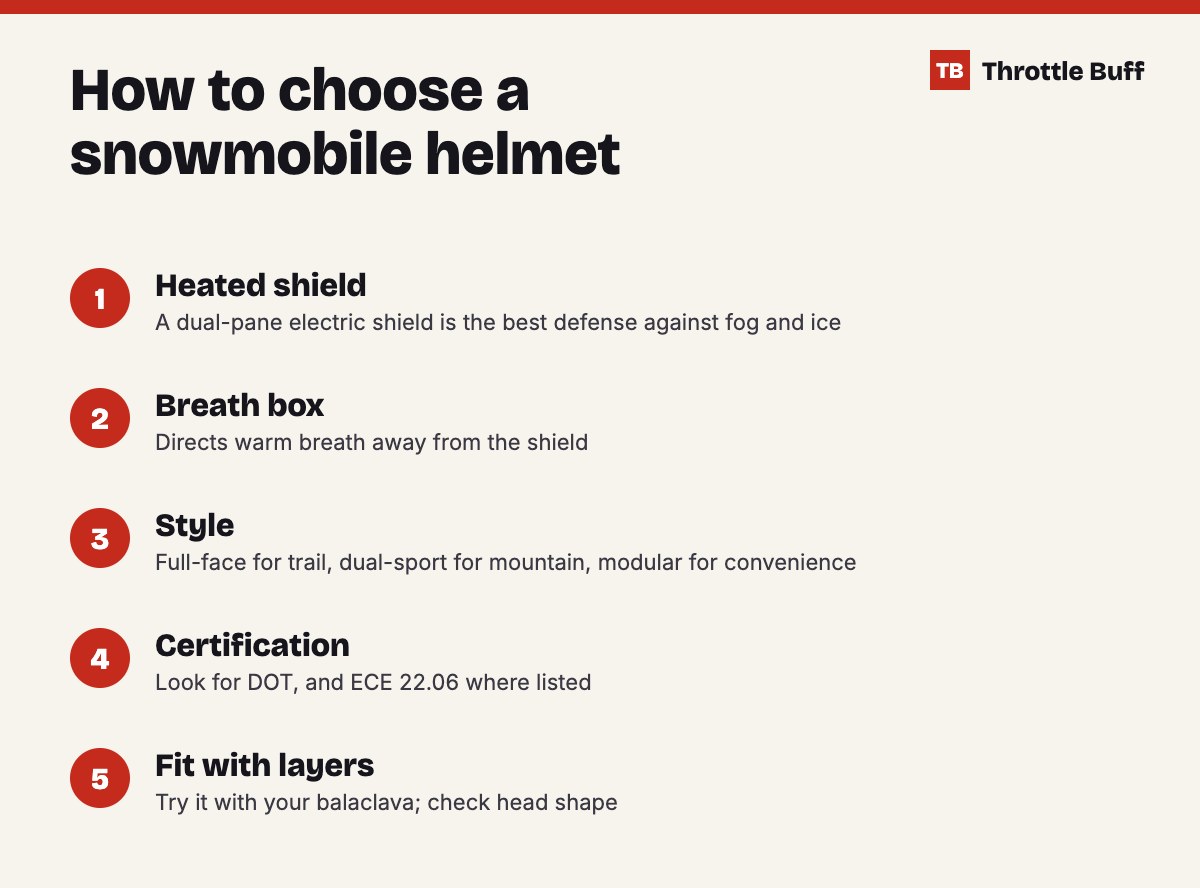
How to choose a snowmobile helmet
Full-face, dual-sport or modular
Full-face helmets are quiet and warm for trail riding. Dual-sport helmets with a peak suit varied terrain and often accept goggles. Modulars flip up at stops, which is convenient but adds weight and complexity.
Heated shield and power
Dual-pane electric shields are the most effective anti-fog option. Check that your sled has a compatible power outlet and that the cord is long enough.
Certification
In the US, look for DOT compliance; the NHTSA explains how to check. ECE 22.06 is the newer European standard, and each model is tested by an independent lab before certification.
Fit with your layers
Try helmets on with the balaclava you’ll wear. Head shape matters: most of these are intermediate oval, while the Delta R4 and Trekker are round oval.
Ride safely
The International Snowmobile Manufacturers Association has safety resources and trail information for riders.
Can you wear a snowmobile helmet for winter UTV riding?
Yes, and in an open-cab UTV it is often the best option. The cold, wind and fog problems are the same as on a sled, and a snowmobile helmet’s heated shield, breath box and chin curtain deal with all three. For a snowmobile-rated helmet that also works in a side-by-side, check three things first.
Look for a DOT rating
Choose a helmet with DOT certification, as most of the helmets above have, and ECE 22.06 where it is listed. Helmet rules for off-highway vehicles vary by state and trail system, so check the rules where you ride. A helmet sold only as a snow accessory with no certification label is not one to wear in a vehicle that can roll.
Plan how the heated shield gets power
Electric shields run from a cord plugged into the machine. Sleds often have a dedicated helmet outlet, while most UTVs have a 12-volt socket instead, so check what plug the helmet’s cord uses and whether you need an adapter before you buy. A dual-pane shield without power still fogs far less than a single-pane one.
Match the helmet to the cab
In a fully enclosed, heated cab you may not need a heated shield at all, and a lighter dual-sport helmet with goggles can be more comfortable. In an open or half-door cab, the full snowmobile setup with breath box and chin curtain earns its place.
Care tips
- Dry the liner after every ride so it doesn’t freeze or smell; our helmet cleaning tips apply here too.
- Check the shield’s power cord and connector for wear before each season.
- Replace the helmet after any impact.
Adding a communicator? Most of these helmets can take one; see the best Bluetooth headsets. For summer riding, see our reviews of the HJC CL-17, Icon Airflite and SEDICI Strada.
FAQ
Can I use a motorcycle helmet for snowmobiling?
You can, but it’ll fog and ice quickly. A snow helmet with a heated shield and breath box is much safer in the cold.
Do heated shields need a battery?
Most, including those here, plug into a power outlet on the sled with an included cord.
What’s the difference between DOT and ECE 22.06?
Both are helmet safety standards. ECE 22.06 tests more impact points at higher speed, and each model must be lab-tested before certification.
Verdict
The 509 Delta V Ignite is the best snowmobile helmet overall thanks to its heated shield, Venturi venting and ECE 22.06 certification. The HJC DS-X1 Synergy is the value dual-sport pick, the 509 Delta R4 Ignite is the modular choice, and the Z1R Warrant Neuron gets you a heated shield and sun visor for the least money.
Browse all our helmet guides.


