
Throttle Buff is reader-supported: we may earn a commission when you buy through links on this page. Read our affiliate disclosure.
How we compared them: this comparison is research-based, built from manufacturer specifications, safety certifications and owner feedback rather than a side-by-side test. How we research.
Short answer: the Cardo Packtalk Bold and Packtalk Slim shared the same mesh intercom technology. The real difference was the shape: the Bold was a single unit on the side of the helmet, while the Slim split the electronics so less sticks out. Both have since been discontinued. If you’re buying today, the Cardo Packtalk Edge is the best replacement for either, the Packtalk Pro is the upgrade, and the Neo is the budget option.
Packtalk Bold vs Slim: the key difference
| Packtalk Bold | Packtalk Slim | |
|---|---|---|
| Design | All-in-one unit mounted on the helmet shell | Split design: thin control unit outside, battery and electronics inside the helmet |
| Intercom | Cardo DMC mesh | Cardo DMC mesh |
| Install | Clamp or adhesive mount; quick to move between helmets | More involved, best kept in one helmet |
| Look and drag | More visible | Lower profile, cleaner look |
| Status in 2026 | Discontinued | Discontinued |
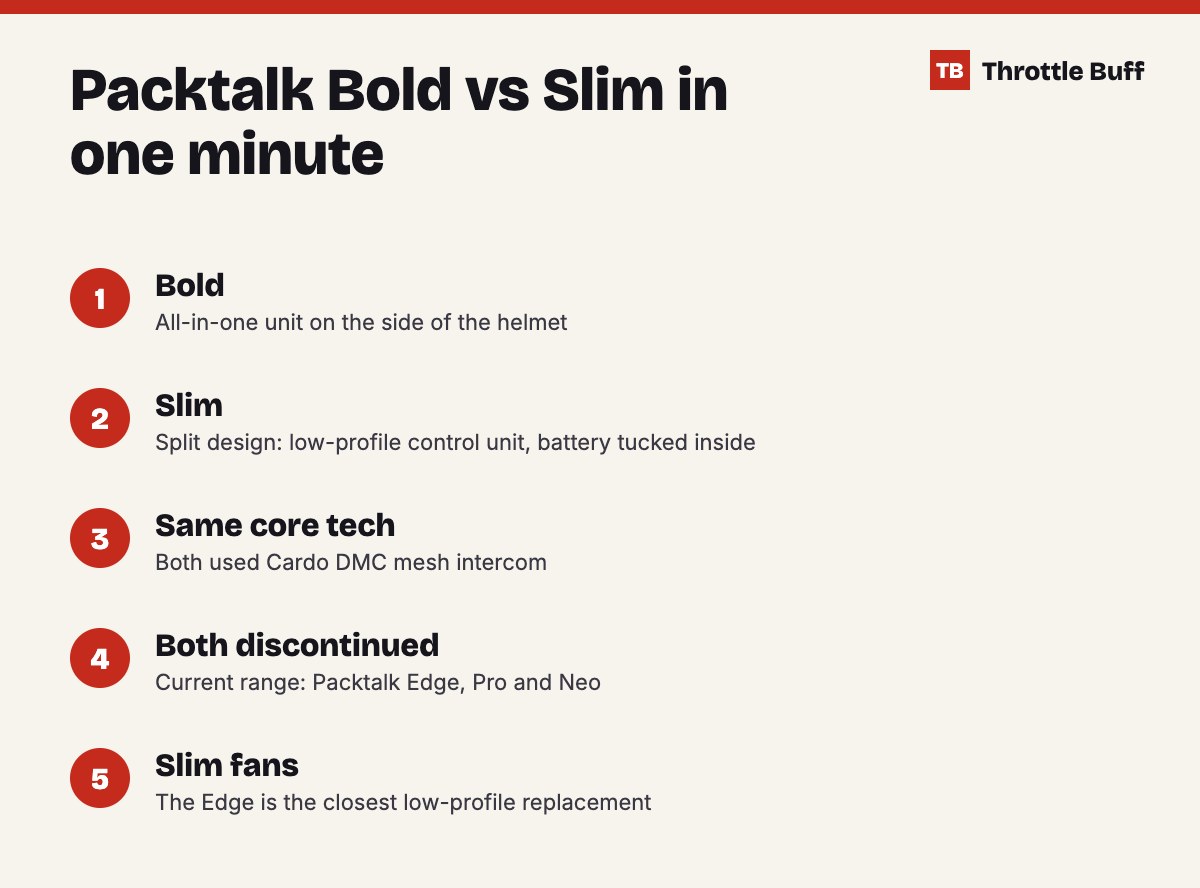
In short: the Bold suited riders who swap the unit between helmets, while the Slim suited riders who wanted the least bulk on one helmet and didn’t mind a more involved install.
Which was better?
For features, neither was clearly ahead, because both ran Cardo’s Dynamic Mesh Communication, which lets riders join and leave a group conversation without the chain pairing of older Bluetooth intercoms. The choice came down to how you ride:
- Bold: better if you own more than one helmet or want to remove the unit easily.
- Slim: better if you hate the look of a box on your helmet or ride at speeds where wind drag and noise matter.
We cover the Bold in more detail, including whether a used one is worth buying, in our Cardo Packtalk Bold review.

What to buy instead
Cardo Packtalk Edge: best replacement for either

The Edge is the direct successor to the Bold, and its compact unit and Air magnetic mount make it a good fit for Slim owners too. It supports mesh groups of up to 31 riders with about 1.6 km of range between riders, up to 13 hours of talk time, IP67 protection and JBL audio, backed by a 3-year warranty. The Duo pack shown here is the better buy if you ride two-up or with a regular partner.
Cardo Packtalk Pro: the upgrade

The Pro keeps the same mesh core and adds larger 45mm speakers and crash detection. Pick it if sound quality and an extra safety net matter to you.
Already own a Bold or Slim? Upgrade the speakers

If your unit still works, a set of Cardo’s 45mm JBL speakers can be a cheap way to improve sound. Check compatibility with your model before buying, and see our guide to the loudest motorcycle speakers.
Mixing old and new Cardo units
Current Packtalk models can generally join mesh groups with other Cardo DMC units, so a friend on an old Bold or Slim can usually still ride with you. Keep everyone’s firmware updated through the Cardo Connect app, and check the compatibility notes on the Cardo Systems website. Note that Cardo mesh doesn’t mesh with Sena mesh; mixed groups need Bluetooth intercom instead.
Comparing brands? See our best motorcycle Bluetooth headsets, Sena 50S review and Sena Spider ST1 review.
Related guides: Cardo vs Sena and ATV helmet communication systems.
FAQ
Are the Packtalk Bold and Slim discontinued?
Yes. Cardo’s current Packtalk range is the Edge, Pro and Neo.
Was the Slim quieter than the Bold?
The Slim’s low profile was designed to reduce bulk and wind drag, which is why riders who wanted a cleaner, quieter setup preferred it.
Can a Packtalk Edge talk to a Bold or Slim?
Generally yes over Cardo mesh, though some newer features may not be available to older units.
Verdict
The Packtalk Bold and Slim were the same intercom in two shapes. Both are gone now, and the Cardo Packtalk Edge replaces either one well, with the Pro as the upgrade.
Browse all our intercom and Bluetooth guides.

