Throttle Buff is reader-supported: we may earn a commission when you buy through links on this page. Read our affiliate disclosure.
How we chose: this guide is research-based, built from manufacturer specifications, safety certifications and owner feedback rather than hands-on testing. How we research.
The best motorcycle airbag vest for most street riders is the Alpinestars Tech-Air 5 Plasma: an electronic airbag that sits under your jacket and inflates in milliseconds to protect your back, chest and shoulders. On a budget, a tethered vest like the Helite Turtle 2 gives you airbag protection with no charging at all.
Quick picks
-
Best overall
- Trigger
- Electronic
- Worn
- Under jacket
- Price
- $$$$
-
Most versatile
- Trigger
- Electronic
- Worn
- Over or under jacket
- Price
- $$$
-
Best for touring
REV’IT! Avertum Tech-Air Street
- Trigger
- Electronic
- Worn
- Under compatible jackets
- Price
- $$$$
-
Best airbag jacket
- Trigger
- Electronic
- Worn
- Airbag built in
- Price
- $$$$
- Best electronic value: Helite e-Turtle 2
- Best tethered airbag: Helite Turtle 2
- Best for the track: Alpinestars Tech-Air 10 V2 Race
Airbag vests and jackets are the biggest safety upgrade in riding gear in decades. We picked current 2026 electronic and tethered airbags from Alpinestars, Dainese, REV’IT! and Helite, replacing the older vests from our previous list. Pair your airbag with a good motorcycle jacket.
Motorcycle airbags compared
| Airbag | Trigger | Worn | Best for | Price |
|---|---|---|---|---|
| Alpinestars Tech-Air 5 Plasma | Electronic | Under jacket | Street riding | $$$$ |
| Alpinestars Tech-Air 3 V2 | Electronic | Over or under jacket | Versatility | $$$ |
| REV’IT! Avertum Tech-Air Street | Electronic | Under compatible jackets | Touring | $$$$ |
| Dainese Smart Sport Jacket | Electronic | Airbag built in | All-in-one | $$$$ |
| Helite e-Turtle 2 | Electronic | Over jacket | Value | $$$ |
| Helite Turtle 2 | Tether to bike | Over jacket | No charging | $$ |
| Alpinestars Tech-Air 10 V2 Race | Electronic | Under race suit | Track | $$$$ |
The best motorcycle airbag vests and jackets for 2026
1. Alpinestars Tech-Air 5 Plasma: best overall

The Tech-Air 5 Plasma is a self-contained electronic airbag that you wear under your jacket. Sensors detect a crash and inflate the bag around your back, chest and shoulders before you hit the ground. It doesn’t need any sensors on the bike.
Check that your jacket has enough room: Alpinestars lists compatible jackets.
Pros
- Fully electronic, no tether
- Wide coverage
- Works on any bike
Cons
- Expensive
- Needs charging
2. Alpinestars Tech-Air 3 V2: most versatile
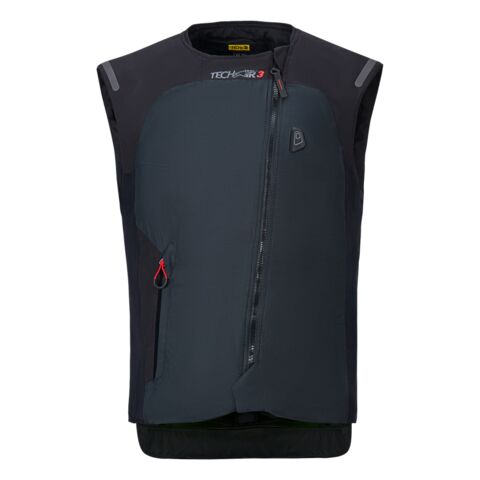
The Tech-Air 3 is Alpinestars’ more affordable electronic airbag, designed to be worn over or under many riding jackets. It is a great way to add airbag protection to gear you already own.
Pros
- Wear over or under many jackets
- Electronic trigger
- Lower price than Tech-Air 5
Cons
- Less coverage than Tech-Air 5
- Needs charging
3. REV’IT! Avertum Tech-Air Street: best for touring

The Avertum uses Alpinestars’ Tech-Air technology in a vest designed for REV’IT!’s compatible jackets. It is a good choice if you already ride in REV’IT! touring gear.
Pros
- Proven Tech-Air electronics
- Made for REV’IT! jackets
- Good for long rides
Cons
- Works best with REV’IT! jackets
- Expensive
4. Dainese Smart Sport Jacket: best airbag jacket

The Smart Sport is a jacket with Dainese’s D-air electronic airbag built in. Wear it on its own in warm weather or under a larger outer jacket when it’s cold.
Pros
- All-in-one design
- Electronic D-air system
- Flexible layering
Cons
- Expensive
- Needs charging
5. Helite e-Turtle 2: best electronic value

The e-Turtle 2 is Helite’s electronic version of its Turtle vest, worn over your jacket. It costs less than most electronic systems.
Pros
- Electronic trigger
- Lower price
- Worn over your jacket
Cons
- Bulkier look
- Needs charging
6. Helite Turtle 2: best tethered airbag

The Turtle 2 uses a lanyard attached to the bike: if you’re thrown off, the cord pulls and the vest inflates. There are no batteries to charge, and the cartridge is easy to replace after a deployment.
Pros
- No charging
- Lowest price
- Simple and reliable
Cons
- Must remember to clip in
- Only triggers when you leave the bike
7. Alpinestars Tech-Air 10 V2 Race: best for the track

The Tech-Air 10 is Alpinestars’ race system, with the widest coverage, made to be worn under a compatible race suit for track days.
Pros
- Maximum coverage
- Race-proven
- Electronic
Cons
- Needs a compatible suit
- Very expensive
How to choose a motorcycle airbag
Electronic or tethered?
Electronic airbags use sensors to detect a crash and can inflate before you leave the bike. Tethered airbags inflate when a cord to the bike pulls, so they only fire when you’re thrown off. Tethered vests are cheaper and need no charging.
Coverage
Look for back, chest and shoulder coverage, and ideally the neck and collarbones. Airbags complement, not replace, your armor; see our back protectors and motorcycle armor.
Certification
Look for airbags certified to EN 1621-4 (airbag protectors). The MSF has more advice on protective gear.
Jacket fit
Under-jacket airbags need room to inflate. Check the manufacturer’s list of compatible jackets, or size up.
FAQ
Do motorcycle airbags really work?
Airbags spread impact forces across a larger area and protect the chest and spine far better than foam armor alone. They are used widely in MotoGP and by many street riders.
What happens after an airbag deploys?
Tethered vests need a new gas cartridge, which is cheap and easy to fit. Electronic systems may need a canister replacement or service; check the maker’s process.
Can I wear an airbag vest over my jacket?
Some, like the Helite Turtle 2 and Tech-Air 3, are designed to be worn over a jacket. Others go underneath.
Are airbag vests worth the money?
If you ride often, an airbag is one of the best safety investments you can make, alongside a good helmet.
Verdict
Buy the Alpinestars Tech-Air 5 Plasma for the best all-round street airbag, the Tech-Air 3 V2 to use with jackets you already own, or the Helite Turtle 2 for a simple, low-cost tethered vest.
Browse all our riding gear guides.