
Throttle Buff is reader-supported: we may earn a commission when you buy through links on this page. Read our affiliate disclosure.
The best motorcycle base layer for most riders is the Alpinestars AT 8 Merino Base Layer Top: merino against the skin, polyester outside, and cut for the riding position. For hot weather, choose a compression mesh top like the Alpinestars Ride Tech V2 Summer, and for wind and cold on a budget, the AXIAL Block shirt.
Quick picks
-
Best overall
Alpinestars AT 8 Merino Base Layer Top
- Fabric
- 250g merino inside, polyester outside
- Fit
- Regular, raglan sleeves
- Price
- $$$
-
Best value
AXIAL Block Base Layer Long Sleeve Shirt
- Fabric
- Windproof membrane, honeycomb fleece
- Fit
- 3/4-zip pullover
- Price
- $
-
Best for hot weather
Alpinestars Ride Tech V2 Summer Long Sleeve Top
- Fabric
- Lycra stretch with mesh inserts
- Fit
- Compression
- Price
- $$$
-
Best compression for cold
Alpinestars Ride Tech Winter Top
- Fabric
- Honeycomb open mesh
- Fit
- Compression (size up)
- Price
- $$$
- Best budget pants: Oxford Base Layer Pants
A base layer controls sweat and temperature under your jacket and pants, and it works with your armor rather than replacing it. Throttle Buff is a research site, so picks come from published specs and listings, not our own testing.
Motorcycle base layers compared
| Base layer | Best for | Fabric | Fit | Price |
|---|---|---|---|---|
| Alpinestars AT 8 Merino Base Layer Top | Best overall | 250g merino inside, polyester outside | Regular, raglan sleeves | $$$ |
| AXIAL Block Base Layer Long Sleeve Shirt | Best value | Windproof membrane, honeycomb fleece | 3/4-zip pullover | $ |
| Alpinestars Ride Tech V2 Summer Long Sleeve Top | Best for hot weather | Lycra stretch with mesh inserts | Compression | $$$ |
| Alpinestars Ride Tech Winter Top | Best compression for cold | Honeycomb open mesh | Compression (size up) | $$$ |
| Oxford Base Layer Pants | Best budget pants | Polyamide, polyester, elastane | Compression | $ |
Price tiers: $ is under $50, $$ is $50 to $99, $$$ is $100 to $150. Prices are RevZilla listings, November 2026.
Best motorcycle base layer: 5 picks
1. Alpinestars AT 8 Merino Base Layer Top: best overall

Alpinestars AT 8 Merino Base Layer Top is a 250g dual-face top with merino wool against your skin and a polyester outer, listed as moisture-wicking and odor-resistant. Raglan sleeves and underarm gussets help it move in the riding position. It suits adventure and touring riders on cold multi-day trips.
Pros
- Merino feel with a tougher outer
- Odor resistant for multi-day trips
- Gussets for riding mobility
Cons
- Premium price
- Not windproof on its own
2. AXIAL Block Base Layer Shirt: best value for cold wind

AXIAL is RevZilla’s house brand, and the Block shirt puts a Freeze-Out windproof membrane over a 3D honeycomb fleece, which traps warm air at your core. Stretch panels cut bulk and a stand-up collar keeps wind out of your jacket neck. Size up if you sit between sizes.
Pros
- Windproof membrane
- Low price
- Size range for most riders
Cons
- Too warm for summer
- Runs small for some
3. Alpinestars Ride Tech V2 Summer Top: best for hot weather

This is the summer pick. Alpinestars maps the top with Lycra stretch on the chest and back and open mesh where you sweat, designed to work with its leather suits and jacket vents. Wear it under mesh or vented gear when the temperature climbs.
Pros
- Built for heat and sweat
- Works with Alpinestars suits and vents
- Compression fit
Cons
- No warmth for winter
- Expensive for a summer top
4. Alpinestars Ride Tech Winter Top: best compression top for cold

The Ride Tech Winter top uses a honeycomb open-mesh structure for heat and moisture exchange in cold weather, with a compression fit and stretch ribs on the chest. Pick it for a snug sport fit under leather. Customers recommend going up one size.
Pros
- Snug sport fit
- Breathable mesh structure
Cons
- Runs small
- Not windproof
5. Oxford Base Layer Pants: best budget pants

Legs get cold too, and the Oxford pants are the cheapest way to fix that. They are listed as fast-wicking and fast-drying with a compression fit, with flat seams to avoid pressure points under riding pants.
Pros
- Very low price
- Flat seams under riding pants
Cons
- Basic fabric
- Compression fit is not for everyone
How to choose a motorcycle base layer
Motorcycle base layer for cold weather
Look for merino or brushed fleece, a high collar and long sleeves that tuck under your gloves. Add wind blocking if your jacket is mesh or old textile. Our guide to staying warm on a motorcycle covers the full layering plan, and a heated jacket liner goes over the base layer on the coldest days.
Motorcycle base layer for hot weather
Choose thin synthetic or compression mesh that wicks sweat into your jacket vents. It works best under mesh or vented gear.
Fit and fabric
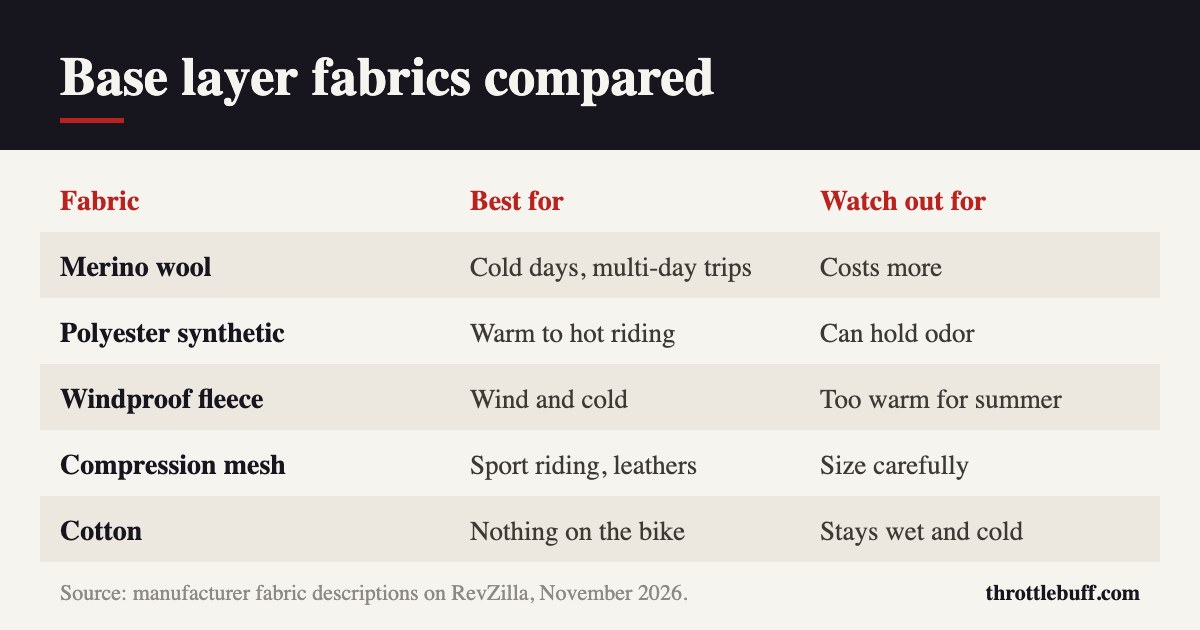
A base layer should sit close to the skin without bunching at the elbows or knees, where your armor goes. Avoid cotton: it holds sweat and gets cold. Base layer pants matter too if your riding pants have no thermal liner.

FAQ
What should I wear under my motorcycle jacket?
A wicking base layer, then a mid layer or heated liner in the cold. In summer, a thin compression or mesh top is enough.
Is merino or synthetic better for motorcycle riding?
Merino resists odor and stays warm when damp, which suits cold and multi-day trips. Synthetics dry faster and cost less, which suits hot days.
Do I need an armored base layer?
Only if your jacket or pants lack armor. See our motorcycle armor guide for options.
Verdict
The Alpinestars AT 8 Merino Base Layer Top is the best motorcycle base layer for most riders who face the cold. Pick the Ride Tech V2 Summer for heat, the AXIAL Block for wind on a budget and the Oxford pants for your legs. Check current sizing at Alpinestars and Oxford, and add a balaclava and winter jacket for full cold-weather cover.
Browse all our riding gear guides.


