Throttle Buff is reader-supported: we may earn a commission when you buy through links on this page. Read our affiliate disclosure.
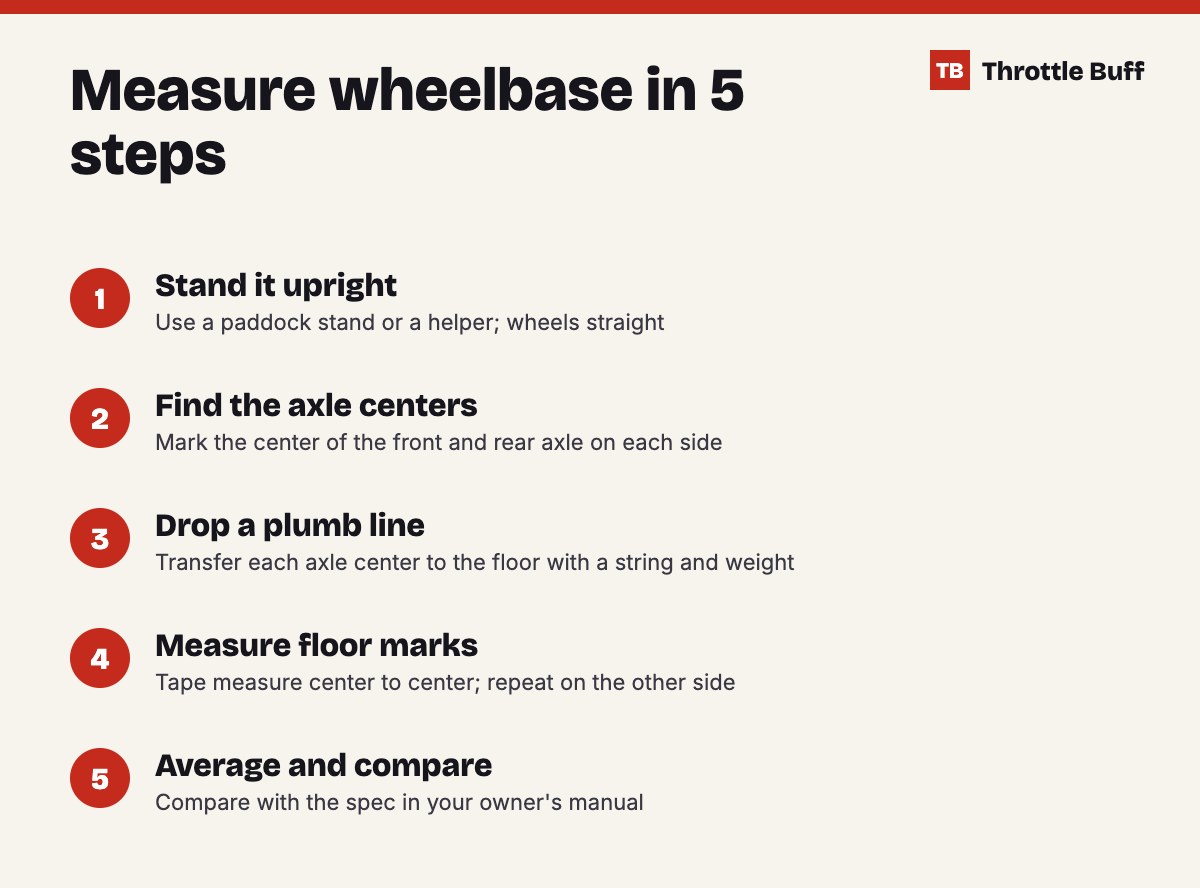
A motorcycle’s wheelbase is the distance between the center of the front axle and the center of the rear axle. To measure it, stand the bike upright with the front wheel pointing straight ahead, transfer the center of each axle to the floor with a plumb line, and measure between the two marks. Measure both sides and average them. It takes about 15 minutes with a tape measure, some string and a helper.
The same axle-center-to-axle-center method works for cars, trucks and bicycles too (see below). Below you’ll find the step-by-step method, why your number might not match the spec sheet, typical wheelbases for different kinds of motorcycle, and how wheelbase affects handling.
What is wheelbase on a motorcycle?
Wheelbase is the horizontal distance between the centers of the front and rear wheels. Manufacturers quote it axle center to axle center, usually in millimeters or inches, with the bike upright, unladen and the steering straight. It depends on three things: the length of the frame and swingarm, the steering-head (rake) angle, and the fork offset. Most modern street motorcycles have a wheelbase between about 48 and 65 inches (roughly 1,200 to 1,650 mm), with the majority in the mid-50s.
You may also see wheelbase measured between the tire contact patches. Because the front axle sits ahead of the steering axis, this gives a slightly different figure, so always compare like with like.
What you’ll need
- A tape measure (a 25 ft / 7.5 m steel tape is ideal)
- A plumb bob, or a length of string with a small weight
- Masking tape and a marker
- A paddock stand, or a helper to hold the bike upright
- Level, flat ground such as a garage floor
Tape measures on Amazon · Plumb bobs on Amazon
How to measure motorcycle wheelbase, step by step
1. Park on level ground and stand the bike upright
The bike must be vertical, not leaning on its side stand, or the measurement will be off. Use a rear paddock stand, or have a helper hold the bike straight. Point the front wheel straight ahead, because any steering angle shortens the reading.
2. Find the center of each axle
The center of the axle nut or axle bolt head marks the axle center on most bikes. On single-sided swingarms, use the center of the rear hub.
3. Drop a plumb line from each axle
Hold the plumb line against the center of the front axle and let the weight settle just above the floor. Mark the spot with masking tape. Repeat at the rear axle. A weighted thread is surprisingly accurate: it’s the method chassis specialists use for alignment checks.
4. Measure between the marks
Run the tape between the two floor marks in a straight line parallel to the bike. Note the figure.
5. Repeat on the other side and average
Measure the other side the same way. The two numbers should be within a few millimeters. A bigger difference suggests the rear wheel isn’t aligned, which is worth fixing (see below). Average the two for your wheelbase.
Quick method: if you just need a rough figure, run a tape measure directly from the center of the front axle to the center of the rear axle along the side of the bike. It’s slightly less precise because the tape has to clear the bodywork, but fine for most purposes.
How accurate do you need to be? Within about half a millimeter is the limit of what’s meaningful, because wheels and tires are often out of round by about that much.

How to measure wheelbase on other vehicles
The method is the same for almost anything with two axles: measure from the center of the front wheel hub to the center of the rear wheel hub, with the vehicle on level ground and the front wheels pointing straight.
- Cars: measure hub center to hub center on one side, then the other. Turned front wheels or a car parked on a slope will throw the number off.
- Trucks with tandem rear axles: wheelbase is usually measured from the front axle to the midpoint between the two rear axles.
- Bicycles: measure between the front and rear axle centers (the quick-release or thru-axle centers), with the bike upright and the bars straight.
- Trailers: spec sheets vary, so check whether the quoted figure runs axle to axle or from the hitch to the axle before you compare.
Doing other jobs at the back wheel? If you also need to measure chain slack or chain wear, see how to measure a motorcycle chain.
Why your number doesn’t match the spec sheet
- Chain adjustment. On a chain-drive bike, the rear axle slides in the swingarm to set chain tension. Moving it can change the wheelbase by up to about an inch (25 mm). A bike with a stretched chain adjusted to the end of its slots will measure longer than the factory figure. See how to adjust a motorcycle chain.
- Suspension position. When the fork compresses, under braking or with a rider on board, the wheelbase gets shorter. Rear sag changes the swingarm angle, which also shifts the figure slightly. Measure unladen for comparison with the spec.
- Modifications. Extended swingarms, raked triple clamps, lowering links and different tire sizes all change wheelbase.
- Steering not straight. Even a few degrees of steering angle reduces the measurement.
Typical motorcycle wheelbases by type
| Motorcycle | Type | Wheelbase | Rake / trail |
|---|---|---|---|
| Honda Grom (2025) | Mini bike | 47.2 in (~1,200 mm) | 25° / 84 mm |
| Kawasaki Ninja 500 (2025) | Entry sportbike | 1,375 mm (54.1 in) | 24.5° / 92 mm |
| Yamaha YZF-R1 (2025) | Superbike | 55.3 in (~1,405 mm) | 24° / 102 mm |
| BMW R 1300 GS | Adventure | 1,518 mm (59.8 in) | Trail 112 mm |
| Harley-Davidson Street Glide (2025) | Bagger | 1,625 mm (64 in) | n/a |
| Honda Gold Wing (2020) | Touring | 66.7 in (~1,694 mm) | 30.5° / 109 mm |
Figures are from the manufacturers’ published specifications, such as Honda Powersports and BMW Motorrad. The pattern is clear: small and sporty bikes have short wheelbases, while touring bikes and cruisers have long ones.
Hauling the bike? Wheelbase tells you whether it fits a truck bed or trailer, and our guide to picking the right size motorcycle ramp covers the loading side.
How wheelbase affects handling
Longer wheelbase: more straight-line stability, a smoother ride over bumps, less tendency to wheelie under hard acceleration, and more room for a passenger and luggage. The trade-off is slower steering: the bike needs more effort and lean to change direction. That’s why tourers, cruisers and drag bikes have long wheelbases.
Shorter wheelbase: quicker, lighter steering and easier U-turns, which suits sportbikes, supermotos and city bikes. The trade-off is less stability at high speed, and with a high center of mass, a greater tendency to lift the front under acceleration or the rear under hard braking.
History shows how much it matters. In the early 1970s, lengthening the wheelbase was the standard fix for high-speed weave on racing bikes, and Yamaha’s TZ750 famously had its swingarm extended by about 3 inches to calm it down.
Wheelbase, rake and trail
Wheelbase works together with rake (the angle of the steering head from vertical) and trail (the distance the front tire’s contact patch sits behind the steering axis’s line to the ground). More rake and trail generally add stability and lengthen the wheelbase; less of each sharpens steering. Modern sportbikes typically run about 23.5 to 25 degrees of rake, while cruisers often run 30 degrees or more. Changing one affects the others, which is why fork and swingarm changes need care.
Can you change your motorcycle’s wheelbase?
- Chain adjusters give small changes. Racers sometimes run the axle further forward or back to fine-tune handling.
- Different sprockets or chain length let you move the axle position within the adjuster range.
- Extended or shortened swingarms make bigger changes and are popular for drag racing and stunt bikes.
- Raked triple trees on cruisers lengthen the wheelbase and slow the steering.
Major changes affect braking, ground clearance and handling, so get professional advice. If you’re shopping for a bike, wheelbase is one of the specs worth comparing; see our guides to types of motorcycles, the best motorcycles for tall riders and buying a used motorcycle.
FAQ
What is the wheelbase of a motorcycle?
It’s the distance from the center of the front axle to the center of the rear axle. Most road bikes measure between about 1,200 and 1,700 mm (47 to 67 inches).
Is a longer or shorter wheelbase better?
Neither is better overall. Longer is more stable and comfortable for touring; shorter steers more quickly for sport and city riding.
Which motorcycles have the longest wheelbase?
Large touring bikes and cruisers, such as the Honda Gold Wing and Harley-Davidson baggers, which run around 64 to 67 inches.
Does adjusting the chain change the wheelbase?
Yes. Moving the rear axle to adjust chain tension can change the wheelbase by up to about an inch.
Does wheelbase matter for beginners?
Somewhat. A moderate wheelbase gives a good balance of stability and easy low-speed handling. Seat height, weight and power matter more for a first bike; see mistakes beginner riders make. For other jobs you can do at home, see our motorcycle maintenance guide.
How do you measure wheelbase without a plumb bob?
Tie a small weight, such as a nut or a key, to a length of string and use it as a plumb line. Or use the quick method: run a tape measure straight from the center of the front axle to the center of the rear axle. Either way, keep the bike upright and the steering straight.
Is wheelbase measured from the center of the wheels?
Yes. Wheelbase is measured from the center of the front axle to the center of the rear axle, not from tire edge to tire edge.
Should I measure with the rider on the bike?
For comparison with the factory spec, no. Measure unladen with the bike upright, because suspension compression shortens the wheelbase.
Summary
To measure your motorcycle’s wheelbase, stand it upright with the steering straight, drop a plumb line from each axle center, mark the floor and measure between the marks on both sides. If the figure differs from the spec, check the chain adjustment and suspension first. And when you compare bikes, remember that a longer wheelbase means stability and comfort while a shorter one means agility.
Browse all our how-to and safety guides.