Throttle Buff is reader-supported: we may earn a commission when you buy through links on this page. Read our affiliate disclosure.
To break in motorcycle boots, wear them around the house in short sessions, flex your ankles the way you do when shifting and braking, then move on to errands and short rides before any long trip. Wear the socks you’ll ride in, and give leather boots a week or two. Skip shortcuts like soaking or heating the boots, which can damage leather, glue and protective parts.
Protective boots are stiff on purpose. Boots certified to the European EN 13634 standard are tested for things like abrasion and cut resistance and how well the boot resists crushing, so they’ll never flex like sneakers. Breaking them in is about letting the liner and leather shape to your foot, not making the boot soft. If a boot still hurts after a careful break-in, it’s probably the wrong size or shape.
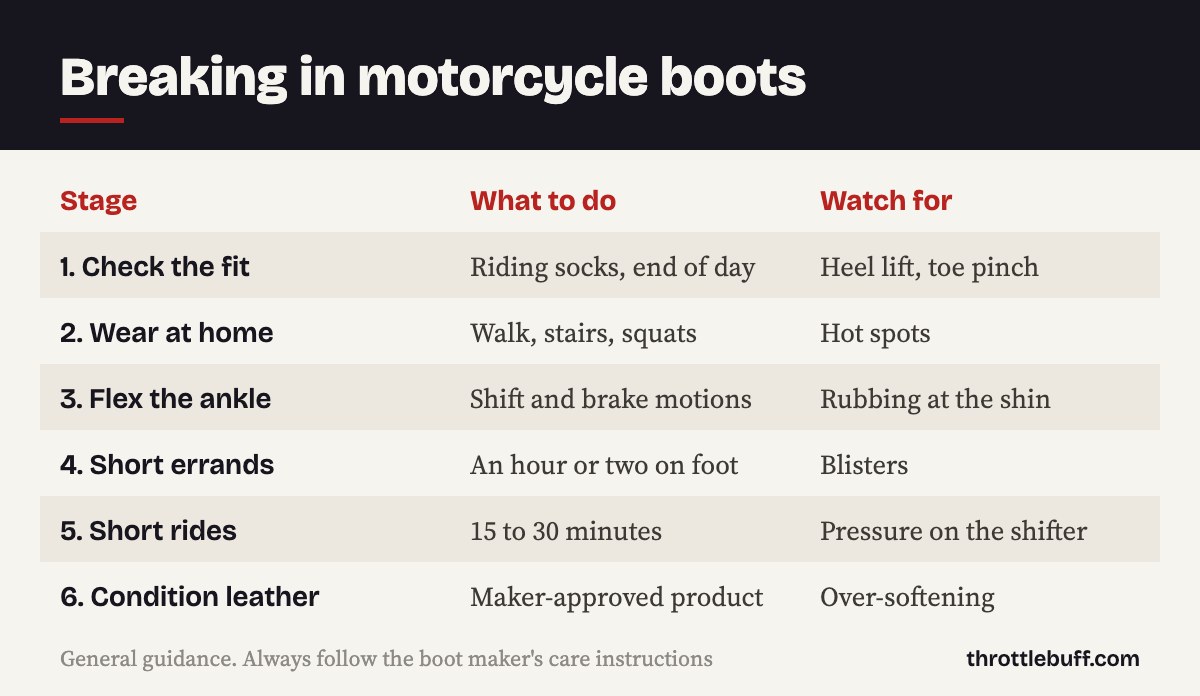
How to break in motorcycle boots at a glance
| Stage | What to do | What to watch for |
|---|---|---|
| 1. Check the fit | Try them on with your riding socks, ideally later in the day | Heel lifting more than a little, toes touching the end, numbness |
| 2. Wear them at home | Walk around, climb stairs and squat for short sessions | Hot spots at the ankle, heel and toes |
| 3. Flex the ankle | Point and lift your toes as if shifting and braking | Rubbing at the shin or ankle armor |
| 4. Run errands | Wear them for an hour or two on foot | Blisters or pressure points |
| 5. Ride short trips | Start with 15 to 30 minute rides before a long day | Feel on the shifter and rear brake |
| 6. Care for leather | Clean and condition only with products the boot maker approves | Softening that weakens support |
How to break in motorcycle boots: 6 steps
1. Check the fit before you start
Break-in can’t fix the wrong size. Try boots on later in the day, when your feet are at their largest, wearing your riding socks. Your toes shouldn’t press against the end, your heel should only lift slightly as you walk, and nothing should go numb. If you have wide or narrow feet, choose a boot built for that rather than hoping it stretches. Our motorcycle boots guide and boots for short riders cover fit by boot type.
2. Wear them around the house
Start with 30 to 60 minutes at a time indoors. Walk, take the stairs, crouch and stand up. That warms the leather and starts shaping the liner and footbed to your foot without the risk of a long ride in boots that rub. Keep the tags on until you’re sure, and check the retailer’s return rules before wearing them outside.
3. Flex the ankle like you’re riding
Sit down and work through the motions you use on the bike: lift your toes as if shifting up, press down as if braking, and roll your foot side to side. Do this in sets while watching TV. It breaks in the flex zones at the ankle and toe box, where new boots usually feel stiffest.
4. Wear them on errands
Once indoor sessions are comfortable, wear the boots for an hour or two on foot: shopping, a walk, a coffee run. Real walking finds hot spots that sitting doesn’t. If you’ll do a lot of walking at stops, see our motorcycle boots for walking.
5. Start with short rides
Ride 15 to 30 minutes at first. New boots change how the shifter and rear brake feel, so practice in a quiet area before heavy traffic. If the shift lever sits wrong with the new boot shape, a dealer or the bike’s manual can show you how to adjust its height. Build up to longer rides over a week or two.
6. Care for the leather the right way
Clean and condition leather boots with products the boot maker approves, and follow its instructions. Over-conditioning can make leather too soft and reduce support, and the wrong product can affect waterproof membranes. Textile and synthetic boots usually need no conditioning at all.
Socks and insoles matter too
Thin cotton socks bunch up and hold sweat, which makes rubbing worse. Riding socks or merino hiking socks that reach above the boot cuff help a lot, and they should be the ones you wear during break-in. If the stock insole feels flat or slips, a replacement insole can improve comfort, but check it doesn’t make the boot too tight.
What not to do
Don’t soak or heat your boots
Soaking boots in water and wearing them dry, or heating them with a hair dryer or oven, are common internet tips. Both can harm leather, dry out or crack it, weaken glued seams and soles, and damage waterproof membranes or protective parts. Ask the boot maker before trying anything like that.
Don’t take a new pair on a long trip
A full day in boots you haven’t worn yet is how blisters start. Break them in at home first, and carry your old pair on the first long ride if you can.
Don’t mistake bad fit for stiffness
Stiffness at the ankle is normal. Sharp pain, numbness or toes jammed at the front are fit problems that break-in won’t fix. Exchange them while you still can.
How long does it take to break in motorcycle boots?
It depends on the boot. Light riding shoes and textile boots often feel right after a few wears. Full leather touring boots usually need a week or two of regular use. Tall race boots and stiff off-road boots can take longer, because they’re built with more structure to protect your ankle and shin. If you’re shopping by style, compare riding shoes, cruiser boots and race boots.

FAQ
Do you have to break in motorcycle boots?
Most leather boots need some break-in before they feel comfortable on long rides. Many textile boots and riding shoes need little or none. Either way, it’s worth a few short wears before a big trip.
How do you break in motorcycle boots fast?
There’s no safe instant method. The fastest safe approach is to wear them often in short sessions, flex the ankle as you would when riding, and ride short trips. Avoid soaking or heating them.
How do you break in leather motorcycle boots?
Follow the steps above and condition the leather only with products the boot maker approves. Leather softens and shapes to your foot with wear, and the right conditioner keeps it supple without weakening it.
Should motorcycle boots be tight at first?
Snug, not tight. They should hold your heel and ankle without pinching your toes or cutting off circulation. Pain or numbness means the wrong size.
How do I stop motorcycle boots from squeaking?
Squeaks often come from new leather rubbing or from the insole. Check the boot maker’s care advice, and make sure the insole sits flat.
Verdict
How to break in motorcycle boots comes down to patience: check the fit first, wear them at home, flex them the way you ride, then build up to longer rides. Skip the soaking and heat tricks, and follow the boot maker’s care advice. For more on gear, see the MSF and NHTSA safety advice and our beginner gear guide.
Browse all our riding gear guides.