Throttle Buff is reader-supported: we may earn a commission when you buy through links on this page. Read our affiliate disclosure.
To clean motorcycle boots, brush off loose dirt, wipe the outside with a barely damp microfiber cloth, and use a cleaner made for each material only where the dirt needs it. Then let the boots air dry at room temperature, away from heaters and sun, and finish leather with a thin coat of conditioner. Skip solvents, bleach, the washing machine and any heat.
The steps below follow the care instructions boot and membrane makers publish, mainly REV’IT!’s footwear care guide and GORE-TEX’s footwear care page. Your boots’ own CE booklet comes first if it says something different, and if you are not sure what your boots are made of, our textile vs mesh vs leather guide explains the materials.
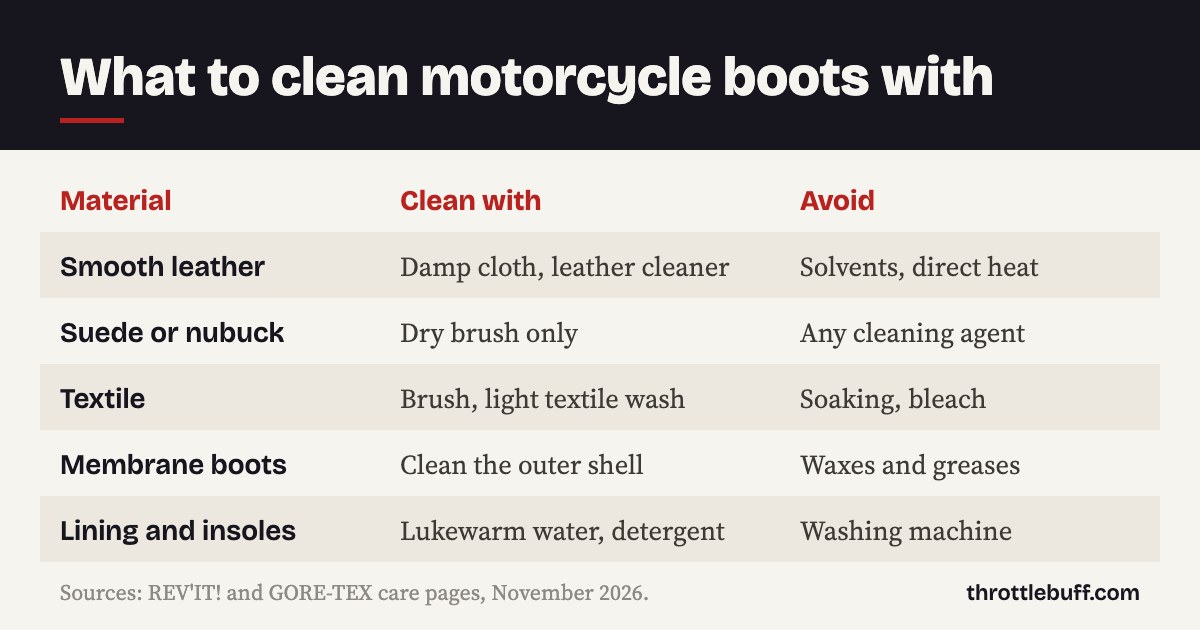
What to clean each part of a motorcycle boot with
| Material | Clean with | Avoid |
|---|---|---|
| Smooth (full grain) leather | Damp microfiber cloth; a little leather cleaner on a soft damp sponge for heavy grime | Solvents, bleach, drying near heat |
| Suede or nubuck | A nubuck brush, dry | Any cleaning agent or leather care product |
| Textile panels | Soft brush, then a very small amount of textile wash worked to a light foam | Soaking the boot, bleach, softener |
| GORE-TEX or other membrane | Nothing directly: clean and care for the outer shell | Waterproofing waxes and greases, stain removers |
| Lining and insoles | Lukewarm water with a small amount of liquid detergent | The washing machine |
How to clean motorcycle boots: step by step
- Check the CE booklet. REV’IT! puts this first: the booklet’s instructions beat any general guide, this one included.
- Close everything. Do up the buckles, zips, snaps and hook-and-loop tabs so grit does not get into them and the straps do not catch.
- Brush off loose dirt. Use a soft brush or sponge on dried mud, and a nubuck brush on any nubuck. If mud is caked on, soften it with a damp cloth first rather than scrubbing hard.
- Wipe the shell. A barely damp microfiber cloth removes most road film. For many rides this is all the cleaning a boot needs.
- Treat heavier grime by material. Leather cleaner on the smooth leather only, a tiny amount of textile wash on fabric panels, and nothing on suede or nubuck. Work up a light foam and do not saturate the boot.
- Wipe off the residue with a clean damp cloth, then pat the boot dry with a towel.
- Air dry slowly at room temperature (see drying, below).
- Condition or reproof. A very thin film of leather wax on leather parts, or a spray-on water repellent on textile parts, once the boot is dry.
That last step overlaps with waterproofing. If your boots have started letting water in, our guide on how to waterproof motorcycle boots covers what to use on each type.
How to clean the inside of motorcycle boots
Sweat does more long-term damage inside a boot than mud does outside. Take out the insoles if they are removable and wash them separately. For the lining, GORE-TEX suggests lukewarm water with a small amount of liquid detergent, and says not to use bleach or stain removers. Rinse with a damp cloth rather than flooding the boot, and never put boots in the washing machine, which GORE-TEX rules out for its footwear.
If the boots smell, the fix is mostly drying: GORE-TEX warns against letting footwear stay wet too long. Dry them fully after every wet or sweaty ride and the smell has less to feed on.
How to dry motorcycle boots
- Press the boots in a towel to take out excess water.
- Stand them upright at room temperature, out of direct sunlight and away from radiators, fires and heaters. Both REV’IT! and GORE-TEX say to avoid direct heat.
- A convection-style boot dryer is fine: GORE-TEX says these work well.
- Do not store them until they are dry inside and out.
Heat is hard on leather, which is why makers warn against it, and boots you spent weeks breaking in (see how to break in motorcycle boots) are worth drying patiently. It is the same rule we give for waterproofing a motorcycle jacket: low and slow.
Mistakes that shorten a boot’s life
- Solvents, bleach and softeners. REV’IT! says aggressive solvents can weaken the materials in a boot.
- Over-conditioning. Too much wax or oil can soften impact zones, attract dirt and reduce breathability. Use a thin film and wipe off the excess.
- Waxes and greases on membrane boots. GORE-TEX says these can affect breathability.
- Leather products on suede or nubuck. Brush these parts dry instead.
- Leaving them wet. Boots that go into a cupboard damp come out smelling, or worse.
If you ride in the wet a lot, our riding in the rain guide covers the rest of a wet weather routine. If you wear the same boots off the bike all day, our pick of motorcycle boots for walking lists pairs with grippier, softer soles.

FAQ
Can you put motorcycle boots in the washing machine?
No. GORE-TEX says not to machine wash its footwear, and REV’IT! specifies hand cleaning only. Clean by hand and dry slowly.
How often should you clean motorcycle boots?
Brush off loose dirt after each ride, as REV’IT! suggests, and do a full clean whenever mud, salt or road grime builds up. Condition leather after a full clean.
How do you clean leather motorcycle boots?
Brush, wipe with a barely damp cloth, use a little leather cleaner on a soft sponge for heavy grime, wipe off the residue, air dry, then apply a thin film of leather wax.
How do you get the smell out of motorcycle boots?
Remove and wash the insoles, clean the lining with lukewarm water and a little liquid detergent, and dry the boots fully after every ride. A convection boot dryer helps.
Can I use a hair dryer to dry my boots?
It is better not to. Boot and membrane makers say to avoid direct heat. Use room temperature air or a convection boot dryer.
Verdict
Cleaning motorcycle boots is mostly gentle and regular: brush after rides, wipe the shell, use the right cleaner for each material only when needed, and dry at room temperature. Keep heat, solvents and the washing machine away from them, condition leather lightly, and a good pair from our best motorcycle boots guide will last many seasons.
Browse all our riding gear guides.