Throttle Buff is reader-supported: we may earn a commission when you buy through links on this page. Read our affiliate disclosure.
A Pinlock visor is a helmet visor with two small pins on the inside that hold a separate anti-fog lens, called a Pinlock insert. The insert’s silicone edge seals against the visor and traps a thin layer of air, which works like double glazing, so the visor stays clear when the air outside is cold or wet. The visor alone does nothing special: the insert is what stops the fog.
This guide explains how the system works, what the 30, 70, 120 and 200 numbers mean, how to fit and adjust an insert, and how to clean it without wrecking the anti-fog surface. Everything here comes from Pinlock’s own pages and helmet makers’ care instructions.
Pinlock visor key facts
| Part | What it is | Why it matters |
|---|---|---|
| Pinlock-ready visor | A visor with two pins molded or fitted on the inside | Without the pins, an insert cannot be fitted |
| Pinlock insert (lens) | A thin, flexible lens with a moisture absorbing surface | Stores moisture in humid air and releases it when the air is drier |
| Silicone seal | A bead around the edge of the insert | Creates the airtight air pocket that stops condensation |
| Eccentric pins | Off-center pins you turn to add tension | Pull the lens tight so the seal touches the visor all the way round |
| DKS code | Pinlock’s product code for each lens shape | Lenses are cut to fit one visor shape, so the code must match |
| Anti-fog level | 30, 70, 120 or 200 | The number is the lens’s fog resistance level: higher resists more |
How a Pinlock visor works
Fog forms when warm, damp breath meets a visor that has been cooled by the air outside. Pinlock attacks that in two ways, as Pinlock explains on its technology page:
- A moisture absorbing lens. The insert’s surface attracts and stores water molecules when the air in the helmet is humid, then lets that water evaporate again when the humidity drops.
- An airtight seal. The silicone bead closes off a pocket of air between the visor and the insert. That pocket acts as a thermal barrier, so the inner lens stays closer to the temperature of your breath and condensation has nowhere to form.
It is also why a poor seal ruins it: if the bead does not touch the visor all the way round, damp air gets into the pocket and fogs it from the inside.
Pinlock-ready visor vs Pinlock insert
The two get mixed up because people say “Pinlock visor” for both. The visor is your helmet’s normal clear shield. If it is Pinlock-ready, it has the two pins on the inside, one near each pivot. The insert is the separate lens that clips between those pins. Some helmets ship with the insert in the box; others only have the pins and you add the insert yourself.
Inserts are not universal. Pinlock says its lenses are customized to the shape of each helmet visor and identified by a DKS number, which you can find on the helmet’s product page. Pinlock does not sell lenses directly, so you buy them from the helmet brand or a dealer. Several brands, including Shoei, Arai, HJC, LS2, Schuberth and Nolan, use their own pins, which is another reason to buy the insert made for your exact visor.
Pinlock 30, 70, 120 and 200: what the numbers mean
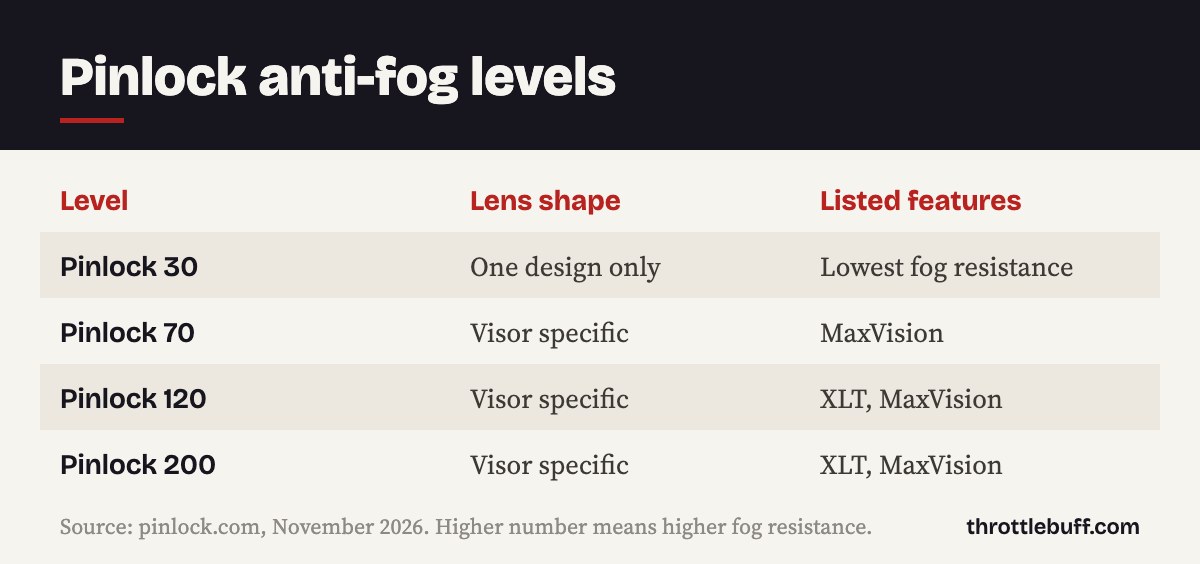
Pinlock sells its lenses in four anti-fog levels, and the number is simply the fog resistance level of the lens. A higher number resists fog in harder conditions. On Pinlock’s product page, the 30 is listed as one design only, while the 70, 120 and 200 are visor specific and listed with MaxVision, Pinlock’s larger lens cut that covers more of the visor. The 120 and 200 also carry Pinlock’s XLT label, and Pinlock says the 200 was tested in MotoGP.
In practice, you rarely choose the number: it is whatever insert your helmet maker supplies for that visor. If you ride through winter, check which level a helmet’s insert is before you buy, alongside the other points in our best motorcycle helmets guide.
Tinted and colored inserts
Pinlock also lists tinted lenses: a yellow lens for better depth perception in overcast conditions, a dark smoke lens that cuts glare much like a dark tinted visor, and PrecisionTone lenses that change color with the conditions. A tinted insert turns a clear visor into a tinted one, so treat it like a tinted visor and swap it out before riding at night. Our photochromic visor guide covers when tinted shields make sense.
How to fit a Pinlock insert
These are the steps from Pinlock’s FAQ.
- Remove the visor from the helmet.
- Check the pins. The arrows on the Pinlock pins should point outwards.
- Flex the visor gently so it bows, and place the insert between the two pins. Let the visor relax so the pins hold the lens.
- Check the seal against natural light. The silicone bead should touch the visor all the way round with no gaps.
- Peel off the protective film from the insert.
- Refit the visor to the helmet.
How to adjust the pins
If the seal shows a gap, add tension with the pins. Pinlock says to take the lens out before adjusting, then:
- One component pins: push the pin outwards, turn it with your fingers and push it back in, in steps of no more than 45 degrees.
- Two component pins: turn them with a flathead screwdriver or a bank card.
- Three component and tear-off pins: turn the hexagon on the inside of the visor with a 5 mm hex tool.
Refit the lens after each small adjustment and stop as soon as the seal is complete all the way round. Pinlock also notes that lenses can shrink over time; if an older insert starts fogging at the edges, turning the pin indicator 45 degrees towards the helmet adds the tension it needs.
How to clean and store a Pinlock insert
The anti-fog surface is soft, and the wrong cleaner removes it. Pinlock’s advice is to rinse the lens and visor with mineral water only, then use a clean, wet microfiber cloth for any remaining marks, and let both dry naturally upright before you put them back together. Shoei’s helmet care page allows neutral soapy water for the visor and Pinlock, and stresses that both must be completely dry before you reassemble them. Shoei also warns against solvents, petrochemicals and window cleaner on any plastic part.
To store a spare insert, Pinlock suggests a dark place free of moisture and dust, wrapped in a soft cloth or a plastic bag, because the lens scratches easily. For the rest of the helmet, our helmet cleaning tips and our guide on how to store a motorcycle helmet cover liners, shells and where the helmet should live between rides.
When a Pinlock still fogs
- Fog between the visor and the insert: the seal is not complete. Take the lens out, dry both parts fully, refit and add pin tension.
- Fog on the visor around the insert: the insert only covers part of the visor. A MaxVision lens covers more, and cracking the visor or opening the chin vent clears the edges.
- Fog inside the insert’s surface after a long wet day: the lens has absorbed all the moisture it can hold. Let it dry out and it recovers.
- Glasses fogging: a Pinlock cannot help your glasses. Our guide to helmets for glasses covers that problem.

FAQ
Do Pinlock inserts really work?
Yes, when the seal is complete, because the sealed air pocket keeps the inner lens from fogging even with the visor shut. Our guide on how to stop helmet visor fogging compares it with the other fixes.
Can you put a Pinlock on any visor?
No. The visor must have Pinlock pins, and the insert must be the one made for that visor shape (its DKS code). A visor without pins cannot take an insert.
Is a Pinlock visor the same as an anti-fog visor?
Not quite. An anti-fog visor usually has a coating on the visor itself. A Pinlock system adds a second, sealed lens behind the visor, which keeps working when the coating alone would fog.
How long does a Pinlock insert last?
Pinlock does not give a fixed life. Lenses can shrink over time, which you can often correct with pin tension. Replace the insert when it is scratched in your line of sight or will not seal even with the pins adjusted.
Do I need a Pinlock for summer riding?
Fog is mostly a cold and wet weather problem, so many riders only notice the benefit in winter and rain. Our guides on riding in the rain and staying warm on a motorcycle cover the rest of a cold weather setup.
Verdict
A Pinlock visor is a Pinlock-ready visor plus a sealed anti-fog insert, and the seal is the whole trick. Buy the insert made for your visor’s DKS code, fit it with the visor off the helmet, tension the pins until the bead touches all the way round, and clean it with water only. Do that and fog stops being a reason to ride with your visor cracked open.
Browse all our helmet guides.