
Throttle Buff is reader-supported: we may earn a commission when you buy through links on this page. Learn more.
In the HJC i10 vs Bell Qualifier DLX debate, the short answer is simple. Buy the HJC i10 if you want the cheapest Snell-certified full face you can find. Buy the Bell Qualifier DLX MIPS if you’d rather have a MIPS rotational layer and a photochromic shield in the box. They weigh almost the same, cost within about $100 of each other, and both fit intermediate oval heads.
One thing matters more than any spec in November 2026: both helmets are near the end of their run. RevZilla lists the i10 as closeout now that the HJC i11 is out, and Bell’s own store shows the Qualifier DLX MIPS sold out in several colors and sizes. If your size is still in stock, this comparison will help you choose. If it isn’t, we cover the direct replacements at the end.
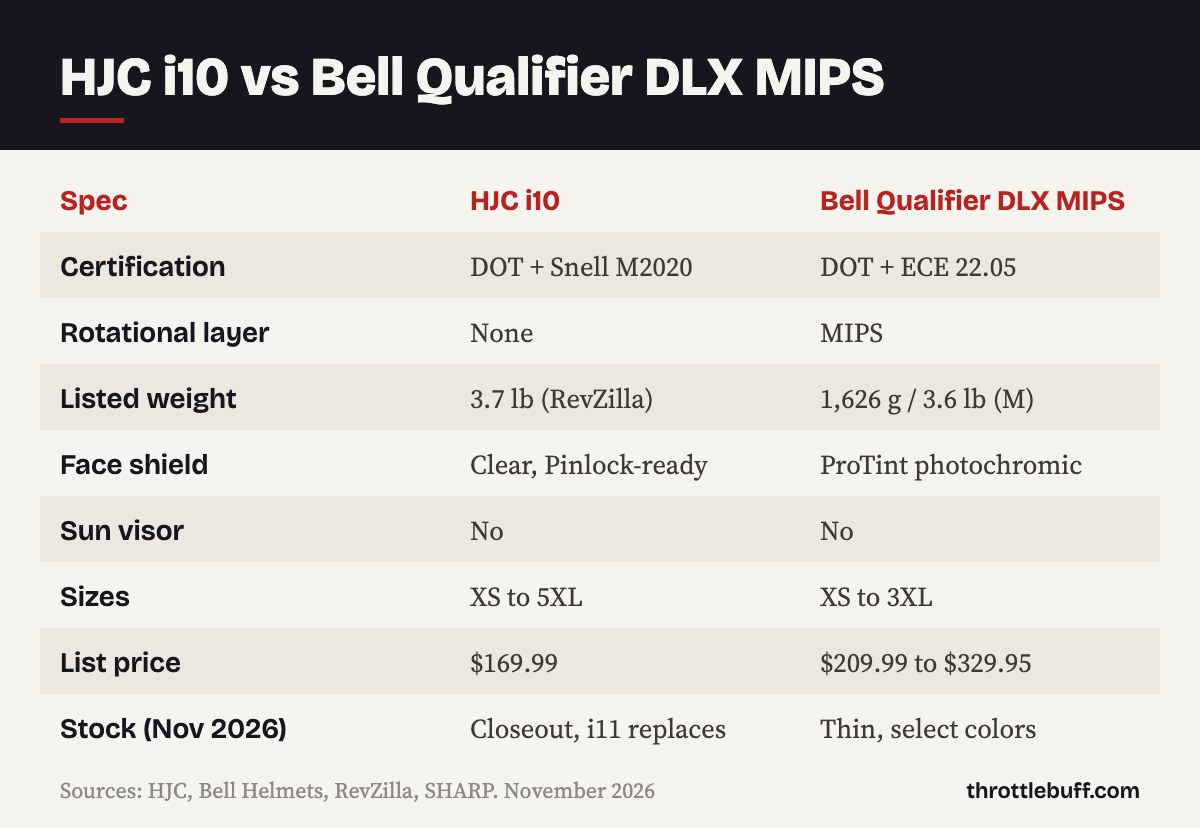
HJC i10 vs Bell Qualifier DLX MIPS: specs side by side
These figures come from HJC, Bell, RevZilla’s spec listings and the UK government’s SHARP crash-test program. We haven’t weighed or crash-tested either helmet ourselves.
| Spec | HJC i10 | Bell Qualifier DLX MIPS |
|---|---|---|
| Certification | DOT + Snell M2020 (3XL and up DOT only) | DOT + ECE 22.05 |
| Rotational protection | None | MIPS liner |
| Independent crash rating | None published | SHARP 3 stars |
| Shell | Polycarbonate composite | Polycarbonate, 3 shell sizes |
| Listed weight | 3.7 lb (RevZilla) | 1,626 g ±50 g, size M (Bell) |
| Face shield | Clear HJ-31, Pinlock-ready | ProTint photochromic, NutraFog II |
| Internal sun visor | No | No |
| Head shape | Intermediate oval | Intermediate oval |
| Comms | Built for SMART HJC 10B/20B | Integrated speaker pockets |
| List price | $169.99 | $209.99 to $329.95 |


Safety: Snell vs MIPS
This is where the two helmets split. The i10 is DOT approved and passes Snell M2020, a voluntary standard with tougher impact tests than DOT alone. The exception is the largest sizes, which are DOT only.
The Qualifier DLX MIPS is DOT and ECE 22.05 certified, and it adds a MIPS slip-plane liner meant to reduce rotational forces in angled impacts. It’s also one of the few budget helmets with an independent crash score: SHARP rated it 3 out of 5 stars in its 2019 test. Nobody has published an equivalent independent test for the i10, so you can’t compare the two directly on impact numbers.
Neither result makes one helmet unsafe. If you trust Snell testing, pick the HJC. If you care more about rotational protection, pick the Bell. Our guides to MIPS motorcycle helmets and ECE 22.06 vs DOT explain what each label covers.
Weight, fit and comfort
On weight it’s close to a tie. RevZilla lists the i10 at 3.7 lb and the Qualifier DLX MIPS at 3.57 lb. Bell quotes 1,626 g (about 3.6 lb) for a medium. When Rider Magazine and Ultimate Motorcycling reviewed the i10, a small came in at 3 lb 9 oz and a medium at 3 lb 10.1 oz.
Both are intermediate oval. Rider Magazine said the i10 leans “just a hair toward round oval,” and Ultimate Motorcycling found it slightly tighter than other HJCs of the same size, so measure carefully if you’re between sizes. Use our helmet sizing guide before ordering either one. If you need a size past 2XL, our guide to helmets for big heads lists helmets up to 5XL.
Both helmets have removable, washable liners. The i10 has glasses grooves at the temples, which makes it the easier pick if you wear glasses (see our helmets for glasses wearers roundup). The Bell has a padded wind collar that Bell says cuts wind and road noise, and Ultimate Motorcycling called the i10 quiet, with no buffeting.
Face shield and vision
The Bell has the better shield. Its ProTint photochromic shield goes from clear to smoke in bright sun, so you don’t need to carry a second shield or put up with glare at dusk. It also has NutraFog II anti-fog coating and Bell’s ClickRelease system for tool-free shield changes.
The i10 comes with a clear HJ-31 shield, Pinlock-ready, and HJC’s RapidFire tool-free swap. Add the Pinlock insert (sold separately) and you have one of the best fog fixes available. Rider Magazine’s complaints were that the first de-fog detent opens too wide and that there’s no drop-down sun visor. The Bell has no internal sun visor either. Our visor fogging guide covers both setups.
Ventilation and intercom readiness
The i10 uses HJC’s Advanced Channeling Ventilation, with crown and forehead intakes, a chin vent that blows across the shield, and an always-open rear exhaust. Ultimate Motorcycling found the top intakes effective and the center forehead vent weaker, and Rider Magazine said the top sliders are hard to find with thick gloves. The Bell uses its Velocity Flow vents, and Bell doesn’t publish airflow figures for them.
For comms, the i10 is built to take the SMART HJC 10B or 20B, which HJC co-developed with Sena, and it has room for other clamp-on headsets. The Bell has integrated speaker pockets. RevZilla notes that newer Qualifier DLX MIPS stock no longer includes the communicator compartment shown in older photos. If you’re shopping on a budget, see our list of budget Bluetooth headsets.
Price and value
RevZilla lists the i10 at $169.99, and its closeout stock has been selling for less. Bell’s own store prices the Qualifier DLX MIPS from $209.99 to $300 depending on the color, and RevZilla’s list price is $329.95. The Bell includes MIPS and a photochromic shield, which the i10 doesn’t offer at any price. The i10 is still the cheaper helmet to buy. For more options, see our helmets under $200 and helmets under $300 roundups.
1. HJC i10: best for Snell certification on a budget
Pros: Snell M2020 plus DOT; lowest price; glasses grooves; Pinlock-ready shield; SMART HJC ready; wide size range.
Cons: No MIPS; clear shield only; no sun visor; runs slightly snug; now in closeout.
2. Bell Qualifier DLX MIPS: best for features and rotational protection
Pros: MIPS liner; photochromic shield included; independent SHARP rating; speaker pockets; padded wind collar.
Cons: Costs more; no Snell rating; ECE 22.05 rather than the newer 22.06; stock is thinning.
If your size is sold out: the replacements
HJC i11: This is the i10’s successor at the same $169.99. RevZilla lists it as DOT plus Snell M2025 (XS to 2XL), with three shell sizes, 50 mm speaker pockets, emergency quick-release cheek pads, a Pinlock-ready HJ-38 shield that also takes HJC’s ShadeX photochromic shield, and a listed weight of 3.69 lb.

Bell Lithium MIPS: This is the closest current Bell to the Qualifier DLX MIPS. It’s DOT and ECE 22.06 approved, keeps MIPS, comes with a Pinlock 70 insert, has three shell sizes and an anti-microbial liner, and RevZilla lists it at 3.81 lb. Its list price is $239.95.

FAQ
Is the HJC i10 discontinued?
It’s being phased out. RevZilla lists the i10 colorways as closeout, and the HJC i11 replaces it at the same price with Snell M2025 certification.
Does the Bell Qualifier DLX MIPS come with a photochromic shield?
Yes. Bell ships it with a ProTint photochromic shield that darkens in sunlight and clears in low light.
Which is lighter, the HJC i10 or the Bell Qualifier DLX?
They’re within a few ounces of each other. RevZilla lists 3.7 lb for the i10 and 3.57 lb for the Bell, which is less difference than you’ll see between two sizes of the same helmet.
Is the regular Bell Qualifier the same as the DLX MIPS?
No. The base Qualifier doesn’t have MIPS or the photochromic shield. Our Bell Qualifier review covers the base model, and best Bell helmets compares the rest of the range.
Can I fit an intercom in either helmet?
Yes. The i10 is designed around the SMART HJC 10B/20B, and the Bell has integrated speaker pockets for most clamp-on systems.
Verdict
Pick the HJC i10 if price and Snell certification matter most, or if you wear glasses. Pick the Bell Qualifier DLX MIPS if you want MIPS, a published SHARP score and a photochromic shield without paying extra. Either way, buy soon or move to the HJC i11 or Bell Lithium MIPS, which carry the same ideas forward with newer certifications. Not sure which ratings matter? Our helmet safety ratings explainer lays them out.


