Throttle Buff is reader-supported: we may earn a commission when you buy through links on this page. Read our affiliate disclosure.
A motorcycle intercom works by putting a small radio, speakers and a microphone inside your helmet. The control unit links over Bluetooth to your phone, your GPS and other riders, or over a mesh network for larger groups, so you hear calls, music, directions and voices in your ears and talk back hands-free.
Every brand uses the same basic parts, so once you know what each one does you can read any spec sheet and spot what matters for the way you ride. Below is how the pieces fit together, how the sound travels, and what the numbers on the box mean. If you are choosing a unit, our best motorcycle intercom guide compares the current models.
The parts of a motorcycle intercom
| Part | What it does | Where it sits |
|---|---|---|
| Control unit | Radio, battery and buttons | Side of the helmet shell |
| Speakers | Play voices, music and GPS prompts | Ear pockets in the liner |
| Microphone | Picks up your voice | Boom arm, or wired mic in a full-face chin bar |
| Bluetooth link | Connects your phone, GPS and 2 to 4 riders | One unit to the next |
| Mesh link | Connects larger groups that spread out and regroup | A network of same-brand units |
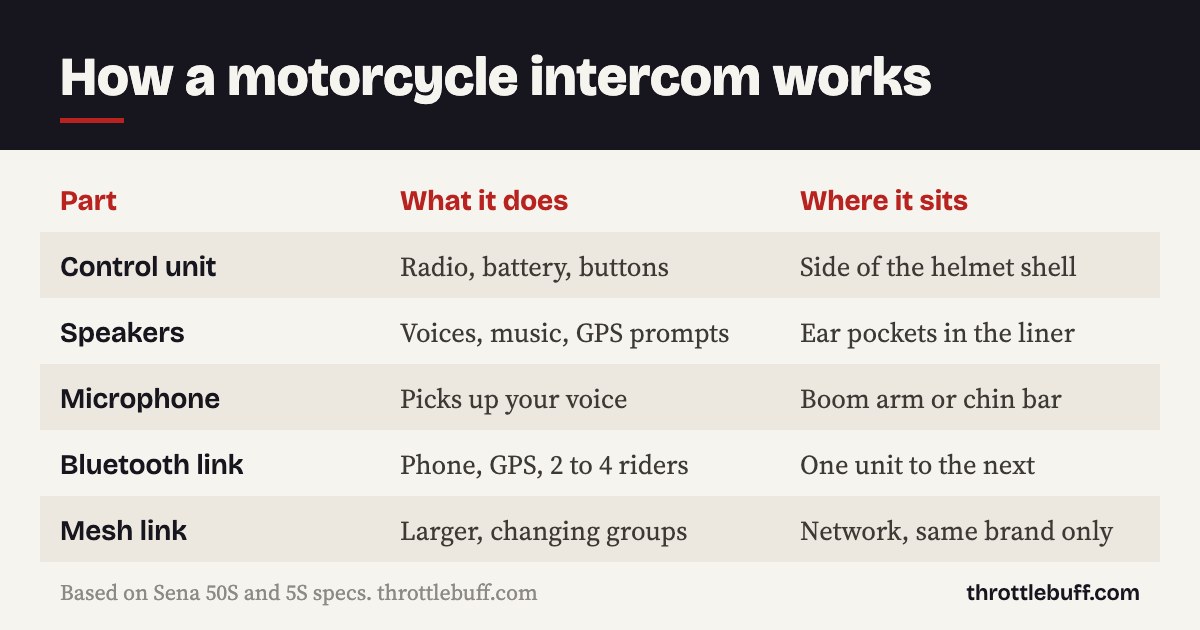
The control unit clips to a mount on the left side of the shell on most kits, or sits in a built-in bay on comm-ready helmets. Thin cables run under the liner to the speakers and the microphone. Our step-by-step guide to installing an intercom in your helmet shows where each part goes.
How the sound gets to your ears
Your phone and GPS talk to the intercom over Bluetooth using standard profiles. Sena lists four on both the 50S and the 5S: HSP and HFP carry phone calls, A2DP carries stereo music, and AVRCP lets the buttons on the unit play, pause and skip tracks on the phone. That is why almost any phone pairs with almost any intercom.
- Calls. The phone sends the call to the unit, and the microphone sends your voice back. Our guide to taking calls while riding covers answering and voice dialling.
- Music. A2DP streams from your phone or music app. See how to listen to music on a motorcycle for the options.
- Navigation. A GPS or a phone map app reads turn prompts through the same link.
Speakers decide how clear all of this sounds. The 50S and 5S both use 40 mm drivers, and fit matters as much as size: speakers that sit right over your ears are much easier to hear at speed. Our tips on making helmet speakers louder start with speaker position.
How rider-to-rider intercom works
Bluetooth intercom
Bluetooth intercom pairs units directly, one to the next. It suits a rider and passenger or a small fixed group. The 50S links up to 4 riders this way, and the 5S links 2. Bluetooth intercom between different brands usually works for basic talk, as our Cardo vs Sena comparison explains.
Mesh intercom
Mesh units connect as a network: every unit passes the signal along, so the group stays linked when riders change places or drop back. Mesh only works between units of the same brand. Our mesh vs Bluetooth intercom explainer goes through the differences in detail, and our guide to motorcycle intercom range explains why real-world range is shorter than the box says.
- Voice activation. Most units open the microphone when they hear you speak, so you do not have to press a button to talk.
- Voice commands. The 50S takes spoken commands in several languages and works with Siri and Google Assistant.
- Noise control. Sena’s Advanced Noise Control, listed on both units, reduces background noise picked up by the microphone, so the people you talk to hear your voice rather than the wind.
- Audio Multitasking. Sena lists this on the 5S: its name for hearing more than one audio source at a time, such as music under an intercom conversation.
What the specs mean: two Sena examples
| Spec | Sena 50S | Sena 5S |
|---|---|---|
| Rider-to-rider link | Mesh and Bluetooth | Bluetooth only |
| Bluetooth riders | Up to 4 | Up to 2 |
| Intercom range (open terrain) | Up to 2 km (1.2 miles) | Up to 700 m (0.4 miles) |
| Talk time | 16 h Bluetooth, 13 h mesh | 18 h |
| Charging time | 2.5 h | 1.5 h |
| Bluetooth version | 5.0 | 5.1 |
| Price tier | $$$ | $ |
Price tiers from RevZilla listings: $ means under $150, $$ means $150 to $250, $$$ means over $250.
Specs are from Sena’s own 50S and 5S pages. Talk time shrinks with volume and cold weather; our guide to intercom battery life explains what to expect.

The 50S shows the full picture: mesh for groups, Bluetooth for other brands, voice commands and Harman Kardon speakers.

The 5S shows the basics: one Bluetooth link to a passenger or riding buddy, plus phone, music and GPS.

FAQ
How do motorcycle helmet intercoms work?
A unit on the helmet holds a radio and battery, with speakers in the ear pockets and a microphone at your mouth. It links to your phone, GPS and other riders over Bluetooth or mesh.
Do motorcycle intercoms work with other brands?
For basic Bluetooth intercom, usually yes. Mesh groups and brand-only features need units from the same brand.
Do you need a phone to use a motorcycle intercom?
No. Rider-to-rider intercom works unit to unit with no phone. You only need a phone for calls, music and phone navigation.
Can you use a motorcycle intercom with a passenger?
Yes. Pair the two units over Bluetooth intercom. A two-rider unit such as the 5S covers this.
Are motorcycle intercoms waterproof?
Most are built to handle rain, but ratings differ by model. Our guide to whether motorcycle intercoms are waterproof lists them.
Verdict
A motorcycle intercom is a radio, speakers and a microphone in your helmet, linked by Bluetooth to your phone and nearby riders, and by mesh to bigger groups. Ride solo or two-up and a basic Bluetooth unit covers you. Ride in groups and mesh is the part worth paying for. Either way, good speaker placement makes more difference than any number on the box.
Browse all our intercom guides.