Throttle Buff is reader-supported: we may earn a commission when you buy through links on this page. Read our affiliate disclosure.
Motorcycle ABS (anti-lock braking system) stops your wheels from locking when you brake hard, so the tires keep gripping and you can keep the bike upright and steerable. It works by monitoring wheel speed and briefly easing brake pressure when a wheel is about to lock. The safety case is strong: the largest US study, published by the Insurance Institute for Highway Safety in 2021, found motorcycles with ABS had 22% fewer fatal crashes than the same models without it. If you’re buying a bike, choose ABS.
How motorcycle ABS works
An ABS system has three main parts:
- Wheel speed sensors on each wheel, usually reading a toothed ring (tone ring) next to the brake disc.
- An ABS control unit that compares wheel speeds and detects when a wheel is slowing too fast, which means it’s about to lock.
- A hydraulic modulator that rapidly reduces and reapplies brake pressure to that wheel, many times per second, keeping it at the edge of grip.
When ABS works, you may feel a pulsing at the lever or pedal. That’s normal. Keep squeezing firmly and let the system do its job.
Is motorcycle ABS worth it? What the research says
The IIHS study published in August 2021 looked at 65 motorcycle models that offered ABS as an option and compared the same make, model and year with and without it. Bikes with ABS had 22% fewer fatal crashes per 10,000 registered vehicle years, a statistically significant result. The reduction varied by type of bike:
| Motorcycle type | Reduction in fatal crash rate with ABS |
|---|---|
| Standard and cruiser | About 32% |
| Touring and sport touring | About 25% |
| Sport | 19% |
| Supersport | 12% |
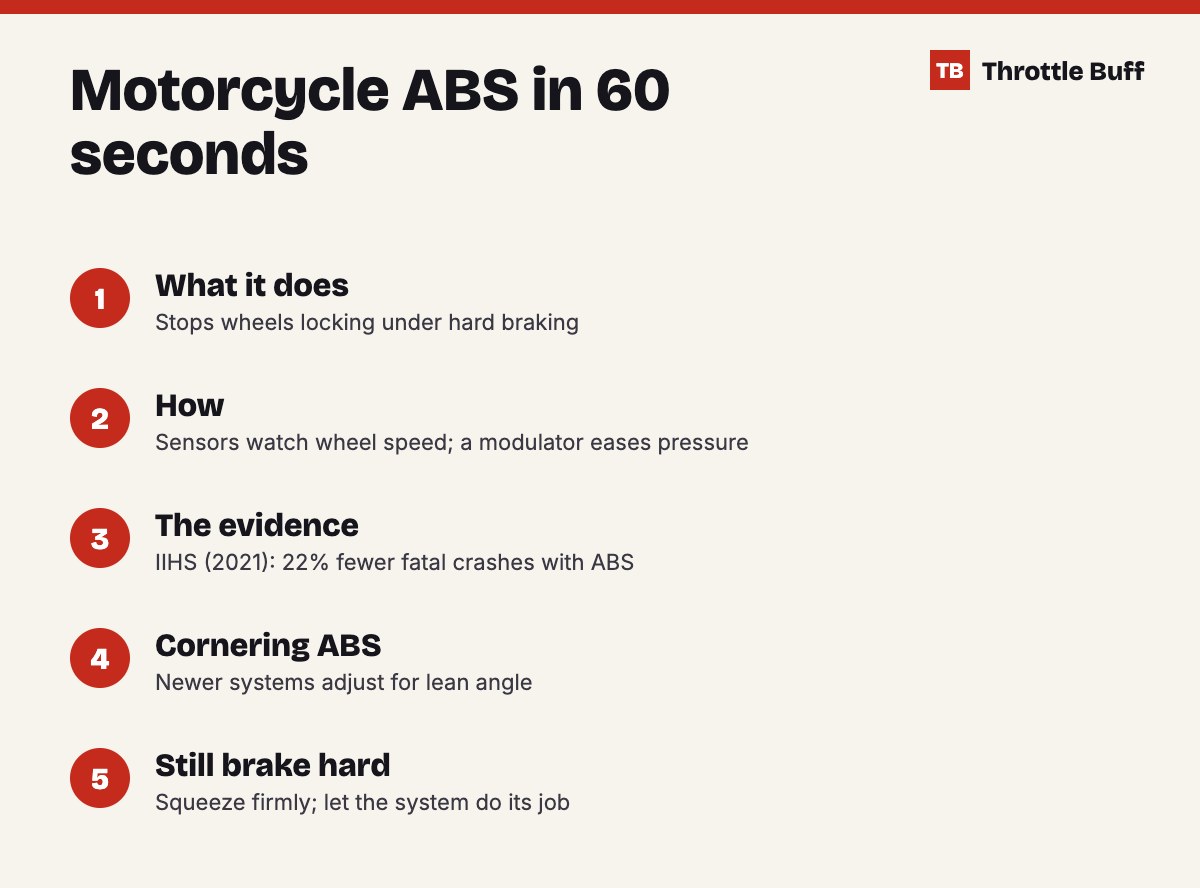
Source: IIHS, 2021. The study’s author called 22% “a very big effect,” and IIHS says the results make a strong case for requiring ABS. IIHS also noted that ABS was standard on more than half of 2020-model motorcycles in the US and optional on about another quarter.
Types of motorcycle ABS
Standard ABS
Prevents wheel lock in a straight line. It’s the most common type and the one most studies have measured.
Combined or linked ABS
Some systems link the front and rear brakes, so using one lever or pedal also applies some braking to the other wheel. This helps riders who rely too much on one brake.
Cornering ABS
Newer systems use a lean-angle sensor (an inertial measurement unit) to adjust braking when the bike is leaned over, where traction is lower. It’s increasingly common on premium sport, touring and adventure bikes. Check your bike’s spec sheet or owner’s manual for what your system does.
Off-road modes
Many adventure bikes let you switch off rear ABS, or all ABS, for loose surfaces where some wheel lock can help. Follow your owner’s manual.
Pros and cons of motorcycle ABS
| Pros | Cons |
|---|---|
| Prevents wheel lock in emergency stops | Adds cost to the bike |
| Lets you brake hard with more confidence | Adds a little weight |
| Helps on wet or slippery roads | Basic systems don’t account for lean angle |
| Linked to fewer fatal crashes in IIHS research | Can be less helpful off-road unless switchable |
Can you add ABS to a motorcycle?
Generally, no. ABS needs sensors, a control unit, a modulator and brake lines designed to work together, and it’s integrated into the bike’s electronics, so aftermarket retrofits are not a practical option for most bikes. If you want ABS, buy a bike that has it. When comparing models, see our guide to the most reliable motorcycle brands.
Riding tips with ABS
- In an emergency, squeeze the front brake firmly and progressively and use the rear too; don’t pump the brakes.
- ABS doesn’t change physics: it can’t add grip on gravel, diesel or ice, and standard ABS isn’t designed for braking hard while leaned over.
- Practice emergency stops in a safe, empty area so you know how your system feels. Courses from the Motorcycle Safety Foundation include braking practice.
- Keep your tires in good condition; ABS works with the grip your tires have. See the best motorcycle tire pressure monitors.
Riding in poor conditions? Read our tips on riding in the rain, and keep your protective gear up to date with the best airbag vests and best helmets.
ABS maintenance
- Keep the wheel speed sensors and tone rings clean; dirt can affect readings.
- If the ABS warning light stays on after you set off, have the system checked.
- Bleed ABS brakes as the service manual describes; some systems need a special procedure.
Doing your own maintenance? See our tips on working on a motorcycle.
FAQ
Does ABS make a motorcycle safer?
Research says yes. IIHS found 22% fewer fatal crashes for motorcycles with ABS compared with the same models without it.
Can I lock the wheels with ABS?
ABS is designed to prevent wheel lock under braking on normal surfaces. Some bikes let you disable it for off-road use.
Do experienced riders need ABS?
The IIHS research covered riders of all kinds. Even skilled riders can face sudden emergencies on poor surfaces, where ABS helps.
What’s the difference between ABS and traction control?
ABS manages braking to prevent wheel lock. Traction control manages engine power to prevent the rear wheel spinning under acceleration.
Summary
Motorcycle ABS prevents wheel lock by easing and reapplying brake pressure when a wheel starts to skid. It’s linked to a 22% lower fatal crash rate in the largest US study, so it’s worth choosing on your next bike. Cornering ABS adds lean-angle awareness, and switchable systems suit off-road riding.
Browse all our how-to and safety guides.