Throttle Buff is reader-supported: we may earn a commission when you buy through links on this page. Read our affiliate disclosure.
A motorcycle helmet chin curtain is the soft fabric or neoprene flap that fills the gap under the chin bar of a full-face or modular helmet. It stops wind, noise, cold air and dust from rushing up into the helmet from below, so the ride is quieter and warmer. It is a comfort part, not a crash part, and on most helmets you can take it out in seconds.
Helmet makers describe the job in the same plain terms. Bell sells a dedicated curtain for its SRT Modular that clips in with tabs, and Shoei’s replacement curtain for the GT-Air 3 is listed as keeping dust and debris out and cutting cold air and noise. If you are chasing a quieter ride, the curtain is the cheapest part of the answer; the helmet itself matters more, as our quietest motorcycle helmets guide shows.
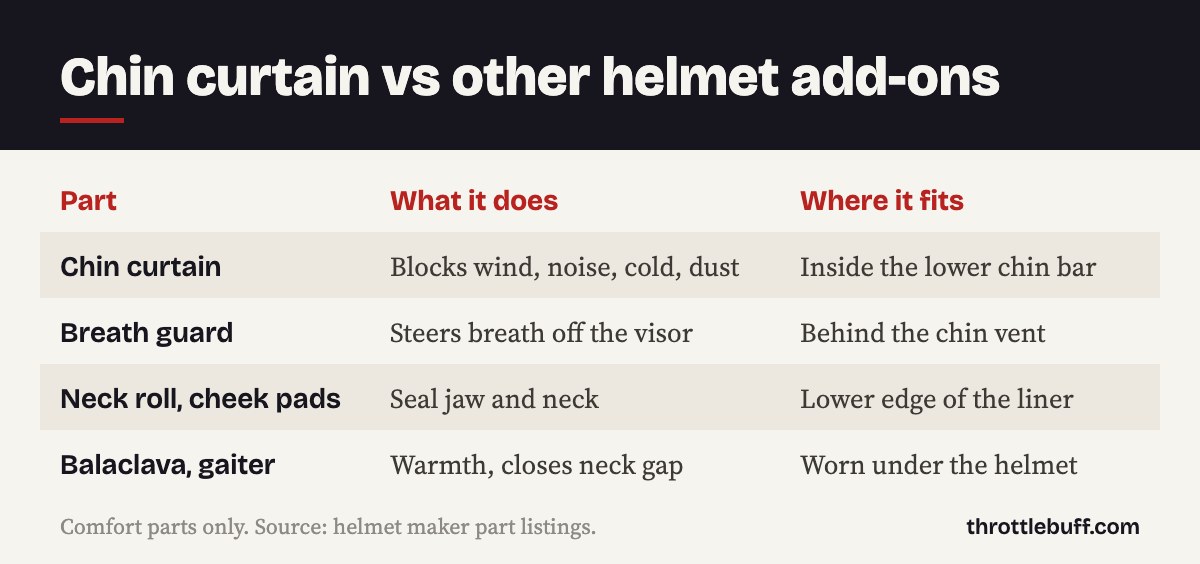
Chin curtain vs other helmet add-ons
| Part | What it does | Where it fits |
|---|---|---|
| Chin curtain | Blocks wind, noise, cold and dust coming up under the chin bar | Snaps or tabs inside the lower chin bar |
| Breath guard | Steers your breath away from the visor to cut fogging | Clips behind the chin vent, near the mouth |
| Neck roll and cheek pads | Seal the helmet around your jaw and neck | Lower edge of the comfort liner |
| Balaclava or neck gaiter | Adds warmth and closes the gap at the neck | Worn under the helmet |
What does a chin curtain do on a motorcycle helmet?
A full-face helmet is open at the bottom so you can get your head in. At speed, air flows under the bike’s screen or around your chest and straight up into that opening. The chin curtain closes most of that gap without touching your chin.
It cuts wind noise from below
Turbulent air under the chin bar is one of the main sources of noise inside a helmet. Closing it off makes the inside calmer, which also helps if you use an intercom: speech and music are easier to hear when there is less roar to fight. If your speakers still sound weak, our guide on how to make motorcycle helmet speakers louder covers placement and settings.
It keeps cold air, spray and dust out
In cold weather the air coming up from below hits your neck and chin first. A curtain stops most of it, and it also keeps road dust, grit and small bugs from blowing in. On winter rides it works best with a thin layer at the neck: our pick of motorcycle balaclavas lists ones that fit under a helmet without pressure points, and how to stay warm riding a motorcycle covers the rest of a cold weather kit.
It changes how the helmet breathes
Less air coming in from below means less fresh air inside. On hot days the helmet can feel stuffier, and some riders notice the visor fogs sooner at low speed because there is less airflow to clear it. That is why many riders take the curtain out for summer and put it back for autumn.
Do you need a chin curtain?
Most riders are better off with it fitted for some rides and removed for others. A simple rule:
- Keep it in for highway miles, touring, cold or wet weather, and any ride where you use an intercom.
- Take it out for hot weather, slow city riding, or if it rubs your chin or beard.
- Check the fit first if the helmet came without one. Curtains are made for a specific helmet shell, and a wrong one either falls out or presses on your chin.
Many modular helmets ship with one because the flip-up chin bar leaves a larger gap at the bottom; our best modular helmets guide compares the current models.
How to remove or fit a chin curtain
Every helmet attaches the curtain a little differently, so the manual for your model comes first. The steps below cover the common designs.
- Find the right part. Replacement curtains are sold by helmet model, often covering several shells from one brand. At RevZilla they run from about $10 to $35 depending on the helmet. Universal curtains exist, but they rarely seal as well as one shaped for your chin bar.
- Remove it. Pull the front edge free of its snaps, tabs or hook and loop, then slide the rear edge out from under the liner. BRP’s manual for its Advex helmet, for example, describes four snaps at the chin and three on each side toward the neck.
- Fit it. Line up the tabs or snaps with the chin bar, press each one home, and tuck the back edge under the liner.
- Check it. Put the helmet on and fasten the strap. The curtain should not touch your chin or sit over the strap, and the helmet should go on and off as easily as before.
One more tip from the same manual: never carry the helmet by the curtain. It can pull free and drop the helmet.
Shoei GT-Air 3 Chin Curtain
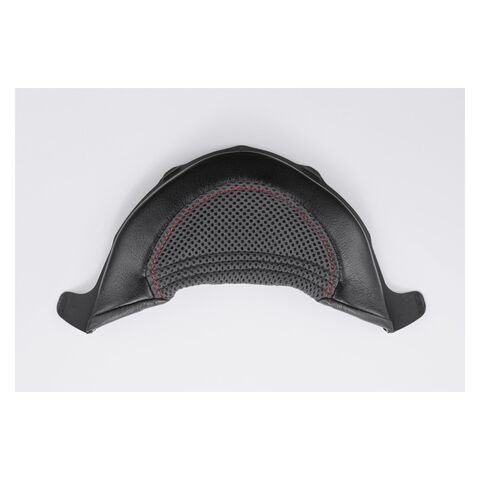
An example of a model-specific part: the replacement lower curtain for the Shoei GT-Air 3. Shoei lists it as keeping dust and debris out and reducing cold air and noise. It fits the GT-Air 3 only, so check your helmet model before ordering. Shoei sells similar parts for its other shells, such as the GT-Air II chin curtain.
Price tier: $ means under $25 when checked at RevZilla in November 2026.
How to clean a chin curtain
The curtain sits right where your breath condenses, so it collects moisture and grime faster than the rest of the liner. Take it out when you wash the cheek pads, hand wash it in lukewarm water with mild soap, rinse, and let it air dry away from heaters or direct sun. Our helmet cleaning tips cover the full liner routine. If the snaps or tabs break, replace the curtain rather than gluing it: a part that comes loose at speed is worse than none.

FAQ
Can you remove the chin curtain from a motorcycle helmet?
Yes, on almost every helmet. It is held by snaps, tabs or hook and loop and comes out by hand. Many riders remove it for summer and refit it for cold weather.
Does a chin curtain make a helmet quieter?
It reduces the noise from air rushing up under the chin bar, which is one of the main noise sources. How quiet the helmet ends up still depends on the shell, the fit and your bike’s screen.
Is a chin curtain a safety part?
No. It is fabric and foam for comfort. Impact protection comes from the helmet shell and the EPS liner. Use the curtain made for your helmet and fit it as the manual shows, so it never gets in the way of the chin strap.
Why does my visor fog with the chin curtain fitted?
Less air comes in from below, so warm breath has less airflow to carry it away. A breath guard or a Pinlock insert helps; see what a Pinlock visor is and our tips to stop helmet visor fogging.
Do open face helmets have chin curtains?
No, because there is no chin bar to fit one to. Open face riders use a neck gaiter or balaclava to block wind and cold at the neck.
Verdict
A chin curtain is a small, cheap flap that makes a full-face or modular helmet quieter, warmer and cleaner inside by closing the gap under the chin bar. Keep it in for highway, touring and cold rides, take it out when it is hot, and buy the one made for your helmet model. If you are still choosing the helmet itself, start with our best motorcycle helmets guide.
Browse all our helmet guides.