Throttle Buff is reader-supported: we may earn a commission when you buy through links on this page. Read our affiliate disclosure.
The best way to listen to music on a motorcycle is a Bluetooth intercom or helmet speaker kit paired with your phone. The speakers sit in your helmet’s ear pockets, so you can keep the volume low enough to hear traffic, and nothing goes in your ears. Bikes with a factory audio system and earbuds are the other options, but earbuds run into state laws.
Below are the four ways riders do it, what each is good for, and how to keep music from becoming the thing that stops you hearing a siren. Product details come from the manufacturers’ own spec pages.
Ways to listen to music on a motorcycle compared
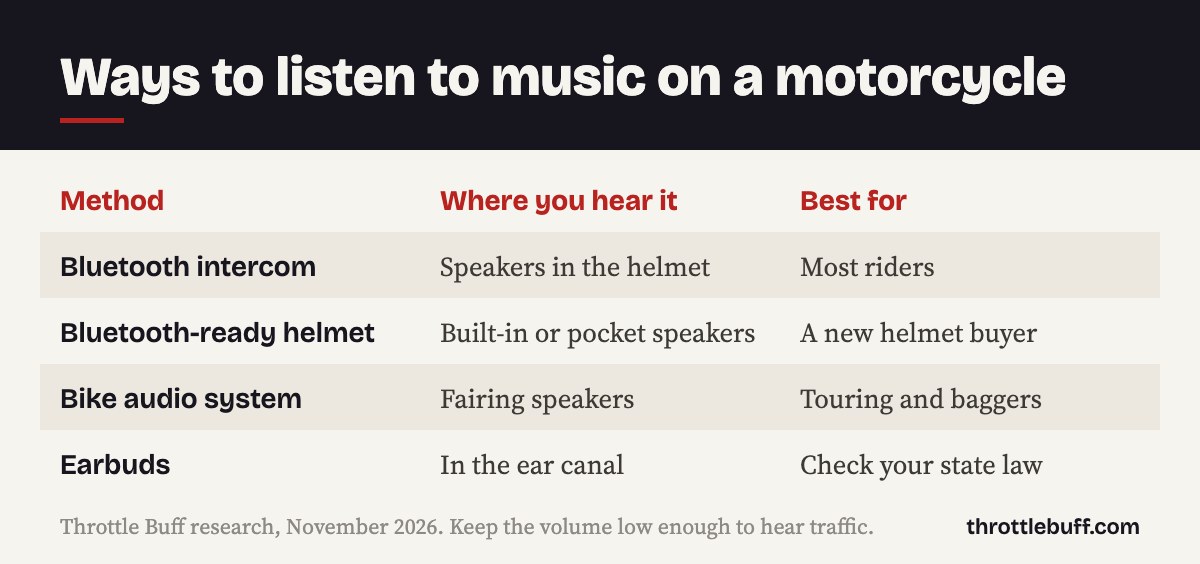
| Method | How it works | Best for | Watch out for |
|---|---|---|---|
| Bluetooth intercom | A unit on the helmet shell streams phone audio to thin speakers inside the helmet | Most riders, and anyone who also wants calls or rider-to-rider talk | Speaker placement and wind noise decide how good it sounds |
| Bluetooth-ready helmet | A helmet with speaker pockets or a built-in system | Riders buying a new helmet anyway | Built-in systems are tied to that helmet |
| Bike audio system | Speakers in the fairing or bags, played through the bike’s radio or your phone | Touring bikes and baggers | Sound has to beat wind noise from outside the helmet |
| Earbuds | Wired or wireless buds worn under the helmet | Riders who already own good earbuds | Some states ban earphones in both ears |
1. Use a Bluetooth intercom
An intercom is a small unit that clamps or sticks to the side of your helmet, with a speaker for each ear and a microphone. You pair it with your phone once, then music, navigation prompts and calls all play through the helmet. Most current units also include an FM radio and let you talk to other riders, which is why this is the setup most riders end up with. If you are choosing one, our best motorcycle intercom guide compares the current models, and mesh vs Bluetooth intercom explains the two ways they connect to other riders.
Two popular examples show what the music side of a current intercom looks like:
Cardo Packtalk Edge

Cardo lists 40 mm speakers with Sound by JBL, three sound profiles, automatic volume, a built-in FM radio and audio sharing, so a passenger or another rider can hear the same music. Cardo quotes 13 hours of battery, you can charge it while riding, and 20 minutes of charging gives about 2 hours of talk time. Specs from Cardo’s Packtalk Edge page.
Sena 50S

Sena lists 40 mm speakers and a microphone with Sound by Harman Kardon, an FM radio with 10 presets, and up to 13 hours of mesh intercom or 16 hours of Bluetooth intercom talk time. Twenty minutes of charging gives about 2 hours. Specs from Sena’s 50S page.
Price tiers: $ under $100, $$ $100 to $250, $$$ $250 to $400, $$$$ over $400, at RevZilla in November 2026.
Fitting one is a home job on most helmets, and our guide on how to install an intercom in your motorcycle helmet walks through it. If the music sounds thin or quiet afterwards, the cause is almost always speaker position, which we cover in how to make motorcycle helmet speakers louder.
2. Buy a Bluetooth-ready helmet
If you need a new helmet anyway, a Bluetooth-ready one saves fitting work. Some have deep speaker pockets and cable channels designed for a specific intercom; a few have the system built into the shell. The built-in kind looks cleaner, but it stays with that helmet when you replace it. Our Bluetooth motorcycle helmets guide covers both kinds.
3. Play it through the bike
Many touring bikes and baggers have a factory audio system with fairing speakers, and many owners upgrade them. Music through the bike needs no helmet hardware, but the sound has to reach you through wind and your helmet, so it needs more volume as speed rises, and everyone around you hears it too. If that is your setup, see our Road Glide speaker guide.
4. Earbuds, with care
Earbuds under a helmet can sound good, but check the law before you rely on them. California, for example, says a person driving a motor vehicle may not wear earphones covering, resting on, or inserted in both ears, with exceptions that include earplugs designed to reduce harmful noise and hearing aids (California Vehicle Code 27400). Other states write their own rules, so look up yours. Our motorcycle earbuds guide covers the models riders use.
How to listen to music safely while riding
- Keep it background volume. If you cannot hear a horn or a siren over the music, it is too loud.
- Cut the wind noise first. Riders often turn music up to beat wind roar. A quieter helmet lets you play it lower; see our quietest motorcycle helmets.
- Set it up before you leave. Pick the playlist and volume while parked, and use the headset buttons or voice commands on the move.
- Let prompts through. Keep navigation and calls able to interrupt the music so you do not miss a turn or an important call.
If you have any worry about your hearing, a doctor or audiologist is the right person to ask.

FAQ
Is it legal to listen to music on a motorcycle?
Helmet speakers are widely used, but the rules on earphones vary by state. California bans earphones in or covering both ears while driving a motor vehicle. Check your own state’s vehicle code before riding with earbuds.
Do you need an intercom to listen to music in a helmet?
You need some kind of Bluetooth headset or helmet speaker kit. An intercom is the most common one because it also handles calls, navigation and talking to other riders.
Can a passenger listen to the same music?
Yes, with headsets that support it. Cardo lists audio sharing on the Packtalk Edge, so a passenger with a paired headset can hear what you play.
Can you hear music over wind noise at highway speed?
Usually, if the speakers sit right over your ears and the helmet is reasonably quiet. If you have to turn it all the way up, fix the speaker position and the wind noise rather than the volume.
Verdict
For most riders, a Bluetooth intercom paired with your phone is the answer: music, calls and navigation in one, with nothing in your ears. Use the bike’s audio system if your tourer has one, and treat earbuds as a check-your-state-law option. Whichever you choose, keep the volume low enough to hear the road.
Browse all our intercom guides.